post

The Bootleg Files: Fun on the Run

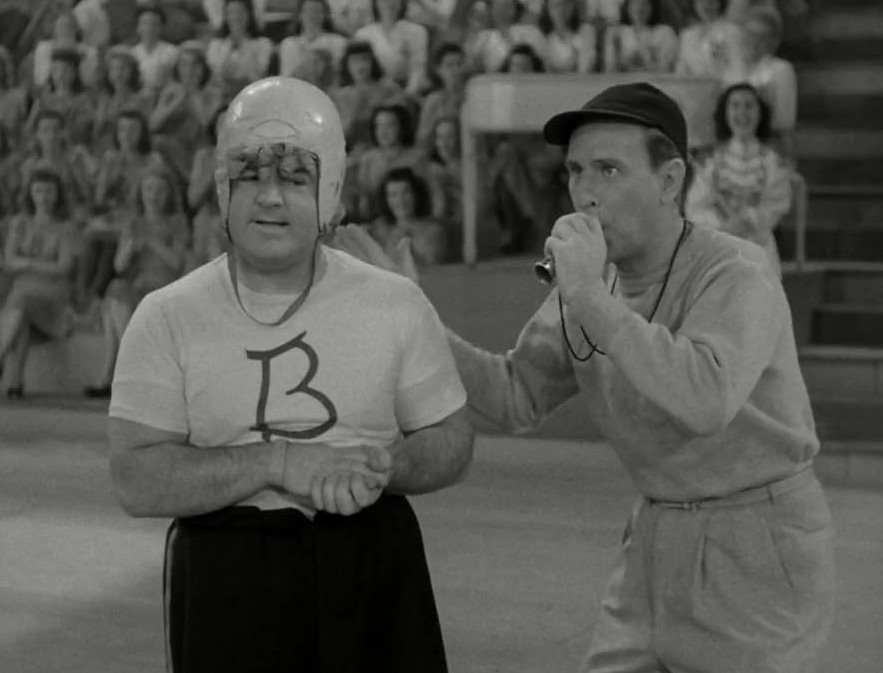
BOOTLEG FILES 946: “Fun on the Run” (1949 short incorporating sequences from Abbott and Costello’s feature “Here Comes the Co-Eds”).

LAST SEEN: On YouTube.

AMERICAN HOME VIDEO: None.

REASON FOR BOOTLEG STATUS: Only available in 16mm and 8mm formats.

CHANCES OF SEEING A COMMERCIAL DVD RELEASE:
None.

One of the most contentious political issues today involves the presence of biological men who identify as transgender playing in women’s sports. But back in 1945, the idea of a man playing on a woman’s sports team was strictly the stuff of comedy – specifically, the Abbott and Costello feature “Here Comes the Co-Eds.”
Continue reading

post

The Bootleg Files: No Indians Please!

BOOTLEG FILES 922: “No Indians Please!” (1948 silent truncated version of Abbott and Costello’s “Ride ‘Em Cowboy”).

LAST SEEN:
On YouTube.

AMERICAN HOME VIDEO: None.

REASON FOR BOOTLEG STATUS: No perceived commercial value.

CHANCES OF SEEING A COMMERCIAL DVD RELEASE: Nope, sorry.

If you’ve been following this column, you may recall that I’ve been on a mini-Abbott and Costello kick. Two weeks ago, I reviewed the new AI-fueled parody “Abbott and Costello Meets the Exorcist” and last week I dug up a video record of a Texas theater company’s 1984 live stage production of “Abbott and Costello Meet Frankenstein.” I was going to put Bud and Lou back on the shelf until I saw a notice announcing that November is Native American Heritage Month – and that seemed like the perfect cue to unspool the team’s 1948 release of “No Indians Please!”
Continue reading

post

The Bootleg Files: Doom of Dracula

BOOTLEG FILES 775: “Doom of Dracula” (8mm reissue of sections from the 1944 “House of Frankenstein”).

LAST SEEN: On YouTube.

AMERICAN HOME VIDEO: None.

REASON FOR BOOTLEG STATUS: No perceived commercial value.

CHANCES OF SEEING A COMMERCIAL DVD RELEASE:
Not likely.

In the years before video cassette recorders invaded living rooms in the late 1970s and early 1980s, movie lovers who wanted to own copies of their favorite films relied on portable projectors that screened the 35mm or 70mm Hollywood theatrical fare in the much smaller 16mm, 9.5mm, 8mm and Super 8 formats.
Continue reading