
 A recently divorced Doctor, Seung-hoon lives in a town plagued by a history of murders. While under anesthesia, his landlord, who also owns the butcher shop, seemingly confesses, leading Seung-hoon on a frantic chase to solve the case.
Right from the start, the audience knows what they’re in for, as the camera lingers on a headless torso in the river. However, anyone hoping for a steady stream of gore will be disappointed, as Lee Soo-Yeon’s Bluebeard is modeled more on a classic whodunit than on a gorier horror film. Lee keeps the colors muted, with nothing overly bright or colorful. It fits the drab town where Seung-hoon lives, adding a grittiness that only heightens the uneasy atmosphere. Lee builds suspense but continually subverts expectations, keeping the audience off-kilter and never entirely sure what to trust. It’s this consistent sense of unease that prickles the back of your neck. You know something is wrong, but you cannot always put your finger on what it is.
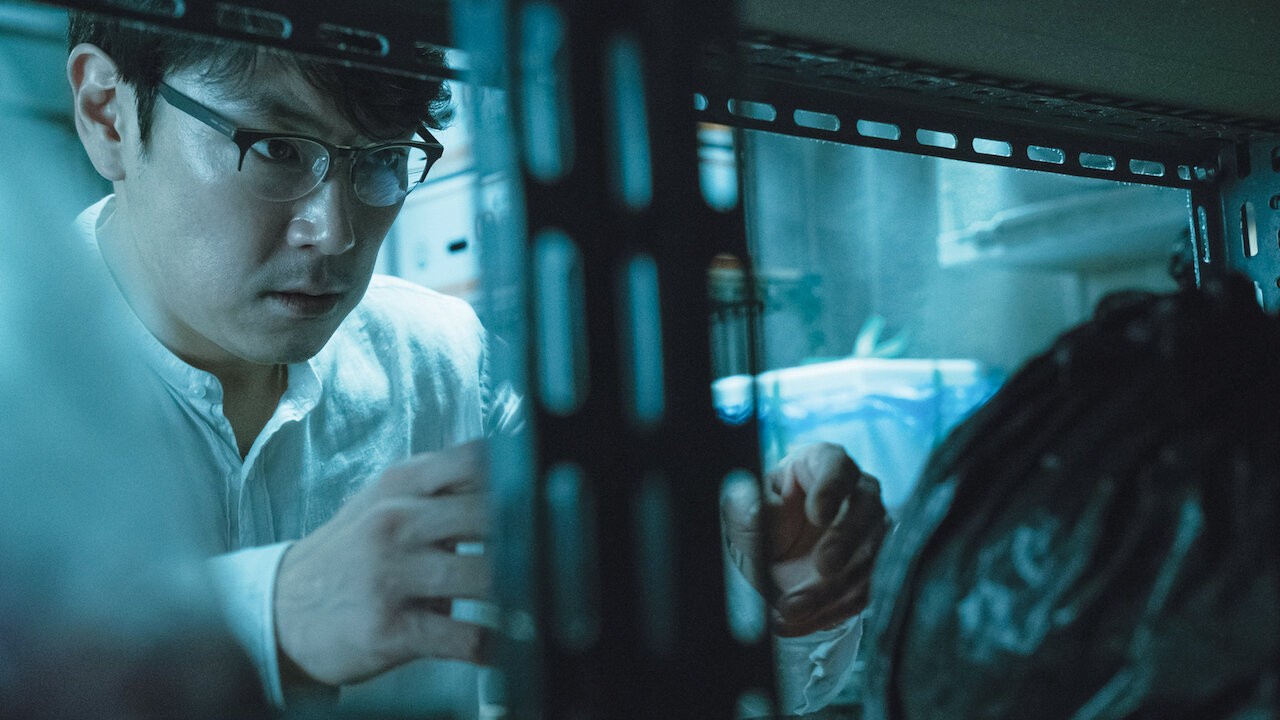 This becomes a theme throughout the film: nothing is as it seems. Bluebeard draws heavily from Hitchcock, most notably Rear Window, with both films following a man who becomes convinced that information he’s gathered about a neighbor points to murder. Lee puts her own spin on the idea by having that information come from the unconscious ramblings of a patient. It immediately raises the question of how much can be trusted, something that becomes increasingly important as the story unravels and the film begins playing with the idea of the unreliable narrator.
The owner of the butcher shop adds another layer to the uncertainty. An older man who is struggling with memory issues, his own reliability is immediately called into question, which further complicates what information an audience can trust. As it all unfolds, small details that played in the background suddenly take on more importance. Bluebeard is absolutely a film that will look different on a second viewing, as seemingly insignificant details take on new meaning.
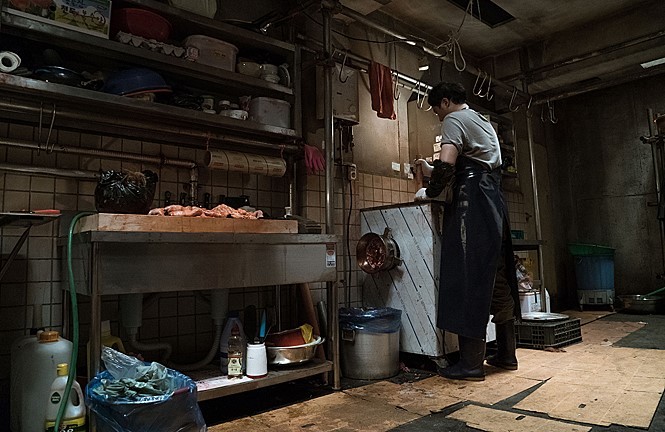 The story is helped along by a strong stable of actors, most notably Cho Jin-Woong, who plays Seung-hoon. Cho manages to be sympathetic while simultaneously being a little pathetic. That’s a hard move to pull off, and Cho manages it effortlessly. Shin Gu also gives a memorable performance as the owner of the butcher shop and possible serial murderer. His performance is never overplayed and genuinely leaves the audience wondering what is really going on. Both performances are essential to maintaining the film’s uncertainty, keeping the audience from ever becoming too comfortable with what they think they know.
The ending will undoubtedly divide audiences. The pace throughout is such a slow burn that when the thread is finally pulled and everything unravels, the sudden shift is jarring, but not necessarily to the film’s detriment. Bluebeard is a fascinating modern exploration of the psychological whodunnit, and Lee’s willingness to upend what came before is fitting for a film centered around uncertainty. The ending may inspire debate, but that shouldn’t deter viewers from watching a compelling mystery with strong performances and excellent cinematography.