

A songwriter who has all but given up on her dreams of stardom moves back to her hometown, where she’s confronted with memories of her past and ghosts of a life she may not have been ready to give up after all, in Nora.
One thing I truly love about seeing films from underrepresented voices is the fact that we can sometimes wind up with a tired story that’s refreshed with an all new viewpoint. And that’s exactly what we get with Nora, which tells a story we’ve all heard before with the entirely fresh voice of Anna Campbell. Every angle of the titular character’s life is fleshed out in ways we’ve never seen committed to film before, and with so much attention to the smaller, more tender details of life as a woman, Nora quickly endeared me and enraptured me, as most any woman can relate to the feelings portrayed here. Societal pressures of motherhood, what it means to be a successful woman, and life itself, are all on grand display, and for once we get a window into the mind of a real woman, torn between her own happiness and dreams, and the expectations of nearly everyone around her.
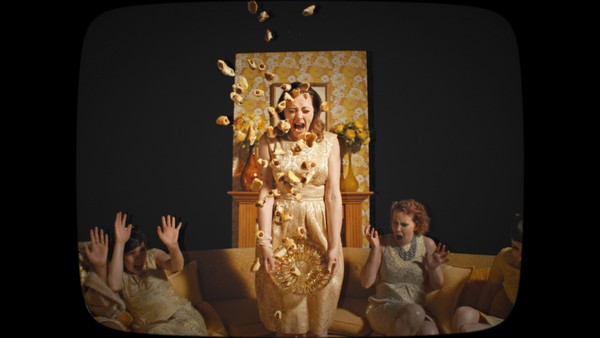
Written and directed by Anna Campbell, an amazing tour de force both in front of and behind the camera, Nora tells a simple slice of life in the shoes of a woman whose dreams are essentially being forcibly put on hold by her attempts at being what everyone expects her to be. A good mother. A devoted wife. A class parent for the school. All the while she’s ignoring what it takes for her to be happy, and we get to see this illustrated through musical numbers that are accompanied by music video stylization. It’s an interesting break of pace, though one that doesn’t always work quite so well. It’s hit or miss in its effectiveness, sometimes going so far as to be immersion breaking, but it never distracts from the story. My only real complaint is the shaky cam style, which feels as though it doesn’t fit with the story being told and detracted from my enjoyment, as it was utilized too often. Many scenes would’ve benefited immensely from stabilization.
That being said, the fact that Campbell is also in front of the camera, and puts on an incredible performance, is not lost on me. Her emotional rawness and ability to perfectly portray every aspect of this character with such finesse and ease is a talent in itself, and one that’s compounded with the fact that she really knows what she’s doing with a film. Joined with a great, but not imposing, supporting cast, with special focus on Sophie Mara Baaden as the adorable young daughter, Sadie, everyone feels real, believable, and downright tangible.
And while the editing is on point and the lighting is just warm enough to feel like home, the film really excels in its sound and music, which allows you a peek into the life Nora left behind, and the one she so craves to return to. I was drawn into the story by every moving and emotional aspect, and getting to hear Nora’s memories as well as watch them was undeniably inviting into the character’s mind, making her incredibly relatable in not only her future, but her past.

One final issue I had with the film, though it’s one more of a matter of preference than actual complaint, is that the ending feels a little abrupt. After spending an hour and a half getting to know this character and her life, I found myself wanting just a few more minutes with her. I almost felt cheated as a result of the sudden stop.
Still, Nora is pretty close to flawless in my opinion, and Anna Campbell is definitely on my list of talented female filmmakers to watch. These are the stories that we need from representation, and I’m so happy we were graded with such a fantastic film as a result of the shift we’re seeing in entertainment. Well done.