
 Nia DaCosta’s 28 Years Later: The Bone Temple is brutal, yet poetic, immediately continuing from the previous entry as Spike discovers the horrible truths about men and Dr. Kelson learns the wonders of monsters.
Last summer, director Danny Boyle and writer Alex Garland returned to the world of 28 [Time] Later franchise, creating a fantastic, self-contained sequel that, while a great zombie movie, was more of an emotionally powerful coming-of-age tale for 12-year-old Spike, as he leaves his safe Scottish island home for the dangerous mainland. 28 Years Later was a moving film with amazing performances by Aflie Wiliams as Spike, Jodie Comer as his mother, and an iconic portrayal of survival by Ralph Fiennes as the strange Dr. Ian Kelson. Still written by Alex Garland, Boyle hands the directing reins to Nia DaCosta, and thanks to filming immediately after 28 Years Later, we receive 28 Years Later: The Bone Temple a mere six months later. Nia DaCosta’s 28 Years Later: The Bone Temple is brutal, yet poetic, with a beating heart under the horror of the ripping and tearing.
Garland writes a very tight film. Set over just a few days and a modicum of locations, it moves the story, characters, their messages, and needs with a quick, efficient precision. Two sides of the story are followed in equal measure, both affecting a form of transition; of men becoming monsters and monsters becoming men. 28 Years Later ended with Spike confronted by a Jimmy Savile-dressed gang led by Jack O’Connell. Forced to join in after a nasty and bloody initiation, Spike is trying to figure out how to live in this new, violent world and see how he can conduct himself to safety. On the other side of the tale, Ralph Fiennes’s Dr. Kelson goes Day of the Dead and tries to tame and cure Alpha Sampson (the one who chased Spike through the train last time). Two fascinating halves complement each other well, of course coming together in a fiery, powerful conclusion: an early contender for one of the year’s best scenes (it’s only January, so let’s see).
The Bone Temple is a world of tough survival, nasty, and brutal. Bodies are ruined; whether it be directed and purposefully nasty skinning and chosen damage, or the animalistic urges of the rage zombies (this one does use the Z word; and as it’s been a conversation forever: yes, they are). It’s gruesome and unflinching. While Boyle chooses to create terror through quick cuts and disorienting kinetics, DaCosta usually holds back, letting the horror seep in to uncomfortable levels, with a few chosen bursts of frenetic energy. The quicker style suits the first film, as Spike determines his world of unknowing terror; DaCosta’s style matches as Spike settles into the next steps. It’s a story of transition, and that includes letting ideas simmer. Thus, the Bone Temple is often meditative and controlled. Like her Candyman sequel, DaCosta’s film is often pensive and thought-provoking while also being gutwrenchingly tense and visually nasty. She holds such astounding tension; I was holding my pant leg in my grip. It’s the sort of set-up where the violence is ready to break, brimming to the absolute edge of tension. It’s delicious. One knows it’s coming, but the wait for the snap and damage to come sends one to the end of the seat. 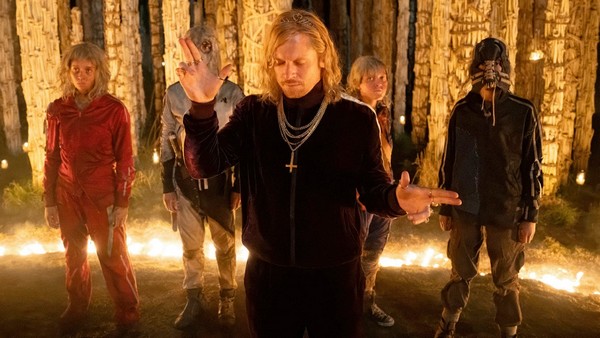 The Bone Temple is brought to life, and undeath, with a wonderful set of performances. 28 Years Later was Alfie Williams’s film, starring as Spike. Unfortunately, he has less to do here, reacting as he works around the more seasoned survivors. He’s the driving force of the film, causing most of the action, but it’s carried more by Jimmy and Dr. Kelson. Coming off of his fantastic villain performance in Sinners, O’Connell again charms, creating a terrifying presence, one with a charm and glimmer in his eyes; of finding a man that may be yearning for normalcy under his monstrosity: he was 8 went he virus took the island, as seen in the previous film, stunting him and making him a very interesting character. As the leader of the Jimmy’s, all patterned for a British children’s entertainer and, as found out after his death in 2011 (thus, unaware of this), acting as his “fingers,” all given new names of “Jimmy” with an additional moniker. It’s fascinating trying to figure him out. Spike makes a connection with Jimmy Ink, as played by Erin Kellerman of Eleanor the Great and Solo. On the other side, Ralph Fiennes is fully committed to Dr. Kelson, giving everything, continuing to make his mad doctor into an icon. (side note: also in release this week is The Choral, a WWI era British drama where he’s going through the motions. Nice to see the prestige drama get a lesser performance than the brutal horror film.) I’ll just say this: Iron Maiden. In a quiet high point of the film, Jimmy and Kelson have a poignant and touching conversation, a testament to fantastic performances and connection, delving into the themes of the film. Finally, acting as a Bub to Dr. Kelson’s Dr. Logan (if you’ve not seen 1985’s Day of the Dead, go watch it now; my favorite zombie flick), Chi Lewis-Parry gives an astounding physical performance as Samson. The two make a great pair, with electric unspoken chemistry and a surprising amount of humor (and musical choices). An absolutely wonderfully insane unexpected sweetness. As I said, the movie has a beautiful heart under the bloody brutality.
28 Years Later: The Bone Temple of a film of what to hold onto and what to let go, and how those shifts happen for us. About finding empathy and connection in a world that revers the violent. It’s a story of transition, of life and memento mori. It’s poetic an dintrospective within. There’s so much to dig into, but that’s spoilers. Garland keeps it tight, very contained, and driving with power. His writing mixes with DaCosta’s control of the camera and performances, moving the film forward with fantastic speed while also letting it and the characters and their needs breathe. Working with her cinematographer for Hedda and The Marvels, Sean Bobbitt, DaCosta presents beautiful landscapes of the deconstructed Scotland without showing off, finding soul in the setting of the wowing and titular Bone Temple ossuary. For a place of bones, DaCosta gives it life. Impressive.
28 Years Later: The Bone Temple, from Nia DaCosta, continues the greatness of Danny Boyle’s 28 Years Later. Tight, tense, with fantastic performances and character under brutality. With the final entry in pre-production (and set up within this film), I can’t wait for it all to come together with another go. I can stay in this isolated, terrifyingly terrible world for 28 Decades Later.