
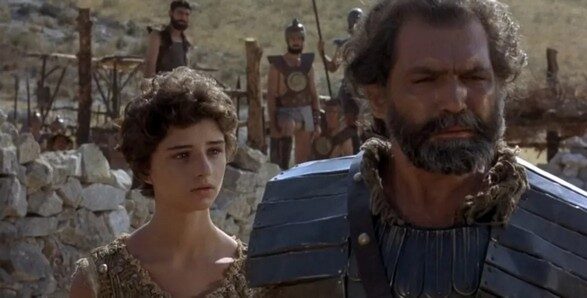
 In Michael Cacoyannis’s 1977 fantastic Greek tragedy adaptation Iphigenia, King Agamemnon is left with an impossible choice: sacrifice his daughter or fail to fulfill his family/national obligations to retrieve his sister-in-law Helen from Troy. Now on Blu-ray from Radiance Films.
The FIlm
Iphigenia is a terrific tragedy, a film of strong emotion, heart-wrenching moments, betrayal, and the weight of choices. Based on Euripides’s final play (perhaps unfinished by the playwright), Iphigenia in Aulis, Michael Cacoyannis directs his third, following Elektra and The Trojan Women. I’ve not seen these, nor his very well-known Zorba the Greek. I need to fill that hole in my film knowledge. It’s a truly magnificent film,
It’s the start of the Trojan War, or about to be. Helen is gone, and Menelaus is ready to get her back by any means necessary. But the winds aren’t there, for the god Artemis is angered at the father of Menelaus and Agamemnon. Frustrated and ready to get to the fighting, King Agamemnon’s men kill a sacred deer in Artemis’s forest. The head of her temple lays down a demand: the winds will only come if this killing is atoned for by Agamemnon sending his daughter Iphigenia to her death. (and now if you ever wondered where fellow Greek filmmaker Yorgos Lanthimos got the title and plot for The Killing of a Sacred Deer, here’s your answer.) He fights with himself and others over what to do, trying to hide the sacrifice from his wife Clytemestria but framing it as a wedding between his daughter and war hero Achilles. That’s the simple version, and I”m not one to detail the turns of a story, and there are plenty as it’s a complex and compelling film.
Conversations, fights, and bickering between many groups drive the plot and drama. At the heart, even through gorgeous cinematography and lens work, it’s a stage drama of conversational confrontations. Everyone has their own combination of conflicts. Agamemnon and Menalislus discuss their sides at the center of the film, in a sequence that highlights the strong writing. The central conflict is between Agamemnon and Clytemnestra. Clytemestra and Iphigenia discuss their own internal conflicts, and they relate to the men. Our titular character debates with Achellis, her almost fake husband. What is duty? Is it stronger for family, immediate, or extended, or to one’s country? What if that line is blurred where family and national leadership are the same?. What’s national compared to personal? How can it be balanced? How can one be saved? Is it worse to sacrifice a daughter because the nation needs it? Especially if one knows a fight against the more powerful Troy might be a fool’s errand, sending countless Greek men to their death?
It’s delicious. Cacoyannis’s script adapts the play to great effect. He adds a first act to help set up connections, deepening the drama. The play starts after the mistake of the hunt and the choice given. The script is rife with layers, double meanings, and deeper and unsaid truths under the surface, occasionally bursting forth. Like so many great plays, it twists and turns on power structures through sharp, rapid dialogue, imbued with emotion and personality. Iphigenia is intimate and heartwrenching.
This powerful drama is made whole by a cast’s worth of powerful performances. Kostas Kazakos is forceful with a simmering uncertainty as Agamemnon. Irene Papas commands every moment of her screentime as Clytemnestra. She’s a force to be reckoned with and was often Cocoyannis’s muse. I can see why. Tatiana Papamoschou as Ifgeneia is more subdued and thoughtful, quiet, but no less powerful. What’s laid upon her weighs and is felt. It’s hard to believe she was merely 13 at filming. Wow.
Cocayannis and cinematographer Giorgos Arvanitis film in a glorious, gorgeous Greek countryside. Mostly outdoors, the sweeping vistas are wowing, and the use of the varied terrains and ruins. Of course, these wouldn’t be ruins at the time of the Trojan War, but the use of these locations sets a physical exterior to the troubles of the interiors of the persons debating. With the addition of several neat camera tricks and uses, Iphignia comes with a heft of emotion.
Michael Cacoyannis’s third Euripides tragedy adaptation is a deeply written, powerfully emoted, and gorgeous travelogue of a film. It’s new to me, as is the rest of his filmography. If the others are as good as Iphigenia, I expect brilliance.
The Package
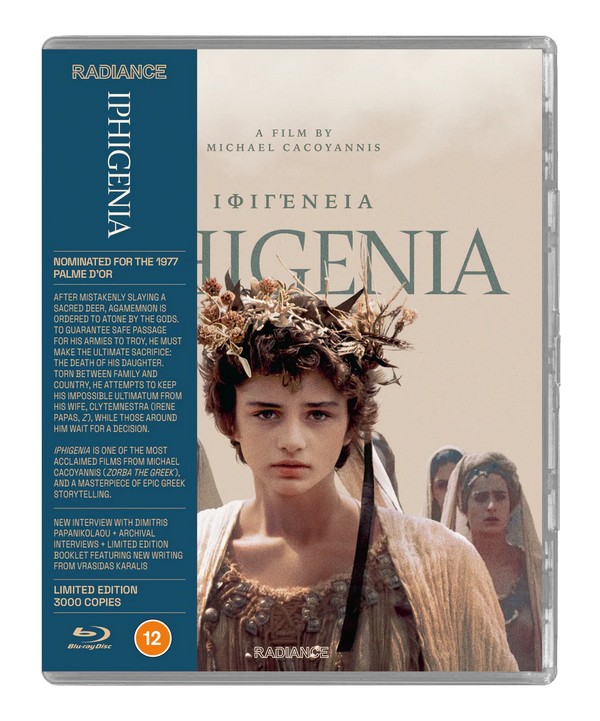
Radiance offers Iphigenia on Blu-Ray, for the first time in the UK (Radiance is a UK company; Olive Pictures had a Region A in 2016). It comes in a clear case, with a reversible sleeve, one side with original artwork and one with newly commissioned art by Time Tomorrow; both options have just the title and cast. As normal for Radiance, the synopsis and features are on a removable paper wrapped around the case. The release is limited to 3000.
The Presentation
The video looks pretty good, but the print also looks faded and damaged at times. Surely better than it’s seen before, of course time of 50 years, the budget and conditions of filming and later storage do that. I’m sure this is as good as it can look, and even with the dig there, it looks rather great. The film is in Greek, the original mono, with English subtitles
The Features
Not a lot on this end, but still a good dip.
Michael Cacoyannis (new)
Dimitris Papanikolaou explores the films and legacy of the director. A great look in, as I noted, I have little knowledge of him. But now I have more! And a bigger understanding of this film and his Euripedies cycle. I love learning more about niches I’m unfamiliar with. (25m)
1977 Interviews
A press conference from Cannes (11m) and Aujourd’hui magazine show (6m) with Cacoyannis and Papas. Strangely, half of both are clips from the film. But what’s left is interesting, getting into how they pair work together and build on one another. A nice insight.
Final Thoughts
Iphigenia is a damned great tragedy from Michael Cacoyannis. Sweeping and intimate, strong writing and performances drive the film. The print is a little faded, and the special features are light, but for those drawn to the film itself, it carries the release. I look forward to finding more of Cacayannis’s work.