
BOOTLEG FILES 948: “Happy Money” (1969 Christian-themed short film starring Jerry Mathers).
LAST SEEN: On YouTube.
AMERICAN HOME VIDEO: None.
REASON FOR BOOTLEG STATUS: Deservedly obscure.
CHANCES OF SEEING A COMMERCIAL DVD RELEASE: None.
In the course of my film reviewing work, I’ve seen an awful lot of short films – as well as a lot of awful short films. But for sheer badness, I am hard pressed to recall a short film as boring and annoying as “Happy Money,” a 1969 offering that is mostly remembered today for the presence of an unlikely actor in its cast.
“Happy Money” was a production of Family Films, an independent operation launched in 1948 by Samuel Hersh, a one-time bookkeeper to several major Hollywood studios. Hersh’s films focused on Biblical themes and were created and distributed in collaboration with The Lutheran Church, Missouri Synod. These films were released on 16mm to churches and youth groups across the United States.
I have nothing against Christian-themed films, but “Happy Money” is the type of Christian film where the viewer’s only out-loud declaration of “Thank God” will occur once the closing credits start to roll. The problem is not that “Happy Money” is unintentionally funny, but that it is unintentionally irritating.
The film focuses on a teen group within an unspecified Protestant congregation that is putting on a play called “Happy Money.” According to Linda, the blonde leader of the teens, the play is supposed to encourage the faithful into viewing their stewardship responsibilities as joyful duty rather than a burdensome chore. Unfortunately, Linda is so strident in demanding that people be happy in giving money to the church that she becomes intolerable.
Linda’s father, however, is openly skeptical to his daughter’s notion of stewardship, and he is equally doubting about her theatrical abilities. The poor man and the rest of his family are dragooned into making magic marker designs on scores of balloons that are supposed to drop during the show’s finale.
Linda also has to convince her fellow teen group members to (pardon the expression) practice what they preach when it comes to stewardship. In this setting, that means denying yourself mild luxuries (like a night at the movies or custom wheels for a car) and channeling the money into the church’s collection plate – or, as Linda calls it, “happy money.” Incredibly, the other teens are so easy to manipulate that they follow her scheme.
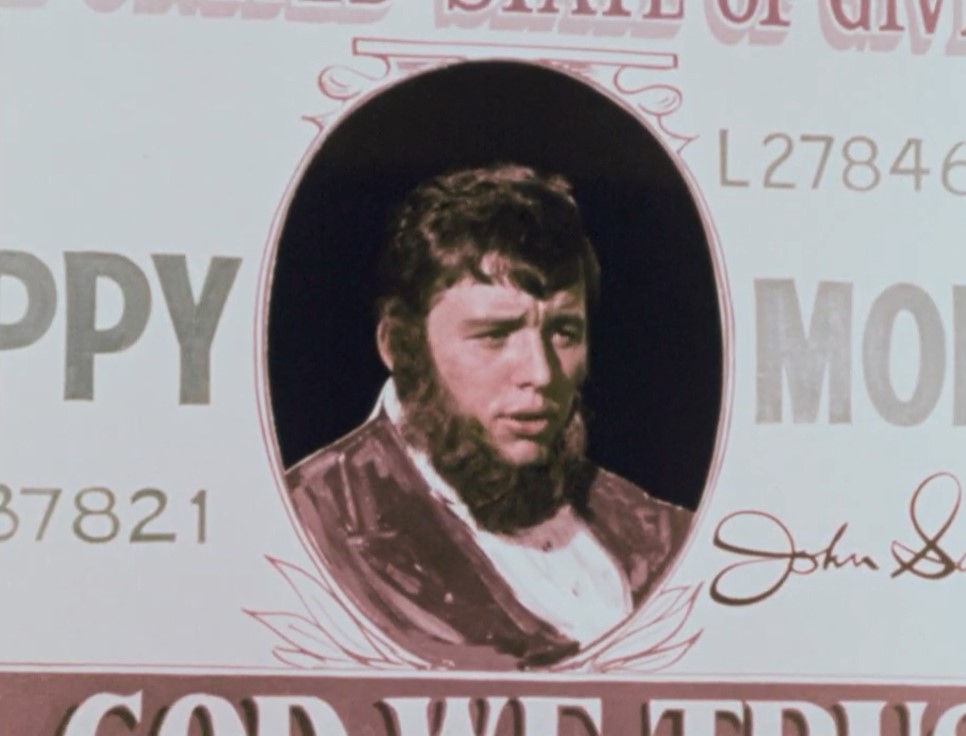
As for the play itself, let’s just say that “Happy Money” does a strikingly realistic job in depicting very bad teen theater. At one point, there are giant mock-ups of the one- and five-dollar bills with actors playing Washington and Lincoln who comment on how wonderful it is not to be circulating in the free market. Lincoln remarks that he was nearly spent on a box of golf balls, while Washington laments that some disgruntled parishioners make parish donations like they were “dealing us out to the church as if they are paying a debt.”
The actor playing Lincoln might be the only reason “Happy Money” gets noticed. It’s Jerry Mathers, the one-time Beaver Cleaver, in his first acting gig after concluding his three-year service in the California Air National Guard. The 21-year-old has a relatively small part in the film, which is dominated by Patricia Stich as Linda and Paul Sorensen as her father – and, oddly, that pair have their names misspelled in the credits.
The one interesting aspect of “Happy Money” is how it depicted the young people of 1969. In this film, the girls all wear mini-skirts and the boys have mod hairstyles – not crazy long, but just enough length to fit in with the current youth culture. Having Linda as the agitator for the happy money concept could also be seen as a nod to the then-nascent women’s movement that began to elbow men to share authority. But Linda is so pushy and unpleasant that she could be used as argument against women’s lib.
There is no commercial DVD release of “Happy Money,” but you can watch a faded 16mm print for free on YouTube – which might be the happiest way possible to save your money.
IMPORTANT NOTICE: While this weekly column acknowledges the presence of rare film and television productions through the so-called collector-to-collector market, this should not be seen as encouraging or condoning the unauthorized duplication and distribution of copyright-protected material, either through DVDs or Blu-ray discs or through postings on Internet video sites.
Listen to Phil Hall’s award-winning podcast “The Online Movie Show with Phil Hall” on SoundCloud and his radio show “Nutmeg Chatter” on WAPJ-FM in Torrington, Connecticut, with a new episode every Sunday. You can also follow his book reviews at The Epoch Times.