
John G. Avildsen’s “Save the Tiger” can be seen as a gift that keeps giving. At the time of its release, it served as a damning indictment of an American society that was morally adrift from its core values. Viewed today, it feels uncommonly contemporary. And at its center are two startling performances that are timeless.
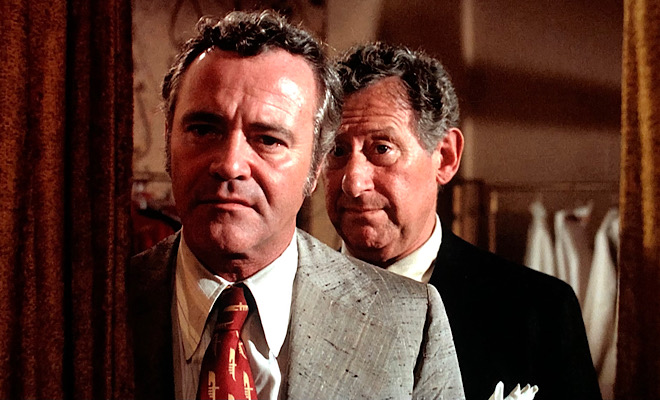
Set in Los Angeles, “Save the Tiger” details the odyssey of a pair of struggling clothing manufacturers who are nearing the end of their frayed fortunes. The primary focus is on Harry Stoner (Jack Lemmon), whose corporate meltdown runs parallel to the beginning of a nervous breakdown. Obsessed with the lost innocence of his youth and haunted by his World War II military experiences, he seems unaware of the disastrous effects of his sleazy business management style which includes arranging call girls for business customers and running a sweatshop full of undocumented Mexican laborers. His partner, the more sedate Phil Greene (Jack Gilford), is appalled by Harry’s plan to torch one of their factories in order to collect on their insurance policy. Yet Harry’s steamroller personality overwhelms Phil’s crumbling resistance.
The most fascinating aspect of Steve Shagan’s screenplay is the utter inability of Harry and Phil to realize that they are very much a part of the socially repugnant situation that they repeatedly decry. On the surface, they represent the American dream of building a start-up into a national business. They clearly enjoy the fruits of their labors (Harry lives in a Beverly Hills mansion with a live-in Mexican maid while his daughter attends a Swiss school, Phil enjoys weekend fishing on his yacht). But ultimately, they are hypocrites. Whether riding mutely in an elevator full of their illegal alien workers or in their casual interactions with various criminal elements, the men clearly contribute to the lost values of the beleaguered country around them. The fact they live far beyond their means does not seem to shake them in the least.
“Save the Tiger” makes broad and nasty comments on 1973 America. Shagan’s screenplay and Avildsen’s direction looks at a country of increasingly hostile interactions, an astonishing generation gap, and the failure of anyone to take responsibility for their actions. When it was released, the nation was at the end of the Vietnam War and the beginning of Watergate. The film provided a harsh mirror to a dysfunctional society.
Viewed today, “Save the Tiger” doesn’t seem dated. Switch around the Vietnam references to Iraq and Afghanistan, substitute the tech industry instead of apparel manufacturing and the film remains relevant and, surprisingly, fresh. Harry’s obsession with his pre-war past should strike anyone who rues for the so-called good old days (and the false allure of nostalgia is still with us, unfortunately).
If there were a problem here, it would come with a few crassly homophobic comments and the fairly obvious stereotyping of Jewish business owners (Harry and Phil never talk religion, but it is somewhat obvious that they are not churchgoers). Clearly, that keeps the film firmly rooted in its era.
As any Oscar addict knows, Lemmon earned his second Academy Award for “Save the Tiger.” The film served as a reminder that Lemmon was more than capable of handling intense drama prior to this, he had not enjoyed a dramatic role since “Days of Wine and Roses” in 1962. Lemmon clearly knew what he had in this material, to the point that he agreed to waive his normally high salary in order to keep the film within its art house-level budget.
But in many ways, the real surprise here is Gilford. An endearing comic actor who bravely persevered through the McCarthy era, he was best known at this time as the star of a popular series of Cracker Jack commercials. Yet Gilford provided an uncommonly solid dramatic performance even when he is reacting to Lemmon’s outbursts, his subtle body language and facial expressions bring forth rich emotional resonance. He was Oscar-nominated here, but he lost to John Houseman’s more showy turn in “The Paper Chase.” Still, it represents his best screen work.
“Save the Tiger” is a disturbing and deeply memorable film. If you’ve never experienced it, you are missing a sharp and intelligent work of cinematic art.