
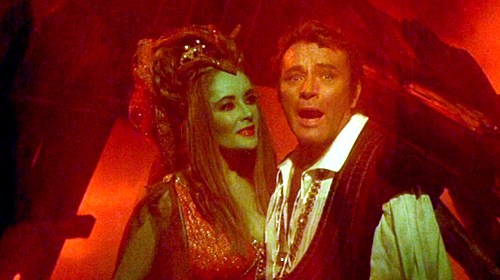
This 1967 feature was based on the 1588 Christopher Marlowe play “The Tragical History of Doctor Faustus.” But this adaptation should have called itself “Doctor Fatuous” – rarely has a cinematic version of classic theater resulted in such a weak and silly endeavor.
The film followed a 1966 appearance by Richard Burton in a staged version of the Marlowe work produced by the Oxford University Dramatic Society. Burton played the title role of the professor who sells his soul to Satan in exchange for unparalleled wisdom and power, while the Oxford students filled out the rest of the cast and the then-Mrs. Burton, Elizabeth Taylor, made a wordless cameo appearance as Helen of Troy.
Burton and the show’s director, Oxford Professor Nevill Coghill, decided to create a film based on their stage production. The two men shared directing credits, even though neither previously directed for the screen, while Taylor’s presence was expanded to play the different women who bedevil Faustus and the other doomed men of Marlowe’s drama. The young Oxford actors were recruited to recreate their stage performances.
The result, quite frankly, was a mess. “Doctor Faustus” was shot on the cheap in a Rome film studio, with patently theatrical settings that called attention to its threadbare production design. A few lousy special effects involving images projected in a skull’s eye socket were added to illustrate the title character’s preoccupation with necromancy, and a clip from Laurence Olivier’s “Henry V” was used as stock footage to illustrate a battle described by Faustus.
Burton mostly bellows his lines in his rich Welsh baritone, but at no point does he ever connect with the emotional complexity of Marlowe’s words – at times, his line readings are so sterile that it almost sounds phonetic. He also receives a surplus quantity of close-ups, to the point that “Doctor Faustus” feels like a vanity-induced home movie. I don’t recall another film where the leading man received so many close-ups.
The young Oxford actors surrounding the star have no screen presence, but Taylor has the wrong presence – she wanders in and out of the film wearing different wigs and sometimes sporting brightly hued body paint. Her presence is a campy distraction to what is supposed to be a serious work, and the poor lady spends most of the film with a bored expression and enervated body language. (A body double stands in rather obviously for Taylor in a brief clothing-free moment.) Their final scene, with a green-skinned Taylor escorting a hysterical Burton to Hell is a masterwork of unintentional stupidity.
Several films critics back in the 1960s observed the film slashed much of Marlowe’s text and incorporated passages from other plays into its dialogue, most notably the “passing brave to be a king” speech from “Tamburlaine.”
But audiences didn’t notice, if only because they didn’t show up to see “Doctor Faustus.” This film marked the beginning of the end of the Taylor-Burton screen reign, a fall from grace that would be fueled further with the calamitous 1968 romp “Boom!”