
BOOTLEG FILES 954: “The African Tale” (1963 Soviet animated short).
LAST SEEN: On YouTube.
AMERICAN HOME VIDEO: None.
REASON FOR BOOTLEG STATUS: There may be a rights issue holding it up.
CHANCES OF SEEING A COMMERCIAL DVD RELEASE: Only in an anthology of Soviet animated shorts.
Very few people have any nostalgic fondness for the Union of Soviet Socialist Republics, but one has to admit that sometimes the old commie propaganda was very entertaining – mostly for the wrong reasons, but occasionally it had a cogent point to make against the excesses of highly fallible capitalist West.
The 1963 animated short “The African Tale” is an animated short made by the state-run Soyuzmultfilm that targets Western abuses in during the years of European colonial rule of Africa. To its credit, it has a lot of fun with Western stereotypes and presents a lively palette of animated characters.
“The African Tale” is inspired by a fable by Jomo Kenyatta, the leader of the Kenyan independence movement who became his nation’s first leader when it gained freedom from the United Kingdom in 1963. Although Kenyatta toured the USSR in his youth, he was skeptical that communism was a viable political solution for his country. Whether “The African Tale” was created to help bring him into the Soviet bloc is uncertain.
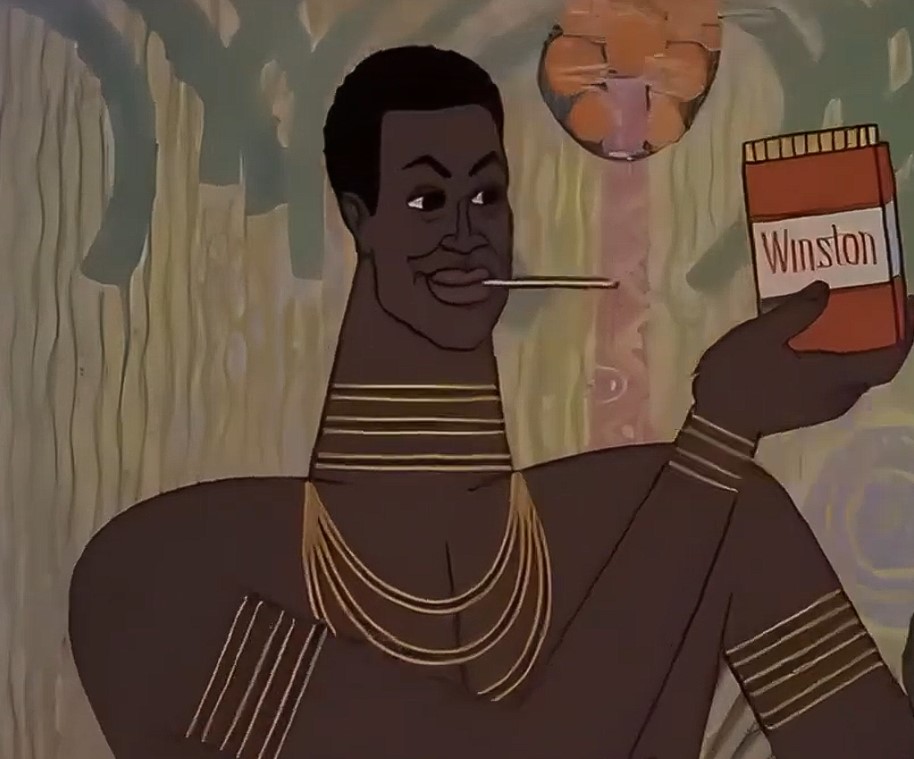
The film pictures an idyllic African wilderness where a man tends the land in a serene manner. Africa is depicted in a vaguely abstract minimalist style, while the man is more striking with his exaggerated anatomy including a Modigliani-worth long neck and uncommonly long arms. The man’s face is handsome and realistic, a far cry from the dreadful minstrel show-inspired depiction of Africans that polluted Hollywood’s Golden Age cartoons.
The scene is disrupted by an anthropomorphic elephant, who is amazed at the pristine beauty of the man’s land. While distracting the man with some Western goodies – a pack at Winston cigarettes and a stack of girlie magazines – the elephant starts to devour everything in sight. He then forces his way into the man’s home and evicts him.
The man seeks justice, but the law is stacked against him. The judge is a lion, the law enforcement is a hyena, the prosecutor is a crocodile, and a rhinoceros is the pious missionary who condones the abuses against the man. The man is found guilty of slandering the elephant, but he is granted leniency because of his perceived “backwardness and savagery.”
The man is allowed to build a new home for himself, but after each residence is completed one of the animals takes possession of it and casts him out. Fed up, the man eventually builds a home that could be considered the African version of a McMansion. When all of his animal enemies fight over who should live there, the man takes a torch to the place and frightens the animals away.
The animals in “The African Tale” look like they came out of a 1950s UPA cartoon. They are marvelous pieces of very limited animation and brilliantly symbolize the stereotypes assigned to them – especially the rhinoceros missionary, which is very funny. The idiosyncratic music score to the film also sounds like it came from the UPA library.
As propaganda, however, “The African Tale” is half on-target. Yes, the European colonial years were ripe with abuses and the film is not wrong in showing how the Western powers corrupted the continent.
But in retrospect, the film got it wrong because Soviet-style Marxism was not the answer, as witnessed in too many post-independence African nations that embraced Moscow’s talking points but wound up with societies suffering from dire socioeconomic poverty. Oddly, Kenya turned out to be an economic hub in Africa because it embraced capitalism without being obsessed by the turmoil that occurred during the British colonial occupation.
Today, “The African Tale” is an entertaining curio from the failed Soviet attempt to bury the West with Marxism. As far as I know, the film has never been part of an American DVD release. However, non-subtitled uploads can be found on YouTube (see below); there is an English dubbed upload, but the soundtrack is so lazy and uninspired that it is recommended to use YouTube’s subtitle generating feature and enjoy the film as it was meant to be seen.
IMPORTANT NOTICE: While this weekly column acknowledges the presence of rare film and television productions through the so-called collector-to-collector market, this should not be seen as encouraging or condoning the unauthorized duplication and distribution of copyright-protected material, either through DVDs or Blu-ray discs or through postings on Internet video sites.
Listen to Phil Hall’s award-winning podcast “The Online Movie Show with Phil Hall” on SoundCloud and his radio show “Nutmeg Chatter” on WAPJ-FM in Torrington, Connecticut, with a new episode every Sunday. You can also follow his book reviews at The Epoch Times.