
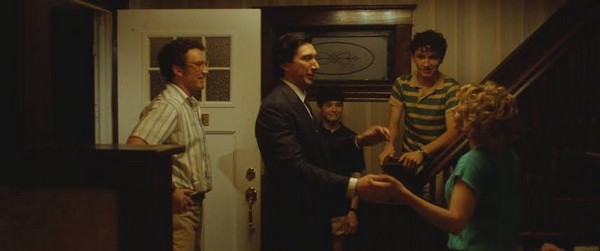
 Two brothers get in over their heads working with the Russian mob in 1980’s New York. Fantastic Adam Driver and Miles Teller performances build up the uneven PAPER TIGER, the new film from James Gray.
For the first half and some of James Gray’s family-based crime drama Paper Tiger, I was fully on board. Gray makes immediately fascinating films with We Own the Night, Little Odessa, and The Immigrant (Ad Astra has moments in its Heart of Darkness-infused story, but was otherwise dull). It was instantly compelling, setting up the lives and relationships of the central family in 1986 Queens: Miles Teller’s Irwin Pearl, his wife Linda, played by Scarlett Johansson, and their kids Scott & Ben. He’s an engineer and contractor, and they’re figuring out how to pay for their eldest son’s college. The fix might come when his brother Gary, an ex-cop played by Adam Driver and now a general wheeler-dealer, sets them up with a new consulting business. That business is with the Russians, who are starting to sweep up property on a polluted waterway in Brooklyn and looking to get it cleaned up. Of course, there’s danger, but this is set up to be on the level. But it instantly has a threat, a building danger for what we know will come. It’s delicious. Gray sets up a naturalist feel, as real and textured as the other recent love letter to NYC: The Only Living Pickpocket in New York. It has that same old-school, low-key feel. Gray uses this texture and the darkness and light of excellent cinematography for an amazing touch.
I was pleased and on the edge of my seat as that looming threat is made real quickly, with no wasted time. My initial thought when this occurs, as Irwin makes a dumb move and gets himself in trouble, is “he should know better; a 39-year-old man living his career in Queens. He questioned this same thing earlier.” But I let it go for two reasons. Apparently, the whole incident is based on something Gray’s father did in a lapse of judgment that we all have, even if we grumble at movie characters making boneheaded decisions, and the terror of the children happened to young Gray and his brother. And goddammit, the sequence is taut, gripping, and so well put together. The editing at that point was moving, with fantastic movement that crafted a fantastic flow.
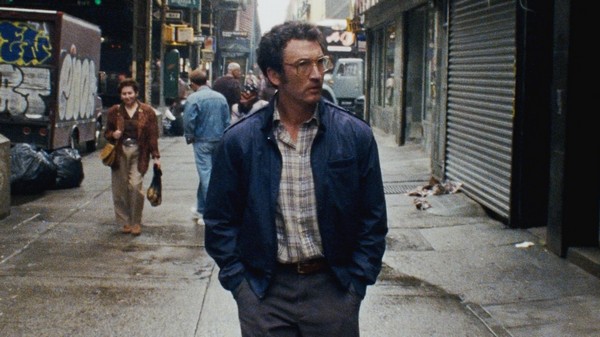 The downside of realizing its own threat early is that the film shows its hand and reaches the apex too soon, turning the rest into a downhill spiral. Around the hour and fifteen, I realized the film itself became the title: a Chinese phrase for an empty threat. With the title, it may be purposely unbalanced, but I don’t think so. Who wants to hobble their own film? What was strong, tense, and absolutely gripping gradually reduced to near nothing. All the tension I felt as Irwin grappled with the issues he stupidly wandered into is too easily defused (even if it hurts), landing with little weight on Adam Driver‘s Gary.
Driver is the strongest force in the film, turning in one of his best performances. He’s absolutely magnetic. The cool uncle for the boys, with a slightly aloof, natural, charismatic, out-there charm and fingers in many pies, compared to the more grounded younger brother. He may be different than Miles Teller’s Irwin, but there’s an undeniable connection. At the center of the film is the family connection of these brothers and the younger generation. Or so it seems until you think about it. The dynamic between the brothers is fantastic, well-written, and naturally performed. Miles Teller’s always been a solid actor (see Whiplash), and between last year’s Eternity and Paper Tiger, he’s proven he can bring something special to the middle-aged dad end of things. He wears all the weariness and worry of a good man looking out for his family, and I loved the connection between him and his boys. It was real.
Similarly, I appreciated the turn against expectations of Driver’s former police officer. For the various other clichés the film moves around, the reversal works, making Driver far more than a compassionate criminal, or dirty cop with a golden heart, but an actual good guy working in maybe shady areas and staying true, trusting in his doing things above board to make it easier for everyone who might work in the grey. I do wish this was worked more, as I did Linda. Sadly, Scarlett Johansson, while turning in a fine performance, is lost in the mix with little to do. There seems to be a bigger, better story for her just out of reach; hints and touches appear, and she has her reasons, but it doesn’t feel substantial. It’s clear she’s not an empty vessel, a thankless “wife” part, but so much is left behind it’s frustrating.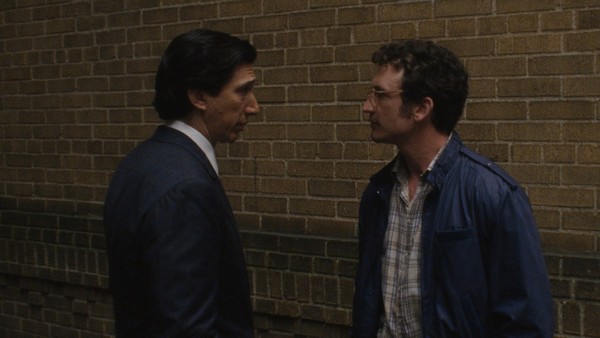
That’s how I turn at the end. Frustrated. There’s so much I loved in Paper Tiger. The production values are astounding; the lived-in world of 1986 Queens and Brooklyn is fully realized. The performances are naturally engaging and filled with chemistry. It’s clear how much Gary cares about putting together something real, pulled from his own memories and life. It’s personal, as all his films feel, but with an extra oomph. But the story comes to a little petering out and loses its bite. It does have an astounding climax, separate from the film it’s in. I’ll give the back portion that.
I wish I liked Paper Tiger more than I did. Maybe my expectations were set differently than Gray intended, and I became too invested in one aspect over another. Maybe I’m just wrong. I will say I have come around more as I’ve written this and sat with the film, and much of it still resonates and stays with me. So something is there. I expect I might be in the minority here, and I’m willing to revisit Paper Tiger, and that counts for something. As it is now, James Gray’s Paper Tiger is worth checking out for the great performances, production value, and strong start, although it stumbles in the story.