

A troubled exorcist returns to his home to reset himself but finds his past and a twist on the genre ready to greet him.
Don’t be turned off by the boilerplate exorcism opening of Shadow of God. Two priests, profane language, contortions, it all goes sideways. You’ve seen it before. After this sequence, setting up the still standard Troubled Priest character, Shadow Of God does go elsewhere. I’m not entirely sure wherever particularly it went, but it was often interesting, although frustrating in rushed, underthought ideas.
I’ll admit: it’s hard to create a exorcism film that either isn’t nearly a copy of the 1973 The Exorcist, or in deliberately trying to avoid said film, it gets lost in the muck. The only ones to truly land would be Exorcist III, the 2-season TV-show continuation of the franchise (I came into that skeptical and was blown away. Check it out), and The Last Exorcism. I could argue The Pope’s Exorcist is successful, in gleefully riding the Trope Train (or Vespa) in a highly entertaining cheese fest. But I digress. For what it’s worth, writer Tim Cairo does point Shadow of God into new directions (after said rote start), including rather strange and out there ones in the final push to make it interesting enough to give a viewing, although the writing doesn’t fill up to the lofty ideas. Director Michael Peterson keeps it all moving along with a nice clip, keeping viewers engaged with interesting visuals especially in dream sequences.
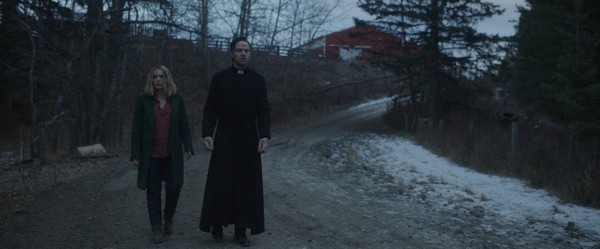
Father Mason Harper is one of the priests who just had an exorcism go wrong in Mexico. To clear his head, he heads to his remote farm country home of his youth. A strange plan, as most of that time was spent being abused by the violent religious cult his father ran. Not the place I’d go after an ordeal, but I’m not a priest all about figuring one’s humanity out. But it seems other exorcists are starting to be killed in mysterious way, so perhaps he’s hiding. This is one of the under-followed up ideas. But maybe not. I’ll admit, the plot and its details got away from me by the end, something that normally doesn’t happen. Maybe it was muddled writing. Perhaps it was Mark O’Brien’s performance as Harper. He’s flatly unenergetic; I’m sure if he was my priest before I retired from my Catholic upbringing I’d nod off during his homilies. Anyway, he heads to his remote farm town home of youth to reset himself and/or hide. The only real connection is Tanis Green, now a psychologist, formerly his high school best friend/lover.
She’s Jaqueline Byers of the truly terrible exorcism film Prey for the Devil, my least favorite film of 2023. She does well in attempting to creating a bond with O’Brien. Unfortunately, she’s not given much to work with. She comes and goes from the film, serving as a plot and idea mechanism. Green banters with Harper over exorcism versus psychology, god versus science (let’s forget many priests have non-theological backgrounds; hell, Father Karras was a psychologist himself), and the like; but post basic verbal sparring, she becomes damsel in distress. She spends much of the back portion of the film tied to post, watching it all play out. Also present is Adrian Hough; a man so cartoonishly portraying evil he could face off against the bad guy of the Karate Kid III in a “Who Just LOVES to be Bad More?” contest. He has some dad’s old cultists with him mugging through reactions. What they’re up to is the driving of the plot, a bigger take than a standard exorcism. But the hows and whys are lost in the script. As the film progressed, I couldn’t help feeling I was missing something essential to solidify the film.
There are noteworthy concepts Cairo explores, even if briefly. Harper’s father is delivered to Green’s House. Too bad he died years ago. Mason has to confront the feelings with his father, facing the past via the dead man in front of him, and said surprise reunion attendee just might need an exorcism. It’s nice to have an exorcism that isn’t from a young person. But as soon as this starts to take hold, it’s over; the film moves on to a new idea.
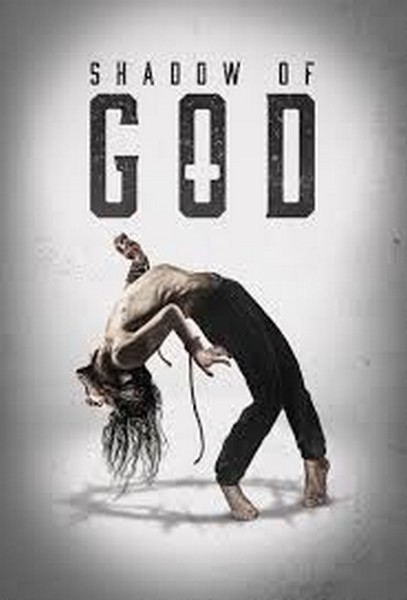
I won’t state where the film goes, but the concepts and their presentation make the first hour worth its muddled nature. I love it when a film lets itself get weird. If Shadow of God was made in the 80s, the climax could have been a bonafide classic. Heck, if It’s been said horror fans will wade through piles of shit for one shining, awesome moment. Shadow of God is not shit, even if the first hour doesn’t quite come together, but that shining, awesome moment IS worth it. The visuals of the climax, along with some sequences peppered in in the lead up, keep Shadow of God fascinating. At 88 minutes the film never stops moving and is not boring. I would have welcomed fa few more minutes into to flesh out the ideas presented, exploring nuances and building up the characters.
Shadow of God is a solid, if underwhelming, entry into the exorcism sub-genre. It takes a new approach in the concept, although the writing doesn’t hold up the ideas as well as it could. The acting delivering said concepts is varied in quality and energy, leading to a weird mix, but the visuals and concepts the film eventually heads to makes a good watch.