
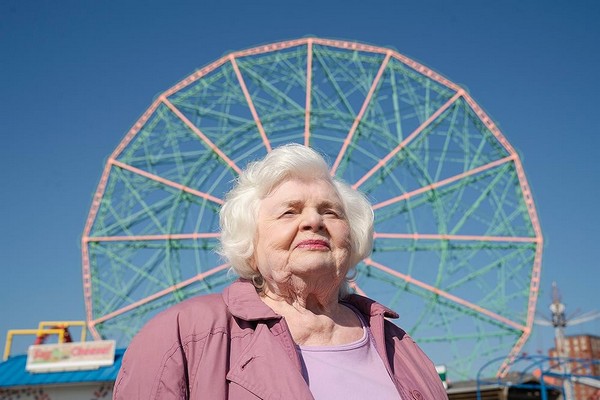
 A nonagenarian connects with a grieving young woman over the lie that she’s a Holocaust survivor in Scarlet Johannsen’s fine-enough directing debut, the June Squibb drama Eleanor the Great.
Grief has a way of upending one’s life. The loss of someone close, whether sudden or expected, can lead to decisions that seem terrible looking back, out of character, and often ruinous. Perhaps the loss of a mother during college causes a student to stop caring about grades, instead zoning out in front of movies. Say, I don’t know any movie reviewer who that might have happened to. Ahem. The point is, the destabilization of one’s life can lead to those poor choices. So I can see why Eleanor, a 94-year-old woman upended from her life in Florida after her best friend dies, tells her friend’s Holocaust survival story as her own in Eleanor the Great, written by Tory Kamen and the directorial debut of actor Scarlett Johannsesn.
June Squibb is the titular Eleanor. I can watch her in anything. She’s always a breath of fresh air, easy to watch and listen to. I’m saddened that her first leading role as the titular Thelma was lost in the mix of award season last year. She was astounding, as was the movie, with it landing solidly in my top ten of 2024. (I have no doubt Eleanor the Great is fully riding the coattails of Thelma). I can only hope to be as vibrant and full of life at 94 as Squibb. She’s a spark of life, full of pep and vigor. She comes off as someone I want to be friends with, or a grandchild to. I realized while watching that she sounds so similar to one of my grandmothers, who passed over 22 years ago. Maybe that’s why she gives me the warm and fuzzies even when terrifying in Blow The Man Down. Maybe she’s just that good of an actress. Or both.
Her Eleanor is spunky, trying not to slow down. She has the fire of life. She tells little lies throughout her life for fun. She refuses to take anyone’s crap and enjoys time with her best friend, Bessie, played with pathos by Rita Zohar. Eleanor’s roommate for 11 years, and a nearly lifelong friend, they swap stories so often they have one another’s lives memorized. After Bessie dies (how this is handled is sublime) and Eleanor’s family moves her to be with them in New York City, she’s unmoored, trying to find focus and a life. Well, one thing leads to another, and she ends up telling Bessie’s tale at a Holocaust survivor support group. Oops. Maybe she could let it go and be fine, except she’s gained the eye of young Nina.
 Nina just lost her mother six months ago. Neither she nor her father, a newscaster played by Chiwetel Eljifor, has been able to process, stuck in their own bubbles. Recognizing the grief she too shares, Eleanor agrees to be the subject of an article about Holocaust survivors. Thus, this is a story of processing grief, and the ways we do it, or don’t, along with the web Eleanor weaves to keep the truth at bay. It’s a strong through line of drama. But Kamen’s script doesn’t fully pull it all together.
The issue with Eleanor the Great is it lacks a spark. All the pieces are there. It’s solidly built, and the characters are interesting. Their needs and wants are compelling. The issue isn’t forced or overdrawn. Scarlett Johansson directs well. She doesn’t direct to wrenthing melacdrma. She leads their compatible cast to solid, measured performances. Nina Kellerman was Nina is a standout. It’s good to see her in a film like this rather than as a piece of the puzzle in Solo or Captain America & The Winter Soldier. It’s not a show-offy direction at all. Solidly done. But it trudges along with a steady pace, never really building to a point. It’s a little of a shrug. The lead-ups, set-ups, reveals, and payoffs are all “oh okay, that’s a thing,” such as Eljifor’s big moment on the news, which in no way feels earned, instead strange and forced.
I ask whose story it is. Elanor is the titular character. It’s her actions that set the plot in motion. We worry what will happen when the shoe falls and she’ caught in telling her friend’s story over her own. Maybe I discount her because I get annoyed by “little lies go big” stories. I’m frustrated and annoyed rather than sympathetic when a character won’t say the one thing that would clear up the whole conflict. That’s one of the many reasons I hate Dear Evan Hanson. That’s a poor movie, and dare I say it, a terrible stage show, all based on me going “aaarrrggh.” But when Nina enters the plot, Elanor’s story takes the back seat, kinda becoming a background character in her own story as a foil to what Nina is experiencing. Of course, stories can have multiple narratives coming and going, intertwining. It’s the nature of storytelling, but for Eleanor the Great, each story feels like the B-plot.
 Kamen’s tale of grief is interesting enough, but unfocused, especially when it comes to the father connection of Nina and her dad. That’s the thing, it’s unfocused, and no one’s story feels important. It’s soft. When eventually truths are revealed (as we know they will), it’s felt in the lead-up; it’ll be that shrug from earlier. It doesn’t keep the heft this story should have.
Eleanor the Great isn’t “great.” But it’s fine. Johansson sits in the director’s chair with ease, working well with her actors, moving the story along well. But also without a strong dramatic push. But I appreciate the restraint from a first-timer. June Squibb is as great as ever (earning that title there, I guess), with great chemistry with Erin Kellyman proving herself in a co-lead. An enjoyable film to watch with the parents, if you’ve already shown them Thelma.