
 A retired spy recalls his exciting past in Helene Cattet & Bruno Forzani’s wonderfully realized violent Euro-spy-thriller throwback, Reflection in a Dead Diamond, premieres in select theatres and on Shudder the first weekend of December.
Helene Cattet and Bruno Forzani know their European genre cinema in and out. Amer, The Strange Colors of Your Body’s Tears, and Let the Corpses Tan have been standouts in modern genre filmmaking. Modern to make, yes. Modern to feel, no. The pair has reveled in recreations of everything that made European (specifically Italian) genre cinema of the 70s last to today’s audience, who eagerly buy new editions of old favorites from Arrow Films or Severin. For that, I can’t praise them enough.
While their previous works have swum in the deep end of Gialli and neo-westernesque, Reflections in a Dead Diamond does its dance in Euro-spy-thrillers. Films like Mario Bava’s Danger: Diabolik (based on pulp comics refered to as “fumetti neri”) may be the largest point of reference for most this side of the pond (as the last episode of the original run of my favorite TV show, Mystery Science Theatre 3000, my perception may be skewed), but Italy and France had a slew of Bond-influenced sexy-spy flicks. Wild plots and wild action, sexy to a fault, effortlessly smooth and stylish. I won’t pretend to have a depth of knowledge on this subject, I’m more into gialli, but there is a solid amount of crossover, in the genres’ histories and within this film. And in doing so, the pair crafts another wonderfully stylized, bug-nuts-insane tour de force of self-aware genre filmmaking. Loving pastiche is what they do, and they do it exceedingly well.
The latest dazzling pastiche is Reflection in a Dead Diamond. I love that title. It is the story of an older spy, played with cool debonair by Fabio Testi, retired and living in a French Riviera hotel. A sultry neighbor awakens memories of his past, and perhaps sets up a new case to solve. Or is he just an actor forgetting his real past, taking his films as real, or a book character? All this and more? I won’t tell. But neither will the film.
 Look, I’ll be honest: I wasn’t entirely sure what was going on most of the time. Who was who, what was where, who wanted what? I got lost. But in the end, that’s okay. And not out of sorts with the types of movies Cattet and Forzani are paying their lovable homage to. Most people watching Reflections in a Dead Diamond are likely at least somewhat versed in Italian Genre Cinema. And does anyone expect, nay… want, Italian Genre Cinema to make sense? It’s part of the fun of it, and our directors know that. For those wanting more coherence or story, Reflection in a Dead Diamond might feel like a pretty but empty box. For me, that worked, but for others, they may grow tired after a little while, and I get that.
But that doesn’t mean they don’t give a hoot about giving the audience everything they can. The craftsmanship and care are tantamount, dazzling, and dizzying. In style and feel, of enjoyment of getting lost in a gonzo genre game. They have a true genre awareness in recreation. Reflections in a Dead Diamond is a loving tribute, a purposely throwback. But, outside of the knowing nature of the project, it is not a comedy or satire. There’s nothing to indicate a sly irony to the film. It’s earnest in doing exactly what it intends to do.
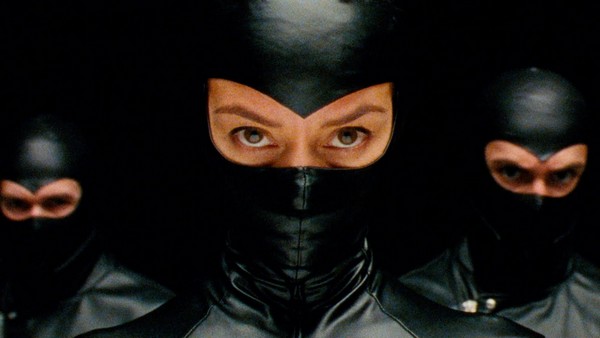
I loved the wonderful detail of time and place. The knowing close-ups. the multi-colored Bondian theme song and credits. A set of women in skin-tight, body-covering leather outfits, only leaving their eyes to entice. The leader of which is Serpentik, never revealing herself from her Diabolique outfits despite a lover/enemy connection, with her razor-sharp talons of fingernails. The other dresses, the awesome weapons, one dress becoming a weapon, all the sexy women and men.
 Yes, this is not a horror film, and yes, it’s on Shudder. But it’s perhaps more violent, bloody, and outright nasty than most of the specific genre. Remember those fingernails on Serpentik? Oh, they are used in wonderfully grotesque ways. Silletto knives for heels. How sharp is a diamond? Ask some woman’s face. And so much more (the ring…). The blood flows as easily as every character is smooth. What’s best? It all looks practical, further selling the homage.
What wonderful casting as the younger, Yannik Renier, and older of the spy are perfectly matched, highlighted in the wonderfully flowing editing, keeping from a jarring switch. Bernard Beet’s editing is astounding. Seemingly moving from time, place, and character, almost matching how one’s memories slide around. Of course, transitioning isn’t the only need for editing, but it pops and shines within the scenes, perfectly visually realized by production designer Laurie Colson. But the continuity of movement is smooth and striking. It’s a skill to keep that flow with the sheer overwhelming number of cuts, zooms, and other active camera uses via cinematographer Manuel Dacosse. It’s a film that never slows, ever stops showing off. In a good way. Reflection in a Dead Diamond is continually impressive.
For those who love to take a big bite and chew into wonderful examples of genre cinema, who love to soak up all the cliches and tropes from filmmakers who are very well aware of the film they are making, Reflection in a Dead Diamond will come home as a flamboyant gem.