
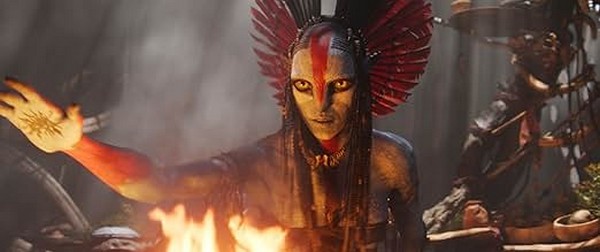
 Jake Sully and his family continue to try to push the military, now helped by a fire-based pirate tribe, off of paradise planet Pandora in James Cameron’s third epic entry to the Avatar series: Fire and Ash.
First, Avatar: Fire and Ash continues the franchise tradition as massively epic and mindblowingly beautiful with astounding visuals and leaps forward in special effects. For that, Fire and Ash succeeds in every way possible, well worth a trip out to the largest and most impressive screen possible this holiday season. Like the other films, I have no doubt the largeness won’t play as well at home. James Cameron creates the sort of spectacle that needs to be experienced. This is a movie’s movie. Meant to be as Big and Loud as Ever. That said, the epic nature is a little exhausting; sometimes it feels like the over three-hour run time with a repetition of scenes, both in this film and across the series, some narrative snags, in part of the length, and the nature of existence as the middle chapter of the five-movie arcs.
Avatar Fire and Ash is a fully technical wonder. I’m constantly astounded by the creation of Pandora. More than the norm single-aspect sci-fi planet situation (of course, I recognize that’s for ease of the story in most cases), Pandora is a fully realized ecosphere. You can feel the sheer amount of work the team has put into the setting to bring it to life. It’s hard to believe it’s all from the computer (with NO generative AI, which Cameron really wants us to know). It may be computer-generated, but it’s done with the utmost care to look and feel as real as any Earth setting. It works; it’s a breathing, living world. Literally, as the aspects of the world are the symbiosis of those living on it and the planet itself. We mostly keep to the previously seen areas, with a few further explorations, but have one specific new space with the home of the pirate tribe. I loved the design. So many awesome bone architectures! Enough to make a Predator, Ralph Fiennes in 28 Years Later, or the Sawyer clan of Texas Chainsaw be pleased. No matter the setting, it’s absolutely astounding. Immersive isn’t strong enough of a description for how engrossing and encompassing it is.
For the story, it’s very much the same as the last two films: the Na’vi versus the Company (not Wayland-Yutani but might as well be) and their Colonial Marines (to use more Aliens parlance, again like The Company, they might as well be, especially since their weapons and vehicles are nearly identical) escort. But, like The Way of Water (my short review: the first film but bigger in every way), tweaking it for the new settings and details. Jake Sully and his family are still living with the water tribe. They are reeling with the loss of their son in the final battle against the military/Company invasion of their land and water to harvest the whale-like creatures.
This time, Quarrich has joined forces with a pirate tribe, the Mangkwan or “The Ash People”. Led by Varang, they are less interested in the community with nature and more into watching it all burn. For… reasons? Maybe we don’t need reasons, like Joker, some people just want it all to crash down. They work together, using one another (the military using the Na’vi more, one would say) for their shared aim: the destruction of everything beautiful for fun and profit.

That’s the main drive: Sully and his family move across the planet, trying to protect adopted human son Spider, biological son of the reborn Quarrich, to safety along with trying to protect everyone on a wider scale. They get captured, escape, capture others, push off invitations and fights, lose, win, and battle. It’s a strain in there is so much going on, but it also feels like “oh I’ve already seen a lot of this twice”. I wonder where Cameron is going to go in the next two. I’d joke that since we’ve already had Earth, Water, and Fire nations, we’d get an Air tribe, but they are a section of this film already.
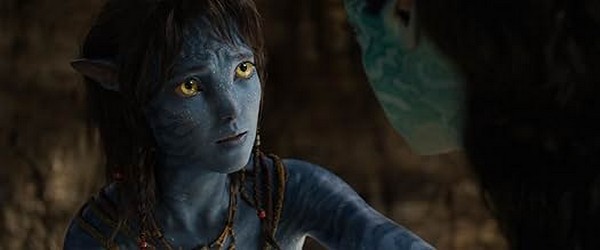
Even with familiar story points, Cameron and co-writers Rick Jaffa & Amanda Silver can keep it fresh with the characters and incredibly designed and executed action scenes. There’s a solid emotional through line in the interanal fo the family dealing with their loss, as Neytriri shuts down and blames Spyder, Jake tries to keep things together with the water tribe, Lo’ak works though losing his brother and BFF (with one less of them, much fewer “bro”s but still sure Cameron wore out the B-R-O keys on his computer), Kiri struggles with connecing to the planet mother (side note for this film and across her career: Dont’ fuck with Sigourney Weaver; she has a freakin’ awesome pay off I loved), and fully human Spyder tries to find his place in the world as Jake and Quarrish continue their parental dispute (Avatar 4 is a courtroom drama for custody: Cameron’s Kramer vs Kramer). Younger sibling Tuk is just there; I guess maybe she’ll get her moments in later films. Sam Worthington for Jake isn’t the strongest, but he does well embodying the character, as does Zoe Saldana is far better as a mourning mother working through his feelings. But even more than the last film, this is Britain Dalton’s film as he takes more of the mantle of lead character. It can be argued that the first Avatar was all set up to allow Lo’ak’s story across the remaining four films. Mostly his movie, as he vanishes for a long time. But that’s an issue across the title as many characters vanish for so long (or are given a short shrift, sorry Kate Winslet). I wondered, “Did she die when I blinked?” for one in particular. Perhaps a shortening of the massive 3-hour, 18-minute run time would have tightened. That said, most of the film runs by quickly; outside those few stretch marks, the lengthy film has the pace of a cheetah (or Pandora’s equivalent animal).
Stephen Lang’s Quarrich continues to be a high point. Lang is an amazing actor, from the 80s in Death of a Salesman and Manhunter to his bulging, brooding, iconic villain performances of late (I still need to see Sisu 2). He’s been a very interesting villain. He was one note but highly entertaining in Avatar, and his recreation into a Na’Vi permanently in Way of Water started some character thoughts of where he’ll end up, questioning his loyalty and needs, just exactly who he is. It made me very interested in seeing how he’ll be explored. That continues for Fire and Ash; without showing the hand too much, he’s the type who knows that voice, that itch is in the back of his head. If he starts to scratch it, it’ll rip a scab, uncovering questions he doesn’t want to answer. So he lends the other way. But he knows it’s there. Lang gives him a fascinating quality to watch him work. By his side is the poster darling Varang as the leader of the Mangkwan tribe. Oona Chaplin, best known to me from Game of Thrones, makes her just as eye-catching and film-capturing as Lang. She’s highly and intensely committed. She gives her a life and power, leaping off the screen every time she’s around. She does come and go, with her and her tribe (after her, they’re all generic) serving more of one-note foils. Even if the character is shallowly written, she’s giving everything to make her memorable. She’s compelling and shows what a capable actor can do with what they’re given. I can’t wait to see where she goes from here.
Avatar: Fire and Ash shines in the action, along with the previously mentioned world-building. Cameron truly knows how to put together astounding sequences as he’s shown us again and again in Aliens, True Lies, Terminator 2, and now these films. Avatar: Fire and Ash builds on the previous entries with its own awesome action, even if they feel a little too much of Way of Waters at times. These are filled with incredible set-ups and pay-offs, large beats that truly wow, huge pushes, character moments, and fantastic action choreography by Garret Warren, Stephen Brown, and Stuart Thorp, and all shot with gorgeous focus by Russell Carpenter. Each of the myriad action bits has a wonderful beat (thank you, six listed editors, including Cameron), huge moments, and is one of the best of the year, as big and grand as anything Cameron has done before.
 Speaking of Carpenter’s cinematography, the High Frame Rate is handled far better than in the previous entry. I did watch the last one in IMAX, and this was Dolby, both in 3D; so that might be the difference, but I also think Cameron took notes from criticisms. The transitions are smoother, less jarring, as the line-to-line shifts from Way of Water. It feels more natural, mostly losing the uncanny valley of seeing the seams. There were only a few times where I was taken out in a “I’m watching dailies” I often get for HFR. Cameron and Carpenter use it well to help Pandora engulf us.
Cameron and his massive team have crafted another highly entertaining epic, even if it can be a little exhausting at times. Avatar: Fire and Ash is a spectacular spectacle of the highest degree. It won’t win over any converts to the series: I put them all about the same ranking; it’s a matter of inches in either direction. But for those willing to visit Pandora for a third time, they’ll find a richness of environment and action, solid character, and a story they’ve seen before with some differences. I will always appreciate a movie that absolutely goes for it on all cylinders. There is no slouching, no laziness. Even if a connection doesn’t fully work or a story aspect isn’t as hearty as it might be or lacks something, it’s not for a handwave.
BTW, let’s curb the “Dances with Wolves/Pocahantas/Ferngully” jokes. It’s old. It was old 16 years ago, but some folks still like to make “Vampires don’t sparkle” jokes from the same era. Let it go. Stories use repeated themes, methods, and ideas. It’s how they use them. And despite the similarities, Avatar has provided its story in very different ways.
Bro.