
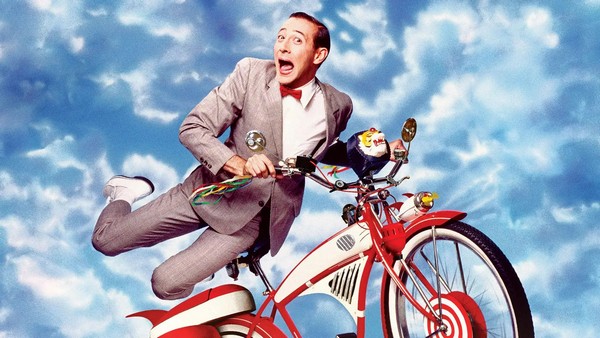
 Pee-Wee Herman searches for his stolen bike in Tim Burton’s 1985 comedy classic Pee-Wee’s Big Adventure, now on a new Criterion 4k UHD.
The Film
Now forty years old, Pee Wee’s Big Adventure is a film I assume anyone reading this site and article has seen at least once. If you’re like me, dozens of times in those forty years. It’s almost pointless to review the actual body of the film, so my “review” notes below are a bit more waxing on the impression of the film than “yes this, no that”. Ultimately, it’s a film that works exceptionally well for fully committing to its brand of insanity, launching or shifting several careers in the process.
Pee-Wee’s Big Adventure is a wonderful whimsy tornado of two unique weirdos, director Tim Burton and actor/writer (with Phil Hartman and Michael Varhol) Paul Reubens coming together to make something truly special, weird, memorable, and iconic for its full 91 minutes. For people of my generation (I’m 43), Pee-Wee’s Big Adventure is a film we all saw too young, but that’s the point; it can be argued that everyone is slightly too young for this oddity of an odyssey. It’s a child’s-eye view of a Lynchian absurdist nightmare hellscape. That’s the appeal. That’s why it works. It’s a film of childlike whimsy, how Pee-Wee and Frances and their circle see the world, that of an excitable 8-year-old. But within that point of view, it’s a candy colored terror of nightmares and disturbing. But not too disturbing, just on the surreal edges. What’s a youth without nightmares of Large Marge? It’s innocent, big and bright (clapclapclapclap deep in the heart of Texas), and goofy, but an undercurrent of Lynch. Not to undo Burton and Reubens. Their specific outlook and styles mesh well to make this specific output, so it’s with love that I mention Lynch. Maybe because I rewatched his catalog after his death and he’s on my mind, but this aspect specifically landed with me this viewing; the upward angles, the sheer blackness of the background (hello Wild At Heart), a dark level under the normal, a level of unknowable absurdity, Kafka for kids!
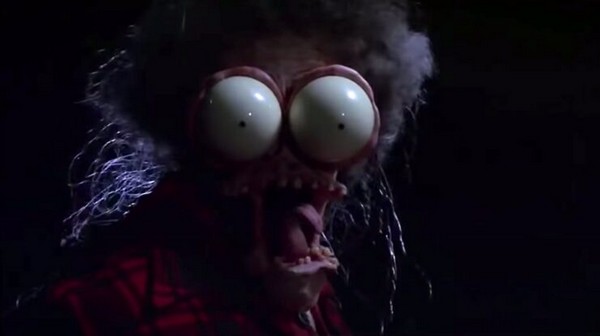 But still a blast of an adventure. Fun with wild and wonderful characters. It’s a unique movie, going one hundred for broke with the specific mayhem and minor nightmare-enducing menace (for most it was Large Marge or the Dream Doctor Clowns, but for me it was the bike-lock clown). It’s scary, but it’s sweet, with a loving, strange journey. It’s a film that shifts genres and ideas, with a wild, running script that sets up its oddities and Pee-Wee’s character and needs with ease. Pee-Wee Herman is annoying but endearing; he’s a lot, but his childlike innocence is infectious as he travels across America for his bike, meeting all sorts of fellow odd folks. It works because the movie is WITH Pee-Wee. It’d be all too easy for everyone he encounters to treat him like an oddity and outcast, sneering at the man-child. But it’s all real to everyone, especially Pee-Wee. It’s the world as it exists to Pee-Wee. His journey is one of heightened reality; anything can be true or happen because he believes it can, and so does Pee-Wiee. It’s an inventive child’s logic, and we can go along with the sheer exuberance, from the delight of magic chop to winning bikers with Tequila to the terrors of falling through infinite space in a convertible with a convict.
Let’s not forget Danny Elfman’s wonderful score, ear-catching and fully memorable, building off of the band (The Mystic Knights of the) Oingo Boingo and his brother’s 1982 film Forbidden Zone. It’s a perfect score in not only how inventive and pleasurable it is, but how it sets the tone of the film just right. A great example of the score and movie working off one another. How well does it set the tone? Elfman’s scores for this and Beetlejuice are often used in trailers to set the tone for other films. Such a great score, where I’ve been vocalising around the house the last few days, to the chagrin of my wife. Sorry Allison. Bum bum bum bum bah bah bah bahbah bum. Dammit, there I go again.
It’s great to revisit this classic yet again. I watch it every few years and fall in love with everything about it all over again. Pee-Wee’s Big Adventure is also a testament to how far one can go with a tiny budget and a lot of creative talent and pure going-for-broke enthusiasm. Pee-Wee’s Big Adventure launched animator and short-film artist Tim Burton (fitting as it’s often a live action cartoon) to the stratosphere, turned Danny Elfman from whatever genre you put Oingo Boingo in (not a dig, a favorite band) artist into a film composer, and brought Paul Reuben’s strange Groundlings character to the masses, landing a full career and childhood mainstay Pee-wee’s Playhouse.
Thanks for the memoirs, Paul Reubens and Phil Hartman, both gone too soon.
The Package
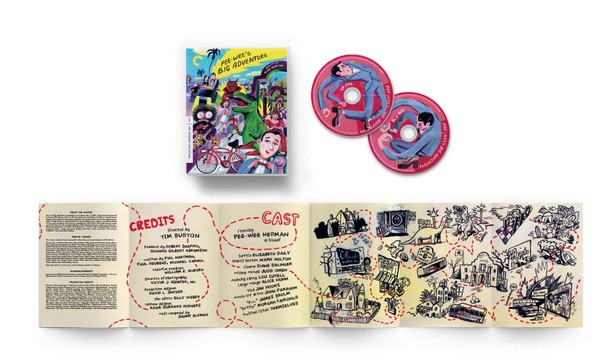
Criterion presents Pee-Wee’s Big Adventure 4k UHD and Blu-Ray discs with a single standard case (Spine #1293), with both discs pressed to one side, overlapping. The other side holds the essay booklet. The sleeve features new art by Luigi Olivadoti.
I gotta shout out the menu screen. A wonderful, clever map of Pee-Wee’s Big Adventure.
Let it play and see where it takes you, with a great joke!
The Presentation
Tim Burton approved a new 4k digital restoration, and it looks great. As noted, it’s a movie I’ve seen too many times in 40 years: on TV, VHS, DVD, Blu-Ray, and a few lucky times theatrically, and now 4k; and it’s never looked better. Crisp with depth, Bruton’s specific otherworldly stylings play well, with the bright cartoonish colors and world. The sound is offered with 2.0 DTS-HD and a 5.1 alternate option (that mostly works with the music). Additionally, the Elfman commentary is just the soundtrack, to help appreciate that.
The Features
The 4K UHD disc features the film and both commentaries. The Blu-Ray features the film, both commentaries, and all of the features. All in all, with the commentaries, Criterion puts about 5 hours of quality material.
2 Commentaries (both from 2000): awesome note – putting on subtitles for either track will subtitle the commentators. I love that.
- Tim Burton & Paul Reubens:
A great talk about the creation of the character, their histories, and how they pulled it all together. Great stories, behind the scenes, and a look into cultural effects. I never thought about it until they mentioned it that the film jumps across so many genres, from scene to scene. Burton said it’s fun to work as a first-time feature director to try out the different methods. While Burton always sounds sleepy (in all his commentaries), Reubens has the ability to push Burton’s comments, and they build off one another, poking for the notes and memories.
- Danny Elfman (over a music-only audio track)
Elfmans’ score is astounding, and it’s awesome to hear it separate from the full audio, allowing a new level of appreciation to essentially listen to the soundtrack with the film matching. Elfman is forthcoming in the talks between tracks of how he approached it, in shifting from Oingo Boingo’s big band outlook to a film score method, what he learned, and how it brought him a huge new career.
Richard Ayoade (new)
The actor interviews Tim Burton. An incredibly open and friendly back and forth, loving the film. But in a nice turn, Ayoade hadn’t seen the film before getting this job, allowing a freshness of perspective. Burton has great insight into the process, looking back 40 years, and how Pee-Wee works as a character and film. Burton and Ayoade have a wonderful report, leading to an engaging conversation. (28m)
 “I Meant To Do That” (new)
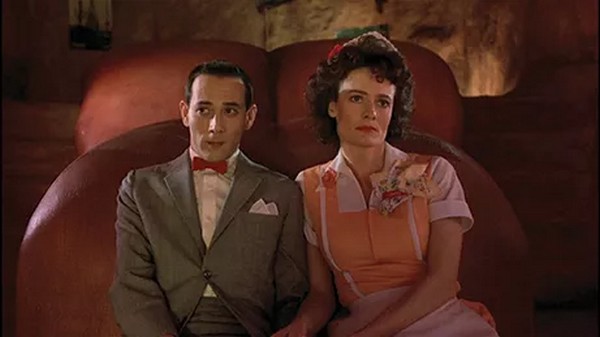
A very well put together featurette of interviews with producer Richard Abramson, production Designer David L. Snyder, co-writer Michael Varhol, and editor Billy Weber. Not content to just dry watch the interviewees and their statements, it’s presented in various methods to keep it lively, with behind-the-scenes and clips, fun touches, and more. Additionally, they have fantastic new points of view on the film after hearing Burton and Reubens. (38m)
Hollywood’s Master Storytellers interview with Paul Reubens (2005)
Insightful, but a little awkward. It’s strange, the interviewer seems a bit not ready, and Reubens slides between being into it with great answers to the questions and checking out. The audio and video are a little fuzzy, but I chalk that up to the time and material filmed then. A few odd cuts, where it seems like questions or answers were cut. (36m)
40th Anniversary Screening (new)
Filmed over the summer, snippies of a large panel interview with both behind-the-scenes folks and on-screen talent (no Burton, though). Yes, part of it is to heap love on the film, but it’s a joy of why it persists. Lots of laughs and emotions. As noted, it’s a cut session, as each participant gets one question and answers with a single audience question. Could hear it go for a while. Host Dana Gould gets some great laughs. Funny aside: co-writer Varhol shoots down the long-standing rumor that they followed the Syd Field screenwriting book to tee. (25m)
Deleted Scenes
A handful of sequences and notes on where they were, and why cut. I can see why each got the ax, none really add much. (11m)
Trailer (3m)
Booklet
A fold-out with the menu screen map and credits on one side and an essay “Why Don’t You Take A Picture?” by Jesse Thorn on the other. Thorn’s essay is interesting but meandering in the careers of Reubens, Burton, the creation, and effects of the film.
Final Thoughts
A great release for a great film. Go out and grab it up with your Christmas cash. And when you get to the cashier, tell ’em large Marge sentcha.