
 A woman searches for her husband and closure in a dead-filled Tasmania in Zak Hilditch’s quiet and meditative We Bury the Dead.
Zak Hilditch’s We Bury the Dead is a very different sort of zombie film. Many may be turned off and struggle through. If you were disappointed that 28 Years Later was a coming-of-age story within the aftermath of a zombie apocalypse, We Bury the Dead will disappoint and bore you as a grief drama in this sort of situation. If you want biting, munching, and shooting every few moments, We Bury the Dead is not for you. This sounds like I’m disparaging and warning you off the film. I’m not. It’s a very well done, thoughtful, meditative story of ifnidgn closure in an uncertain situation, using the tenets of the undead subgenre to touch the story. I really, excuse the pun, dug the Daisy Ridley-led film. While it doesn’t fully stick the idea, it has more than enough to pull along with its special sort of sadness.
The set-up itself is rather different, to start. The united states military, with its infinte wisdom (/s), has accidentally detonated a bomb just off the coast of Tasmania. It sends a sort of wave across the island, boiling every brain it hits. Yes, the whole island is dead. Without property damage, outside of what happens when all the humans and animals suddenly die: crashed vehicles, fires, etc. A very select handful sometimes come back. But unlike other stories, they are docile, still, and have a strange sadness behind their eyes. Mostly. There are hiccups to the reanimation, but how it plays and the variations are the film’s to tell. Daisy Ridley is an American Physical Therapist who volunteers to help clean up the dead, visiting house to house, business to business, cataloging the deceased. 
Just like some of the risen, We Bury the Dead is a sad film. A contemplative, meditative zombie film about loss and closure. When bad things happen, especially to one member of a family, we strive to get answers. Not knowing, letting things remain unknown, is unbearable. We become untethered at the unknown. That’s what Ava needs: to find a way to get an answer about her loss. Her husband was at a work retreat south of Hobart when it went down, so she has ulterior motives for her volunteering. She strives to sneak away from her group and close the open wound.
Daisy Ridley is phenomenal as an anchored, desperate lead as Ava. I’ve felt bad for her in the decade since The Force Awakens released. She’s had a decently steady career, but it feels like it should be bigger and better. She was great at Rey, intended to be the new face for the franchise (ultimately, Kylo Ren got the job), and has since had a modicum of notice. Marsh King’s Daughter was, and Chaos Walking were total misses, not for Ridley, as she was solid in both. She’s consistently great in this film. She carries it with intense hurt and drive.
This is a new wasteland of few people and few zombies, at least as we normally see them. The main other human is Brandon Thwaites, of Hocus Pocus and Titans, a crude, give-no-shits fellow clean-up member. He allows her to tap into what she’s hiding, the way into facing herself. Also is an off-putting military member, played fantastic shark film Beast of War’s lead Mark Coles Smith (aside: coming to Shudder in two weeks) as a soldier mourning his island. Both serve their purposes for Ridley’s arc and serve as full characters on their journeys. They make choices, for good or ill, for direct and secret, and it serves them and the plot well.
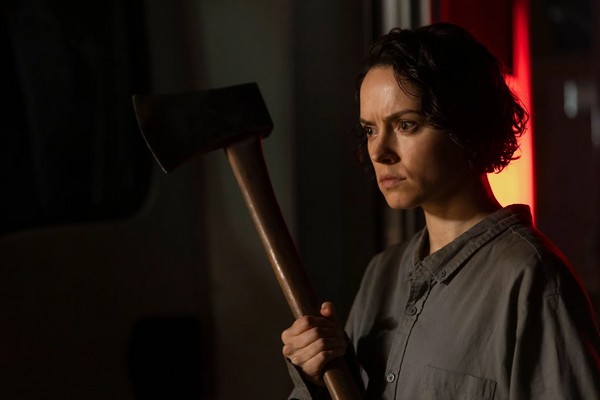
We Bury the Dead is a film of intense sadness. Watching, I was left with a melancholy, compared to the normal faster pace terror, even in other slow-paced zombie films like Romero’s Dawn of the Dead have more action beats. There are a few, but that’s not the point of the movie. And this might hold off many people as the film explores what’s left behind in tragedy, in the unfinished business of families with children leaving this world early, of stories left unfinished. The photography lends a beautiful stillness to the countryside and desolated cities and villages of Tasmania, using the openness and a focus on wider master shots to highlight the emptiness of this slice of the world. Add in a vibrant and often scary aural landscape between the nothing and the sounds of the undead, and Hilditch’s world comes together. To bring it home, the zombies look fantastic. The make-up is a high point, especially as it goes on and gets more complicated. Those bored with “ugh, drama” can at least look at gorgeous ugliness.
While I appreciate the different method and the slow build, it doesn’t quite fully come together. The ideas are fascinating, but upon reaching the end, I feel unfulfilled. I guess I didn’t get the closure the characters are striving for. It comes to an appreciation of a full connection.
That said, I recommend We Bury the Dead for those who want something different out of their zombie movies. Yes, there is a great deal of “grief metaphor” in horror these days, but that doesn’t make it any less of a good flick with a great lead.