

What begins as a desperate escape from violence quickly transforms into a haunting confrontation with guilt, grief, and the lingering weight of the past.
Centered on a refugee couple struggling to rebuild their lives, His House explores the psychological toll of displacement and survival through the lens of supernatural horror. Blending psychological terror, cultural folklore, and intimate human drama, the film delivers a deeply unsettling experience that uses horror not just to frighten, but to explore themes of identity, trauma, and belonging. Directed by Remi Weekes and written by Felicity Evans, Toby Venables, and Weekes, the film maintains a grounded emotional core even as it ventures into increasingly surreal territory. While the narrative functions effectively as a traditional haunted-house story, its deeper exploration of refugee trauma and cultural displacement gives the film a resonance that lingers long after the final scene. His House follows a refugee couple who escape the horrors of war in South Sudan only to face a different kind of terror after being placed in a deteriorating home on the outskirts of London. As Bol and Rial struggle to adjust to life under strict asylum conditions, unsettling events inside the house begin to blur the line between supernatural horror and psychological trauma.
Wunmi Mosaku delivers a powerful performance as Rial, a woman determined to preserve her cultural identity even as the world around her demands assimilation. Rial is the first to recognize that the presence haunting the house is not simply an evil force but something connected to their past. Mosaku plays Rial with emotional intensity and quiet strength, grounding the film’s supernatural elements in lived experience. Her character’s understanding of the apeth, or “night witch,” becomes central to the film’s unfolding mystery, and Mosaku conveys both fear and resilience with striking authenticity.

Sope Dirisu brings equal depth to the role of Bol, a man desperate to make their new life work at any cost. Bol believes that survival depends on fitting in and avoiding attention, even if it means suppressing his past and distancing himself from his cultural identity. Dirisu portrays Bol with a controlled tension that slowly unravels as the haunting intensifies. His attempts to rationalize the events in the house reveal a man struggling not only against supernatural forces but also against a terrible secret he cannot escape. The contrast between Rial’s spiritual awareness and Bol’s denial creates a compelling emotional dynamic that drives much of the film’s tension.
The horror elements in His House are particularly effective because they remain deeply tied to the characters’ experiences. The film relies less on traditional jump scares and more on creeping dread, unsettling imagery, and psychological disorientation. Figures appearing in walls, distorted bodies emerging from darkness, and shifting realities create a persistent sense of instability. The supernatural threat never feels random; instead, it serves as a reflection of the couple’s trauma and moral conflict. The score and sound design further enhance this atmosphere, blending silence with sudden bursts of noise that heighten the film’s tension without overwhelming its emotional core.
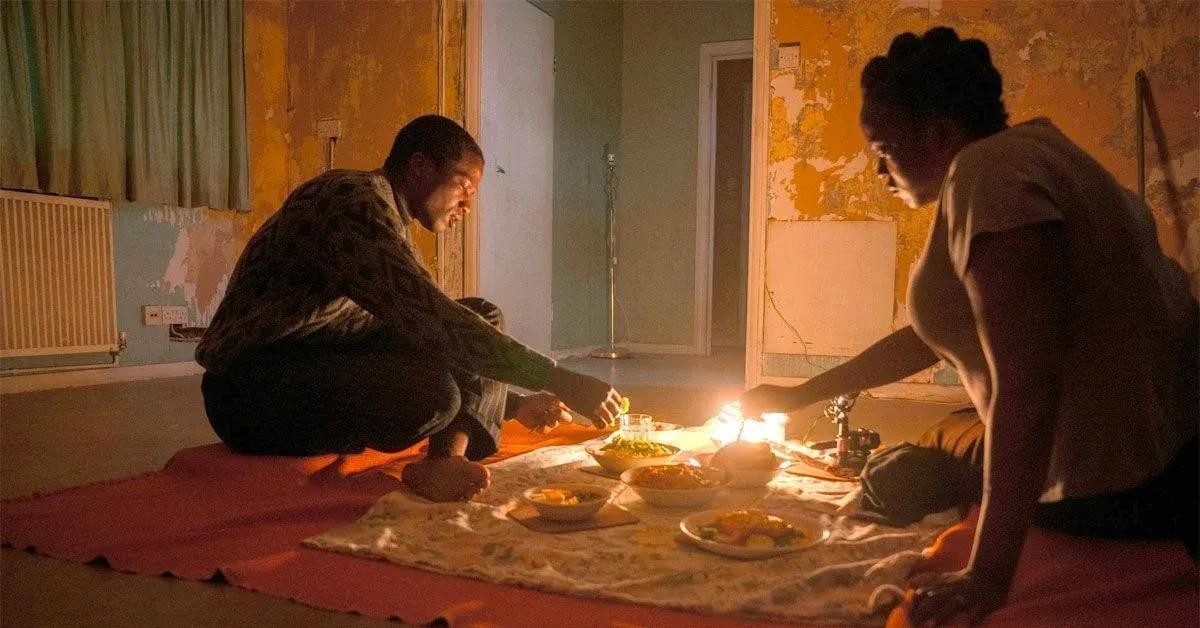
His House is deliberate and atmospheric, using its confined setting to create a constant sense of unease. The government-issued home assigned to Bol and Rial is drab and deteriorating, its peeling walls and dim lighting reflecting both their unstable living conditions and their emotional state. Hallucination-like sequences blur the line between memory and nightmare, creating imagery that often feels like a fever dream. The contrast between the promise of safety in England and the psychological prison the couple finds themselves trapped within turns the house into a physical manifestation of their unresolved past. His House follows Bol and Rial as they attempt to build a new life while confronting the consequences of the choices that allowed them to survive. Their journey transforms from one of hopeful resettlement into a painful reckoning with the past. The film carefully reveals the truth behind their experiences, leading to a plot twist that recontextualizes everything that came before it. Rather than offering easy answers, the story forces both the characters and the audience to confront difficult questions about survival, guilt, and redemption.
While His House does not follow the conventions of mainstream horror, it stands out as a uniquely original and emotionally powerful film. Its combination of cultural storytelling and supernatural terror creates an experience that feels both intimate and unsettling. The film’s exploration of displacement and identity adds depth to what might otherwise have been a straightforward haunted-house narrative. Those expecting a traditional horror film may be surprised by its emotional intensity, but His House rewards viewers willing to engage with its deeper themes. In presenting horror through the lens of the refugee experience, the film offers a perspective rarely seen in the genre, making it one of the more distinctive and underrated horror films of its time.