
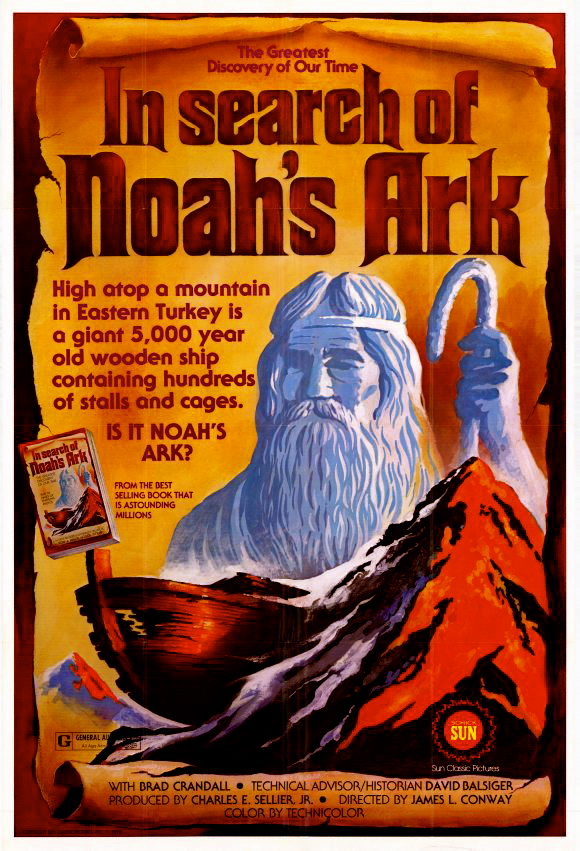
BOOTLEG FILES 945: “In Search of Noah’s Ark” (1976 nonfiction feature from Sunn Classics).
LAST SEEN: On YouTube.
AMERICAN HOME VIDEO: Three different VHS video releases.
REASON FOR BOOTLEG STATUS: Out of circulation for many years.
CHANCES OF SEEING A COMMERCIAL DVD RELEASE: None.
If you were going to the movies back in the 1970s, you must remember Sunn Classic Pictures, also known as Schick Sunn Classics. This small Utah company happily littered movie theaters in with films that promised to unlock the secrets of cryptozoology, paranormal activity, historical conspiracies and the more opaque corners of Biblical text. Each film produced by this Utah-based company was distributed with a blaring, carny-worthy marketing campaign that saturated local television stations and newspapers with bombastic advertisements that greatly exaggerated the depth and scope of the presentations. The company also four-walled the theaters where their films played, thus giving them a generous share of the box office.
The 1976 “In Search of Noah’s Ark” was one of the company’s most financially successful releases, bringing in $55.7 million from North American theaters – and that was a damn good haul for a time when ticket prices averaged around $2.00. Sadly, “In Search of Noah’s Ark” was not only one of the company’s worst films, it was also among the most boring nonfiction feature films that I’ve ever seen. I hate to say that I started to doze off while watching it.
Please note: I am calling this a “nonfiction film” instead of a “documentary” because too many of the alleged facts in this production are either incorrect or heavily skewed to push an agenda.
“In Search of Noah’s Ark” was based on a book by David W. Balsiger and Charles E. Sellier Jr. that insisted the legendary vessel described in the Book of Genesis was intact atop Mount Ararat in Turkey. In fairness, this is not a hare-brained idea – as far back as the fourth century, there were theories about Noah’s Ark surviving atop this great peak.
However, the problem with the film is that it insists that the Bible is an irrefutable historical text, which means that the tale of Noah and his ark must be accurate. Yet the film’s depiction of the ark seems to contradict that notion.
The most entertaining part of “In Search of Noah’s Ark” (albeit from the point of unintentional humor) shows Noah and his family building the ark and bringing aboard its animal passenger list. We never see the grand parade of the planet’s wilderness arriving in pairs, but instead we get a scraggly number of animals coming in one at a time. There are a few animals that were not native to Noah’s domain in present-day Iraq, including a racoon, a brown bear, and a chimpanzee. The latter animal is used for comic relief in rounding up the chickens for the ark and later slapping dough for the human crew’s gluten fix.
While the ark is being built, the film presents a small number of Noah’s neighbors who stand around and laugh uproariously at Noah and his family. Clearly, these people had no jobs, no meals to prepare, no homes to attend, and no hobbies.
The film admits that flood legends similar to Noah’s tale exist in other cultures. But it doesn’t mention that “The Epic of Gilgamesh” had a near-identical legend that preceded the story of Noah and might have inspired it.
“In Search of Noah’s Ark” insists that the Great Flood of Genesis must have occurred because fossilized oceanic sediment has been found amid mountain peaks. But, of course, that doesn’t prove the sediment found its way up the mountains because God flooded the planet.
Indeed, proof is in very short supply in this film. Tales of explorers and curiosity seekers who ventured up Mount Ararat to find (and, in one case, walk upon) Noah’s Ark have no serious confirmation. And some anecdotes, such as Russian aviators flying over Mount Ararat in 1917 and confirming the ark’s presence, have been widely dismissed as phony.
The film tries to drive home its points with a series of interviews with experts on the subject. But by the closing credits, it is obvious no one has produced any photographic or confirmed physical evidence that Noah’s Ark is atop Mount Ararat.
“In Search of Noah’s Ark” is not helped by having one-time New York disc jockey Brad Crandall as the on-screen narrator. A professorial individual with a heavy beard, dark rimmed glasses and stentorian voice, Crandall looks the part of a serious narrator. Unfortunately, he is a dull physical and vocal presence. He steamrolls through the narration with nary a nuance to his recitation. Indeed, it is a shame the producers couldn’t have coughed up a few more buck to have Orson Welles as the film’s host – he was genial on-screen ham and had the vocal gift of creating alchemy with leaden narrative text.
“In Search of Noah’s Ark” was the subject of a VHS video release on three different labels, but to date a commercial DVD/Blu-ray has not occurred. Copies of the film are available in unauthorized YouTube uploads, but a fully restored digital home entertainment release is probably as elusive as Noah’s Ark itself.
IMPORTANT NOTICE: While this weekly column acknowledges the presence of rare film and television productions through the so-called collector-to-collector market, this should not be seen as encouraging or condoning the unauthorized duplication and distribution of copyright-protected material, either through DVDs or Blu-ray discs or through postings on Internet video sites.
Listen to Phil Hall’s award-winning podcast “The Online Movie Show with Phil Hall” on SoundCloud and his radio show “Nutmeg Chatter” on WAPJ-FM in Torrington, Connecticut, with a new episode every Sunday. You can also follow his book reviews at The Epoch Times.
Not too long ago, they released the Sunn Classics movie The Lincoln Conspiracy on Blu Ray, so there is a chance this Sunn Classics movie will get a disc release.
Sunn Classics would four-wall the theaters for two weeks, but their print and TV ads screamed “ONE WEEK ONLY!” The idea was to gin up enough audience reaction so after a few days the new ads said “HELD OVER BY POPULAR DEMAND!” for people who had been on the fence.