
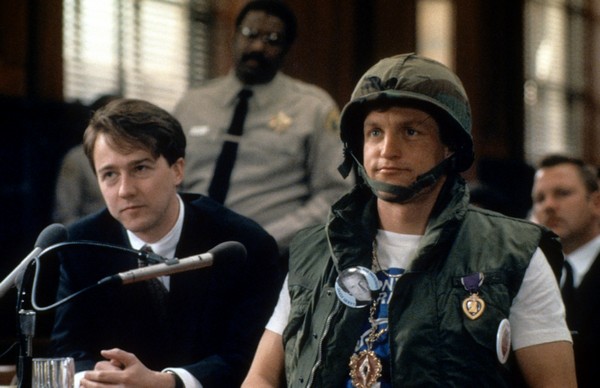
 The People vs. Larry Flynt, directed by Miloš Forman, traces the life of the Hustler founder and his defense of the First Amendment. The wonderful and engaging biopic is now available in 4k UHD from Arrow Video.
At first glance, Larry Flynt is an odd choice to give the biopic treatment: that being The People Vs. Larry Flynt, as directed by Milos Forman and written by Scott Alexander & Larry Karaszewski. But it’s soon clear why. In real life, and especially as played by Woody Harrelson, is a wild man: big, loud, raucous. A total character of a person. He careens through his life, working on whims, purposely pushing buttons, and ruffling feathers. He’s a man with no filter, but uses that lack of tact in wondrous ways. Born into poverty in Kentucky, he grew up to host a series of strip clubs (with a little extra on the side) and fell into peddling pornography and the issues that arose from it across the 60s until his death in 2021 (this film covers up to about 1988 or so). Starting as a newsletter sort of ting for Hustler clubs, the distrubuted nudie pictures soon took off attracting the attentions of people wanting to see boobs and bush (though he had to wait for that, as much as he pushed) and people mad other people want to see boobs and bush and trying to stop him such as various “Christian” groups, people he focuses upon, and other uptight prudes. He’s a tornado of anarchy: the Joker if he was a magazine publisher.
The core of the film, and the underlying power that separates it from much of the genre, is the court battles throughout. Not just the battles but what he and the film have to say about freedom of speech, the religious right, hypocrisy, and whose job it is to police so-called morality. Whether it be from selling a magazine in a store, to not revealing a source of a video (courtesy of a Norm MacDonald cameo), and more, Flynt is in and out of court and jail. It’s done with incredible gusto, giving life to the proceedings, with Harrelson’s Flynn playing very well against an early-career Edward Norton as his level-headed lawyer, Isaacson (an amalgamation of several real-life lawyers for ease of storytelling). Funny enough, the main court case, the one that makes up the back part of the film, isn’t about pornography at all, but about parody and libel laws. A fake ad about Jerry Falwell, played with uncanny exactitude by Richard Paul, gets the most hot water.
The court and the discussions of freedom, the First Amendment, censorship, so-called obscenity, and all give the depth, but the personalities involved are the icing. Woody Harrelson is pitch-perfect casting, coming hot off Natural Born Killers, directed by Oliver Stone, who produced this, and gives a firebrand, Oscar-nominated performance (he lost to Geoffrey Rush in Shine). With him are a series of great character performers, including Vincent Schiavelli, Crispin Glover, his real-life brother Brett, to play Flynt’s brother who is a non-actor but damned you wouldn’t know it, James Cromwell, James Carville, and a wonderfully strange Donna Hanover as President Carter’s sister Ruth, who had an unlikely friendship with Flynt. But the film’s hidden weapon, well, less hidden but more unexpected, is Courtney Love as Althea, Flynt’s wife and right-hand-woman. She’s legitimately great, giving a full-power role that could have easily reached caricature, telling a film filled with people who themselves were nearly caricature.
Writers Scott Alexander and Larry Karaszewski made the standard biopic into something else, previously elevating it for Tim Burton’s Ed Wood (his best movie) with a wonderful sense of comic timing and storytelling. Larry Flynt finds the same spirit. Their biopics never feel like point-for-point Wikipedia retellings but rather fully enveloping pictures, avoiding the clichés and telling stories with truth, great lines, character depth, and vim. Funny enough, they wrote the original Problem Child (although it was neutered and shifted by the production from their original darker script); so a Problem Adult is right up their alley. (Side props for their writing of the Better Than It Needed to Be Goosebumps adaptation). Of course, Larry himself gives them so much material to work with: the stunts, the largeness of his personality, and him and everyone around him. Forman, who excels with Big Personality and Big Cast Dramas in One Flew Over the Cuckoo’s Nest, Man on the Moon (aka Jim Carrey is an Ass to Everyone: The Movie) and Amadeus, reins it in for a layered film, controlled in all the big moving pieces. It’s a discussion of a film, finding a sweet spot where it’s less about defending Flynt’s actions themselves and more about the right to do them. It’s a measure. No wonder he was also nominated for best director (lost to The English Patient).
The People Vs Larry Flynt is simply a fantastic feature with a heck of a subject at the center, told incredibly well, with a nudie mag full of great performances.
The Packaging
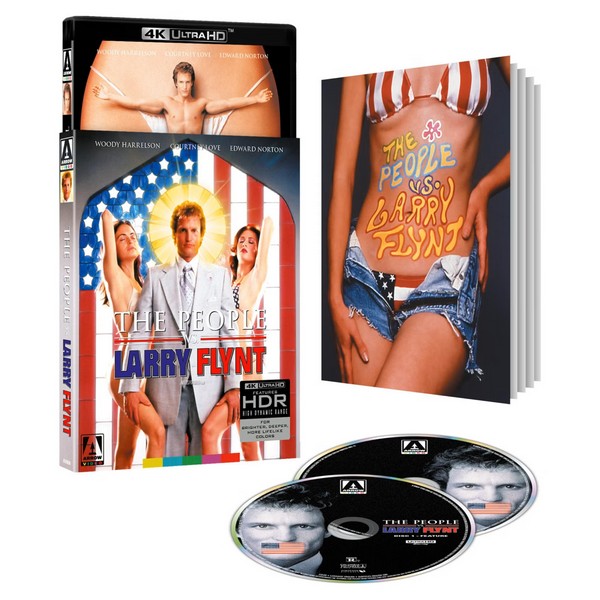
Arrow releases The People v. Larry Flynt as a two-disc set. The 4 K UHD includes the film and some features, while the Blu-ray includes only features. No Blu-ray of the film, sorry. Both discs feature Harrelson’s face with the Flag muzzle and the title; one is reversed from the other. In the black 4k case is also a booklet. The sleeve is reversible, with two sets of original posters. It also has an O-ring sleeve with a poster image.
The Presentation
Arrow gives a 4k scan of the film and, as is the case, it looks amazing. In Dolby Vision, the details stand out, and the depth comes through. Audio is the original stereo and 5.1. In English with English subtitles.
The Features.
Arrow puts together a great package, porting over everything from the previous editions and adding a few new interviews. In a great touch, so much is about the film’s overall message rather than the filmmaking itself. There’s so much; one disc is only features, not something they tend to do.
Disc 1 contains:
Commentaries (both from 2003)
1: Scott Alexander and Larry Karaszewski get into the details of their careers and how they developed this after Ed Wood, working from the ground up. Fascinating, with fewer resources than now (or in 2003), and they had to learn and work around it; it became a new ballgame that Flynt himself got involved. The pair speak well and are funny, with so many great anecdotes. It’s also nice to hear how much the studio believed in them and assisted.
2: This is one of the sorts that’s more of a scene-specific cut-together, featuring Woody Harellson, Courteney Love, and Edward Norton talking during some of their scenes. It’s a little sparser and more direct to the moment than the others. They share fine anecdotes, especially Harellson and his Flynt stories. Good to hear their processes and memories of the film.
Disc 2:
Hail Larry! (new)
Woody Harrelson, as noted above, is one heck of a character himself and leans into it with the public persona. So he brings his wild A-game to reminiscing about this film, working with Forman and Love partially, and the stories of Flynt himself. (27m)
Satire in Satin (new)
Lisa Henson and Janet Yang converse together about the trials and tribulations of getting the film under way, since there would be expected backlash of biopicing a brash pornographer. So for this we get a lot of the background movements of production. Love the stories of Flynt and Fallwell hooking up to promote it, almost derailing the release in its own weird way. (30m)
Only in America (new)
Screenwriters Scott Alexander and Larry Karaszewski reminisce about the film and its impact, and about their careers since. It does repeat much from the commentary, but that’s to be expected. They are great to listen to. (28)
À la lumière de l’evidence (archival)
A very frank and direct Philippe Roselot talks about Forman and the process of working on this film in America with a style he’s not used to (this is touched on in the commentaries too). Fantastic insight. (30m)
Charlie Rose Show (1997)
Milos Forman on the show gets into the gritty details about the subject, free speech, and responds to Gloria Steinem’s railing against it (including clips of her appearance). Especially interesting as this is one of the few times Forman himself gets to talk about the film on the disc. (22m)
Free Speech or Porn? (1996)
A solid EPK from the release. Like noted above, much about the validity of Flynt as a subject and how the film approaches it, along with the standard talking heads of “sell th movie.” Smartly done. (30m)
Larry Flint Exposed (1997)
Dennis Hopper! Hell yes. Hopper narrates this awesome look at Flynt himself and life and controversies. (30m)
Deleted Scenes
Two, 5 minutes total including commentaries. One is about Flynt’s run for President and the other shows his parents a replica of their old home.
TV Spots –
Six bits, totaling 12 minutes. A few are TV spots for the film, but a great add-in is including Flynt’s actual ads from one of his many political runs. (12m)
Promotional gallery
-158 images from the film
-63 Behind-the-scene photos
– A four-page treatment for Oliver Stone
-THE WHOLE FREAKIN’ SCREENPLAY. I didn’t read it, but that’s cool. (it’s 147 pages BTW)
Booklet
A 44-page bound booklet. The norms: production info, cast/crew, BTS shots, production photos, and posters. The specials: 1) Introduction by Scott Alexander & Larry Karaszewski. Excerpt from their book The Shooting Script: The People vs. Larry Flynt (1996). It’s a wonderful introduction to their approaches to this idea and the fascinating design for hitting the tone. A great approach and look at the process. 2) Peddling Smut or Promoting Freedom by Andreas Halskov explores how this film fits within Forman’s oeuvre, the troubles of making the film, and the response to it. 3: Interview with Milos Forman by Adam Davidson is also from the 1996 script book. Here Forman talks about the script, working it as a biopic, and how it’s a political picture. It’s important to note, although I haven’t until now, Forman’s history of escaping the Iron Curtain after surviving WWII and that informs how he approaches personal freedom, in life and as it relates the film.
Final Thoughts
The People Vs Larry Flynt is an astounding film, with depth and character. Arrow gives it a great treatment with a beautiful transfer and a whole slew of special features. As an attention seeker, Flynt would be glad for everything lavished upon Miloš Forman’s presentation of his life