
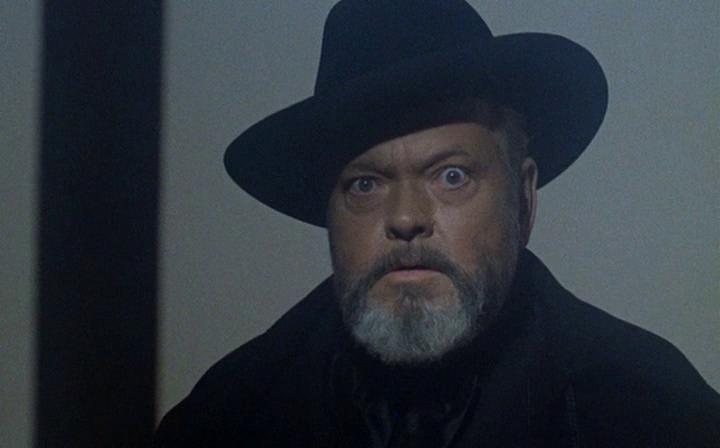
BOOTLEG FILES 593: “Orson Welles’ Frozen Peas” (1970 audio outtakes of Orson Welles’ tumultuous recording of a series of British TV advertisements).
LAST SEEN: It is on YouTube.
AMERICAN HOME VIDEO: Various tributes to the recordings are on a several home entertainment releases.
REASON FOR BOOTLEG STATUS: These were never supposed to be publicly released.
CHANCES OF SEEING A COMMERCIAL DVD RELEASE: Maybe as a special feature.
Orson Welles is revered today as one of the most innovative and daring artists to work in the cinematic arts. During his lifetime, however, Welles often struggled to gain the respect of his peers whenever he sought funding for his film projects. Having been burned on several occasions by dubious financial backers and business partners, Welles often sought to self-fund his projects. As a result, he appeared in too many film and television projects that were far beneath his talents just for the sake of getting extra money to keep his dreams alive.
In 1970, Welles was hired by the J. Walter Thompson advertising agency to go into a recording studio and narrate a series of British television commercials produced on behalf of the Findus brand of frozen foods. It is not certain whether Welles came to work in a supremely bad mood or whether he was astonished to find himself in an endeavor that he viewed as significant. In any event, Welles roared through the recording session with a mix of bafflement, angst and emotional exhaustion – and it was all captured on audio tape.
It appeared that Welles was cold-reading his script while the footage of the commercial was being broadcast on a screen – and this may have been the start of the problems. The first commercial was for Findus Frozen Peas, and it showed a Lincolnshire farm inexplicably covered in snow during the summer.
“We know a remote farm in Lincolnshire, where Mrs. Buckley lives,” Welles says in his narration. “Every July, peas grow there.” At this point, Welles stops and asks the session’s director, “Do you really mean that?” The director answers, “Uh, yes, so in other words, I–I–I’d start half a second later.” To which Welles responds, “Don’t you think you really want to say ‘July’ over the snow? Isn’t that the fun of it?”
Welles tries again, and the second take is even more difficult than the first. From the audio transcript:
Orson Welles: We aren’t even in the fields, you see? We’re talking about them growing and she’s picked them. What?
Director: …in July.
Orson Welles: I don’t understand you, then. When must–what must be over for “July”?
Director: Uh, when we get out of that snowy field.
Orson Welles: Well, I was out! We were onto a can of peas, a big dish of peas when I said, “In July.”
A second voice – we don’t know if this is another director or a producer or sound engineer – asks Welles to emphasize the “in” in “in July.” And that was the match in the fuel tank. “Why?” bellowed Welles. “That doesn’t make any sense. Sorry. There’s no known way of saying an English sentence in which you begin a sentence with ‘in’ and emphasize it. Get me a jury and show me how you can say ‘in July’ and I’ll… go down on you. That’s just idiotic, if you’ll forgive me by saying so.” Welles later grumbles about the “bad copy,” adding that “there’s too much directing around here.”
From there, Welles and his collaborators attempt to record the narration for a commercial highlighting Findus’ frozen fish. The results are no better than the frozen peas effort.
Orson Welles: “We know a certain fjord in Norway, near where the cod gather in great shoals. There, Jan Stan–, Stangdilan”…shit!
Director: A fraction more on the–on that shoals thing, ’cause you rolled it round very nicely.
Orson Welles: Yeah, roll it round and I have no more time. You don’t know what I’m up against. Because it’s full of–of–of things that are only correct because they’re grammatical, but they’re tough on the ear. You see, this is a very wearying one, it’s unpleasant to read. Unrewarding. “Because Findus freeze the cod at sea and then add a crumb, crisp…” ooh, “crumb, crisp coating.”
To his credit, Welles insists that “crumb, crisp coating” is not “conversationally written,” so the director agrees to remove “crumb.”
In a third commercial, Welles prefixes his narration “under protest” and then “We know a little place in the American Far West, where Charlie Briggs chops up the finest prairie-fed beef and tastes…This is a lot of shit, you know that?” he complains.
When the director argues that Welles emphasizes “prairie-fed” rather than “beef,” he replies, “But you can’t emphasize beef” – that’s like he’s wanting me to emphasize ‘in’ before ‘July.’ Come on, fellas, you’re losing your heads! I wouldn’t direct any living actor like this in Shakespeare! Will you do this? It’s impossible!”
And then comes the final showdown:
Orson Welles: The right reading for this is the one I’m giving it!
Director: For the moment.
Orson Welles: I spent… twenty times more for you people than any other commercial I’ve ever made. You are such pests! Now, what is it you want?
Director: Now, I think…
Orson Welles: In your depths of your ignorance, what is it you want? Whatever it is you want, I can’t deliver it because I just don’t see it.
Director: That was absolutely fine, it really was.
Orson Welles: Here, you… (crumples script, stands up) This isn’t worth it. No money is worth listening to…
From there, Welles angrily exits the studio. It is uncertain whether any of his narration ever made it to the three commercials, but the tape of the ill-fated session was preserved. Over the years, it circulated through bootleg audio channels and became known as “Frozen Peas,” in honor of Mrs. Buckley’s July wintertime crop. The first major parody of the recording was an “SCTV” spoof with John Candy as Welles, and other spoofs were seen in a “Pinky and a Brain” episode and the animated series “The Critic.” An animated recreation of the doomed session is a popular YouTube video, while the standalone audio is also all over YouTube.
Of course, there is no likelihood that roughly four minutes of audio outtakes would qualify for a standalone DVD release, but maybe someday the “Frozen Peas” recording will turn up as a special feature on a Welles release. Hey, if “The Other Side of the Wind” ever gets a DVD send-off, that would be a perfect bit of fun to add to the disc!
IMPORTANT NOTICE: While this weekly column acknowledges the presence of rare film and television productions through the so-called collector-to-collector market, this should not be seen as encouraging or condoning the unauthorized duplication and distribution of copyright-protected material, either through DVDs or Blu-ray discs or through postings on Internet video sites.
Listen to “The Online Movie Show with Phil Hall” on SoundCloud.
Maurice LaMarche’s imitation of Orson Welles in “The Critic” is so absolutely brilliant and hilarious.