
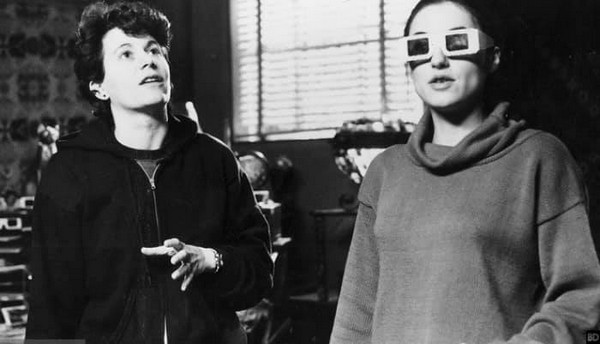
Rachel Talalay may not be a household name, but her work touches down on a lot of familiar territory. She’s directed episodes from such shows as Supernatural, The Chilling Adventures of Sabrina, Superman & Lois, and even Doctor Who. She also happens to be one of my favorite directors thanks to her work on 1995’s Tank Girl, a comic book adaptation that continues to stand the test of time. But we’re not here to swoon over Rachel’s catalog of pop culture gold. Today I’m here to talk to you about the time Rachel Talalay killed a dream demon in 1991’s Freddy’s Dead: The Final Nightmare.
Teaming up with Wes Craven and Michael De Luca, Rachel co-wrote the script and directed the very last installment of the Nightmare on Elm Street franchise. Future Krueger outings would see him taking on the real world, or crossing paths with Jason Voorhees, who was killed off in his own franchise in 1993’s Jason Goes to Hell: The Final Friday. At the time, 1991’s Nightmare installment didn’t have its sights set on the future. It was the last chapter in a wildly whimsical slasher series that dominated the 1980’s and won the hearts of horror fans for decades to come. It was no easy task. Beyond that, New Line Cinema insisted that the film feature a climax shot in 3D. This proved to be more of a nuisance that a charming addition to the film.
“The end of Freddy is really a problem, I mean not only the question of how do you kill Freddy? But also the fact they made me shoot it in 3D. Because, to me, what could have been really cool in killing Freddy would have been if you could have made this really fantastic effects sequence, but I was limited in shooting 3D.”, Rachel Talalay said when interviewed shortly after the film’s release.
Talalay didn’t mince words when it came how she felt about Freddy’s Dead. In her brief interview found on the blu-ray release for the film she called the 3D effects lame and despised how they looked on any home release. It should be said, that my box set of A Nightmare on Elm Street films doesn’t include the option to see the final act in 3D. Objects, creatures, and scenery float toward, and around, the camera with no real rhyme or reason. But this isn’t Rachel’s fault, and she knows that.
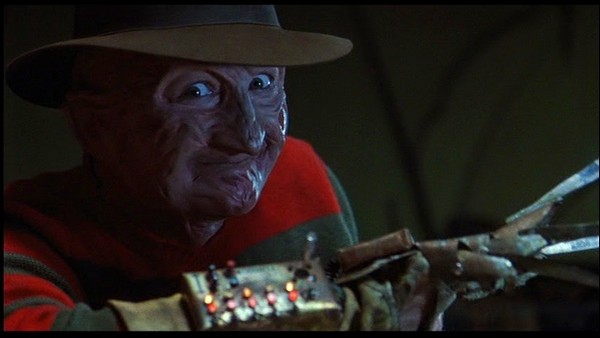
The movie appropriately opens up with a quote about sleep by Friedrick Nietzsche but before audiences could fully appreciate the high brow addition, they’re hit with another quote that reads, “Welcome to prime time, bitch.” Which is, of course, credited to Freddy Krueger. From there, the movie immediately feels like a fever dream, and rarely lets up. While not nearly as dark as the earlier installments, Freddy’s dead delivers enough cartoon-like mayhem to entertain any horror fan for its run time. Screen gags range from a Wizard of Oz reference to a kill made with a custom Power Glove, the infamous wearable controller for the NES entertainment system. …It’s so bad. But in that late 80’s, early 90’s, way.
Despite being unamused with the effects, and even the use of Freddy’s glove to slay him… Rachel wasn’t entirely put off by the project. In fact, she contributed the most defining lore A Nightmare on Elm Street had received since the infamous pilot episode of Freddy’s Nightmares, an anthology series that opened up with Krueger’s criminal trial. Freddy’s Dead explores Krueger’s life as a married man, introduces audiences to his daughter, and shows a brief pact made with demons in his final hour. Prior to these scenes, audiences believed Krueger to be nothing more than a lonely child killer, slain by angry citizens, and revived by their nightmares. This is where Rachel got the most from working on the project. By exploring his back story, audiences see why he’s seemingly unstoppable, and who might be able to break that trend.
Viewers can look forward to seeing familiar faces during this “final” outing. Johnny Depp has a blink-and-you-miss-it appearance that shows the ill-fate of his character from the first film, falling victim to a frying pan in a scene lampooning the “this is your brain on drugs” PSA’s of the era. However, the star of the show is still Robert Englund, who thought this was his last outing as Krueger.
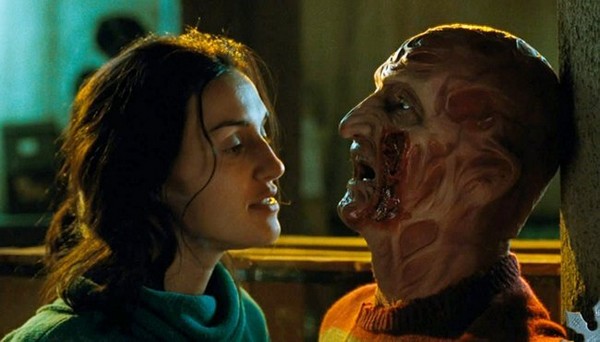 Accidentally assuming that Freddy Krueger is his father, one of the disposable teens of our story inadvertently returns his adult daughter, Maggie, to him. Which ends up being Krueger’s downfall. Where Freddy lived his life tormenting and killing children, his daughter has taken on a career of rehabilitating wayward teens. Where he’s predatory, she’s a defender. Determined to protect the kids under her care, Maggie gets pulled into Springwood, where she’s forced into taking on the gloved lunatic in a battle to the death.
When the film’s campy it scratches the horror-comedy itch just right. When the visuals need to be bombastic, they’re properly over-the-top. Occasionally we need to be reminded that this is, in fact, a horror movie. The occasional spine-chilling visuals ground us. Be it a television pouring blood like it belongs in the lobby of the Overlook Hotel, or a disgusting representation of a lustful “father”… Rachel Talalay doesn’t let the audience get too comfortable. However, the film is nothing if not fun.
It’s safe to say, Rachael Talalay’s work on Freddy’s Dead fit the overall narrative, expanded the lore to new heights, and ended the franchise’s legacy on an “up note”. Talalay would move on to direct Ghost in the Machine just two years later, showing that her love for horror didn’t stop with Krueger.