
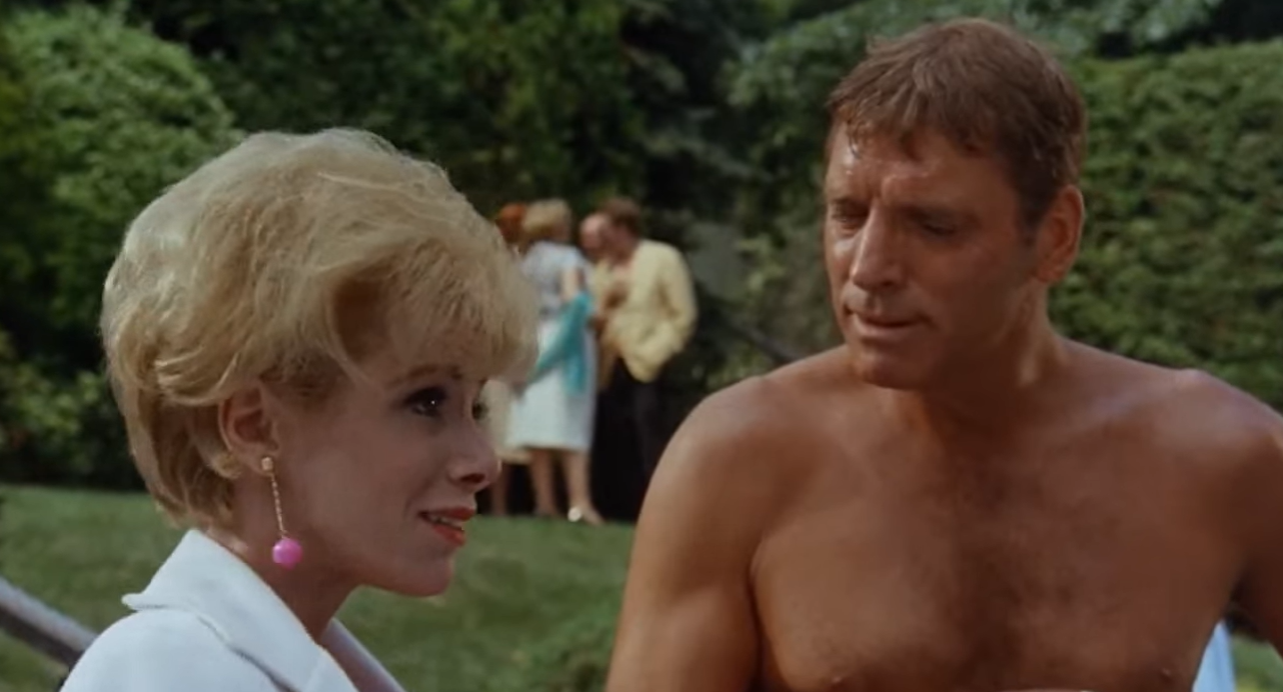
It’s a shame that “The Twilight Zone” ended its television run just before John Cheever’s short story “The Swimmer” appeared in The New Yorker – Rod Serling’s half-hour anthology drama would have been a perfect environment for adapting Cheever’s surreal and disturbing 12-page tale. Instead, the husband-and-wife team of Frank and Eleanor Perry opted to greatly expand the Cheever story into a feature-length film. The result was the cinematic equivalent of building a three-story home on a one-story foundation.
“The Swimmer” opens on a Sunday summer morning in Connecticut’s ritzy Gold Coast, where Ned Merrill inexplicably emerges from the woods surrounding the estate of old friends. Ned is only clad in swimming trunks – it is not explained why he was in the woods wearing next to nothing. Ned surveys the landscape and realizes the trajectory back to his home can be traced through a series of backyard pools on the neighboring estates. Dubbing this line of pools the “Lucinda River” after his wife, he decides to swim his way back home, pool by pool.
Ned is initially greeted was friendliness in the stops along with way, but as his journey progresses there is growing agitation and displeasure at his presence. When he comes closer to his home, the poolside denizens become more hostile when he shows up. Even worse, his neighbors cite unpleasant incidents in his personal and professional life that he cannot recall. Ned views himself as a successful professional and family man, but everyone else has a different experience regarding his behavior – yet Ned is never able to grasp that he is viewed as a failure or that his wife and daughter will not be waiting for him once he finally returns home.
To the film’s credit, Burt Lancaster is perfectly cast as Ned. His odd charm and declamatory line readings capture Ned’s peculiar mental state, while his fit and trim body makes him the ideal candidate for playing a middle-aged man who retained the physique of his youth.
But unlike its leading man, “The Swimmer” is a flabby film. A good 15 to 20 minutes could have easily been cut – scenes drag on for too long and new segments invented for the film, including Ned impulsively racing against a horse in a paddock and his encounter with a lonely boy whose family pool is drained, don’t fit into the story. Much of the beauty of the Cheever story was the writer’s minimal yet intelligent use of dialogue – conversation is quick and to the point – but in the film the characters never know when to shut up. Also missing from the film was Cheever’s brilliant imagery of Ned’s warm summer day slowly but lethally turning into the chill of autumn – the film gives Ned the best of summer until the final scene, which is so meteorologically extreme that it feels like it belongs to another movie.
Much of the problem with “The Swimmer” could be traced to the production, where Lancaster and director Frank Perry were constantly at odds with each other. Joan Rivers, who had a brief appearance as a pool party guest seduced by Lancaster, recalled that Perry gave her specific direction for her scene while Lancaster would take her aside and try to direct her to play the part differently. Producer Sam Spiegel fired Perry and hired Sydney Pollack to finish the project, which involved recasting some actors and reshooting scenes with the new talent. This might explain why the film often feels raggedy and patchwork when it should be smooth and focused. Spiegel realized the finished product had problems, as he removed his name from the credits.
“The Swimmer” was a commercial flop when it was released in 1968, although critics were mostly supportive. Over the years, it gained an enthusiastic and worshipful cult following – and that makes any unsupportive opinions of the work seem as futile and foolish as Ned’s long swim home.
Oh, for those who only know the film and not its source, here is Cheever’s story: https://loa-shared.s3.us-west-2.amazonaws.com/static/pdf/Cheever_Swimmer.pdf