
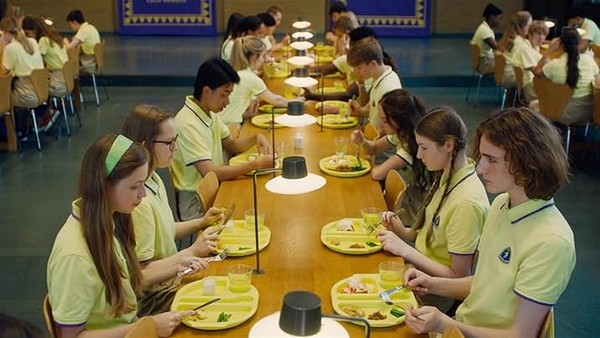
 Currently available on the streaming subscription service Film Movement Plus.
A classroom experiment that seems harmless at first gradually turns sinister, becoming a quiet slide into control, obsession, and disturbing beliefs.
Directed by Jessica Hausner and co-written with Géraldine Bajard, Club Zero blends satire, psychological horror, and biting social commentary into a slow-burning, quietly disturbing experience. Set in the sterile halls of an elite international boarding school, the film unfolds with eerie restraint as it examines our collective anxieties around food, consumerism, and the blind pursuit of belonging. With Hausner’s signature clinical style and a hauntingly controlled performance by Mia Wasikowska at its center, Club Zero becomes a hypnotic parable on the dangers of groupthink, and the convincing manipulative leaders who herd us there.
Miss Novak, played with icy precision by Mia Wasikowska, a new teacher whose lessons on “conscious eating” evolve into something far more extreme. Her affect is calm, almost maternal, but her ideological grip tightens subtly with each passing scene. Early on, Novak’s class appears to be about mindfulness, eating with intention, and reducing consumption, but as her rhetoric grows more dogmatic and controlling, her students’ physical and psychological decline becomes impossible to ignore. Wasikowska leans into quiet menace, embodying a teacher whose unwavering belief in her mission creates an abuse of power and authority.
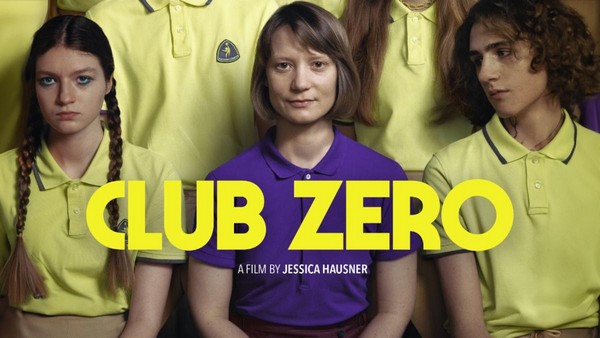
Visually, the film is dull and restrained, mirroring the emotional suppression within its characters. Hausner and cinematographer Martin Gschlacht employ faded colors and static shots, which makes the unfolding events all the more unsettling. Even the school itself feels sterile and impersonal, a backdrop that amplifies the characters’ emotional isolation and dependence on Novak’s approval. This deliberate visual minimalism mirrors the themes of uncertainty and discomfort.
The young cast, particularly Ksenia Devriendt as Elsa, shines as the impressionable students who fall under Novak’s spell. Elsa’s arc is quietly devastating. Her wide-eyed devotion, denial, and eventual complicity are rendered with heartbreaking believability. These teens are not caricatures; they are vulnerable, well-meaning, and desperate to belong. And that’s what makes the story so unsettling: the horror here isn’t loud or grotesque, but rooted in the ordinary ways manipulation can creep in when we’re looking for structure, for purpose, for control in an unpredictable world. Club Zero doesn’t hit viewers over the head with exposition or moral lessons. Instead, it lets the cringiness build organically.
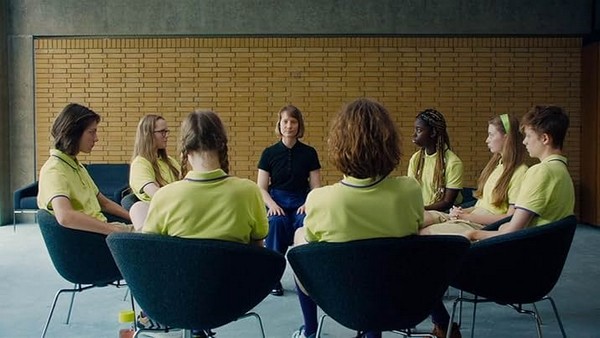
The pacing is methodical, and the dialogue is purposefully stilted, mirroring the emotional disconnection at play. There are moments of surrealism, audacious sequences that flirt with horrific, disturbing images, but they’re treated with the same deadpan tone as the rest of the film, forcing the viewer to sit in their discomfort without release. Long silences, awkward pauses, and ambient soundscapes carry as much weight as any spoken word, creating a kind of atmospheric tension. The audience, like the students, finds itself lulled into a state of suspended discomfort.
Club Zero doesn’t spell out its critique of food culture, wellness obsession, or performative environmentalism; instead, it uses Novak’s cult like ideology as a mirror to examine how good intentions can become toxic when left unchecked. It’s a film that provokes and pushes limits with false rhetoric to a gullible population. While it may not appeal to audiences craving conventional thrills or emotional catharsis, Club Zero rewards viewers willing to sit in ambiguity. It’s an intelligent, disturbing reflection on how quickly influence becomes indoctrination, and how easily we mistake restriction for righteousness. Like all great cult stories, it leaves you asking: Would I have seen the signs? Or how did the parents allow this to go on so long?