
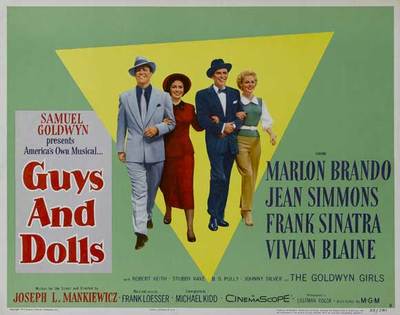
“Guys and Dolls” is a film at odds with itself. Most of the footage is a pleasant distraction when it should be an invigorating entertainment, and the peak moments are strangely few and far between. At two-and-a-half hours, it constantly runs the risk of wearing out its welcome. And by the closing credits, it leaves the viewer serenely amused rather than knocked out by the greatness it should have achieved.
From a style viewpoint, there are two films going on. The depiction of New York’s Times Square is blatantly stagey, giving the impression of a filmed played, while other sequences – particularly the detour to Havana – give the impression of real life rather than the proscenium-framed version. Complicating matters was a strenuously reworking of the source material to accommodate Marlon Brando as Sky Masterson and Frank Sinatra as Nathan Detroit. Brando was no song-and-dance man, so several of the character’s musical numbers in the stage production were scrapped. And Sinatra was no one’s idea of a bumbling New York Jewish second banana, so his role was expanded and reconceived while he gained more time for on-screen singing.
The unlikely casting could be blamed on producer Samuel Goldwyn, who wanted Brando’s box office draw despite his lack of musical experience, which is obvious. But Goldwyn didn’t want Sam Levene, the character actor who originated the Nathan Detroit role on Broadway, illogically arguing to director Joseph L. Mankiewicz that “you can’t have a Jew playing a Jew, it wouldn’t work on screen.” More likely, Goldwyn believed Sinatra’s presence would double the box office on “Guys and Dolls” – and he was right, as the film was a major commercial success.
Further confusing the situation was giving the directing duties to Mankiewicz, a two-time Oscar-winning director who never helmed a musical before. Outside of the lively and imaginative opening segment with Michael Kidd’s frenetically choreographed interpretation of a typical day in Times Square, most of Mankiewicz’s direction is flat and observational. He also has trouble calibrating the performances of the leading ladies, with Jean Simmons (as the object of Brando’s affection) coming across as flat while Vivian Blaine (recreating her Broadway role as the too-patient fiancé of Nathan Detroit who has been waiting 14 years for their wedding) playing the part as if she was still on the stage selling the show to the last row of the balcony.
The only time “Guys and Dolls” soars comes near the film’s end, when Stubby Kaye’s character Nicely-Nicely Johnson – up until then, a peripheral figure to story – suddenly steps forward in the climactic mission house prayer scene to deliver “Sit Down, You’re Rockin’ the Boat.” Kaye, who also repeated his Broadway role, make a subtle use of his rotund body language and his character’s sympathetic mien to launch into the song’s religious-fueled imagery of an unrepentant gambler and hedonist coming to a too-late realization of his reckless behavior. It is a startling presentation that steals the show – even Sinatra recognized it, staying in the background amid the extras while Kaye took the spotlight for his late chance to shine. The segment is sharp, funny, stylish and surprising, keeping in spirit to raffish Damon Runyon humor that inspired the musical. It’s a shame that the rest of “Guys and Dolls” never matched that brief burst of energy.