
 An unemployed family man decides he has No Other Choice but to remove his job competition by any means necessary in Park Chan-Wook’s searing black comedy thriller, based on the novel by Donald E. Westlake.
In Donald E. Westlake’s 1997 novel, an unemployed man kills seven competitors for the same job. A simple, but enticing, premise, and from what I know of the book, pretty straightforward to that; good but direct. But look at the director. Park Chan-Wook has previously written (as co-writer or adapter of novels) and directed Old Boy, Sympathy for Mr. Vengeance, Decision to Leave, and his best film, The Handmaiden (I’m also a big fan of the underappreciated director-only Stoker). He’s been trying to adapt it since reading the book over twenty years ago (it was previously adapted in 2005 by Costa-Gavras). However, he makes the basic premise entirely his own, twisting it into a profound metaphor of life, presenting twists and shifts in scenario, discussion, and depth.
No Other Choice is a devastatingly bleak, dark comedy thriller that explores the perils of capitalism and the struggle to fight through them, no matter how one may. Despite the nearly 30 years since publication, the novel’s heart, the terrible corporate culture of profits over people, leaves so many in the lurch, forcing terrible decisions for the layperson while the suits run away. All the more prescient with the rich and powerful trying to replace the workforce with misused AI, cutting healthcare, pay rates, and let’s not even think about private equity firms throwing wrenches into the whole thing. No Other Choice might be a Korean film, but the core of why it works so well is applicable across cultures and continents. No matter where, we’re all cogs in the money machine. All the more sadder is the story, and life, makes the cogs fight one another instead of the machine they should be raging against.
Man-Su is a 25-year veteran middle manager at a paper factory, celebrated with many awards (as he’ll tell you). New American owners force him to cut a portion of the workforce, and then he gets the ax as well, pushing his family to the edge, and thus to the extreme extent to clear the path to a job. It’s said that in 3 months, they’ll lose everything. Stretching out for over a year (with sacrifices as needed, including demeaning jobs where a simple request means being fired, stripped from the uniform, and forced to leave in tighty-whities) when it reaches breaking point, it’s familiar to anyone paying attention. A teenage son, Ri-one, is tempted to burglary to get by (as so many in real life are for resources), and a neurodivergent daughter, Si-one, is a brilliant cellist but needs more expensive lessons to level up (so much brilliance is lost to lack of resources for the genius). In a funny touch, their pair of dogs (which have to be taken care of by others for cost saving) are named Ri-two and Si-two. Sacrifices are made to hold onto humanity and life, to feel alive and real. A strong slice in the battle not to sell the generational house. After all, it’s their house, legacy, and lifeblood is there; they didn’t make the mistakes, how dare the skeevy businessman down the road think about buying it to ruin it? 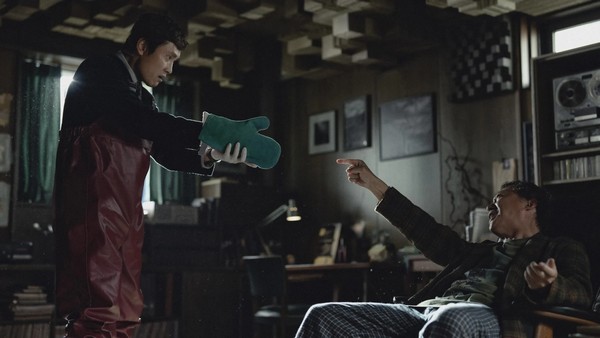
Lee Byung-hun, previously seen in Squid Game and I Saw the Devil and heard on K-Pop Demon Hunters, gives a beautiful stated multi-level performance. The everyman forced into the extreme situation, it’s fascinating seeing him pushed, working so many tracks of thought and want at the same time. It’s heartbreaking. I wanted to call out Son Ye-jin as Miri, the wife. Apparently, a barely nothing character in the source, Park Chan-Wook’s script gives her a full agency and life, continually surprising how she ties into Man-su’s journey. I love how she’s used. I can’t tell for a spoiler, but it’s big and fitting. Even with the increased size of the role, I do wish we saw her more and followed her journey in more extended moments.
Chan-Wook continues to as a master at subversion in story and tone. No meticulously designed scene or set-up (the camera choices are chef’s kiss) goes as expected, always shifting to create a complex, intricate web of intrigue in an intricate, layered film. Nothing goes as we think, nor for Man-su as well, creating a hilarious comedy of errors inside the thriller of the moving pieces and the horror of the whole situation. There is a major Coen Brothers vibe to how it plays, shifting and turning with multiple forces comedically sliding around one another. Like that pair, Park is a master of the cinema and still wows with a dazzle of darkness, balancing the tonal shifts or just multiple simultaneous feelings within the same scenario. It’s hilarious when a murder attempt goes sideways, but it’s also shocking and sad. The sequence around the center, involving wives, infidelities, drunks, and music (vague of course, you know when you see it) is a masterclass of how to put together a brilliant sequence; also existing as the film in miniature in so many ways.
No Other Choice is a brilliant dark comedy portrait of desperate people and the desperate actions taken to remain more than the nothing modern society is attempting to make them (not unlike the Korean best picture winner Parasite). The fight of those in need to live and the extreme measures are something that will, sadly, always resonate. No Other Choice resonates. Sadly, the workers are forced against one another while the brass sits mighty, away from the results of their machinations for more money and power. But in Park Chan-Wook’s hands, it’s also strangely hilarious even when it’s shocking and horrific; with maybe a little less bite than earlier work (but so did Decision to Leave, nothing wrong with shifting in age). With a great look and great performances, No Other Choice is another brilliant film full of shocks and surprises from a consistently brilliant filmmaker.