
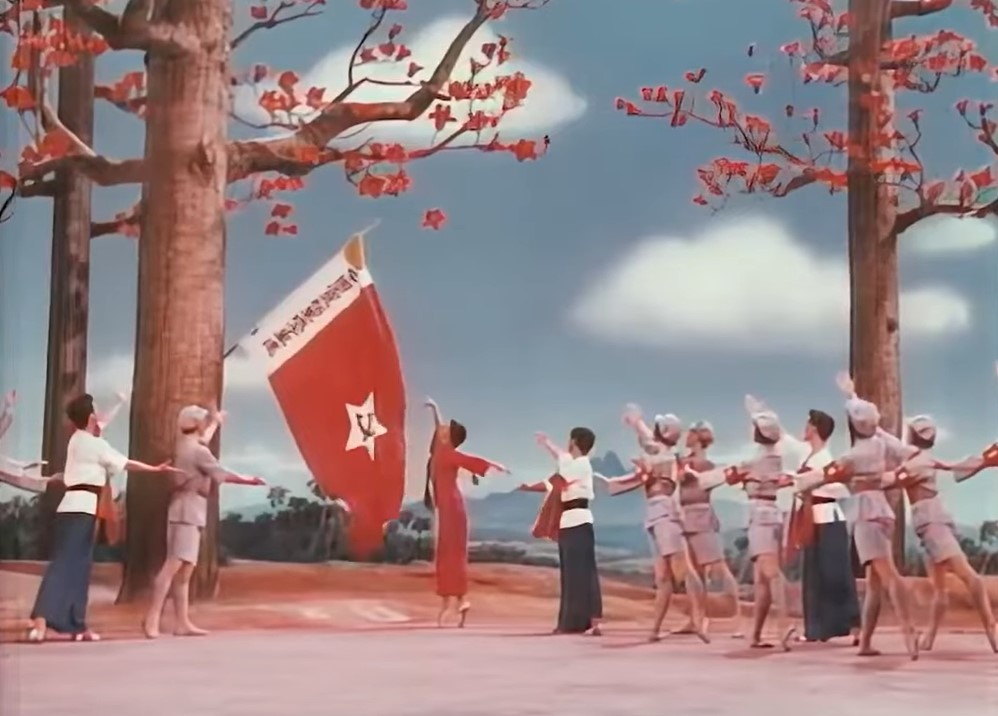
BOOTLEG FILES 932: “The Red Detachment of Women” (1970 Communist Chinese ballet film).
LAST SEEN: On YouTube.
AMERICAN HOME VIDEO: None.
REASON FOR BOOTLEG STATUS: It was never theatrically released in the United States.
CHANCES OF SEEING A COMMERCIAL DVD RELEASE: It is possible that someday it would appear on a US label.
I need to prefix this review by admitting that I am not a big fan of the ballet and I have even less enthusiasm for Chinese Communist propaganda. Thus, having me review “The Red Detachment of Women,” a feature-length ballet film produced during the Chinese Communist era known as the Cultural Revolution, might run the risk of ingrained bias.
Having watched this film, I can say that my feelings about this production are decidedly mixed. On one hand, I am highly impressed by the aggressive choreography, stirring music, and wildly athletic performances by the cast, and I appreciate that the co-directors Pan Wenzhan and Fu Jie created an engrossing cinematic adaptation of a stage-bound work.
But on the other hand, the concept of “The Red Detachment of Women” with its all-female battalion drilling and fighting for a Communist utopia makes this feel like a Chinese version of “Springtime for Hitler.” Indeed, the level of historical kitsch is so thick that you must wonder if Chinatown versions of Max Bialystok and Roger DeBris collaborated on this work.
“The Red Detachment of Women” began its odyssey as a 1961 dramatic film about a maidservant of a feudal landlord during the 1930s who escapes to join a battalion of women training to fight for the Communist takeover of China. In 1964, the film was adapted into a ballet. When the Cultural Revolution began in 1966, the ballet was grouped into a series of eight “model” works that were deemed suitable for presentation to the Chinese population by the repressive Communist leadership. Productions of the ballet were staged across China during the mid-to-late 1960s before the decision was made to adapt it into a film.
The plot is pure old-school Maosim. The peasant girl Wu (Xue Jinghua) is imprisoned and tortured by her landlord Nan Batian (Chengxiang Li) when she is unable to pay her rent. However, Wu isn’t your typical peasant girl. She is a tall and regal figure dressed entirely in red (naturally), and she possesses a steely confidence to stand up to her oppressor. Nan’s servants beat Wu and leave her for dead in a rain-drenched field, but luck is on her side. The heroic Hong (Qingtang Liu), an officer in Mao’s army, finds her and brings her to a military camp where an all-female army detachment is being trained. Wu immediately feels at home and embraces a Communist battle flag as if it was the Golden Fleece.
Wu becomes part of Hong’s plans to infiltrate and eliminate Nan’s reign of terror, but things don’t go according to their plans. Since this work is not very well known outside of China, I’ll stop the plot summary here to avoid potential spoilers – although it is probably no surprise to declare that the good guys (the Communists) eventually come out victorious before the closing credits.
To its detriment, “The Red Detachment of Women” is so heavy handed in its Communist ideology that is often feels unintentionally funny. This is a level of Communist kitsch not seen since Samuel Goldwyn’s bizarre 1943 Soviet tribute “The North Star.” The underlying message of this film seems to be that all the cool and attractive women are fighting for Mao, so grab a rifle and dance along.
It doesn’t help that the dancers were directed to hold their faces in wild-eye semi-orgiastic gazes and grimace or grin as they were playing to the last row of a grand old theater. It is the kind of emoting that went out of fashion when Mack Sennett stopped making silent films. And one segment where five smiling (but not very masculine) Communist men dressed in white uniforms and brandishing knives start dancing about can generate more than a few giggles.
But on the flip side, the most rewarding aspect of this film is Xue Jinghua. She is on the screen for more than half of the film’s running time, either doing solos or in performance with her cast mates, and the energy and passion she brings to this role is astonishing. While the character of Wu is broad in its obvious propagandistic shadings, Xue gives the role a nobility and drive that turns a stock character into a fiery woman eager for revenge and determined to plant a red flag over China.
Sadly, this is the only film Xue appeared in, and apparently the only role she is remembered for. Two years after her film performance, she danced the role in a live staging of the ballet when President Richard Nixon made his historic visit to China in 1972 and later in 1973 for the visit by French President Georges Pompidou. She retired from dancing shortly afterwards at the age of 28, citing exhaustion, although she briefly returned to the stage when “The Red Detachment of Women” had several stagings in the U.S. in 1978. She later became a ballet instructor and is still with us at the age of 80.
Mao’s government felt that they had something special with “The Red Detachment of Women” and the film was submitted in 1971 to the Venice Film Festival, which marked the first time that a Communist Chinese production played at that prestigious event. Theatrical screenings were arranged in several world capitals, but an American release never occurred.
To date, no U.S. home entertainment label has released this. But a clean (and unauthorized) copy is uploaded to YouTube for your viewing pleasure or bafflement, depending on your taste in ballet and Communist Chinese propaganda.
IMPORTANT NOTICE: While this weekly column acknowledges the presence of rare film and television productions through the so-called collector-to-collector market, this should not be seen as encouraging or condoning the unauthorized duplication and distribution of copyright-protected material, either through DVDs or Blu-ray discs or through postings on Internet video sites.
Listen to Phil Hall’s award-winning podcast “The Online Movie Show with Phil Hall” on SoundCloud and his radio show “Nutmeg Chatter” on WAPJ-FM in Torrington, Connecticut, with a new episode every Sunday. You can also follow his book reviews at The Epoch Times.