
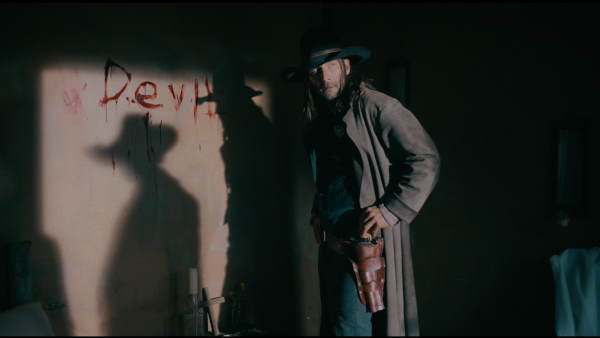
A single mother finds herself grateful that her son has returned home after vanishing, only to discover that he isn’t who he once was.
The Wolf and the Lamb tells the story of Josephine ‘Jo’ Beckett, a widow with just one child who lives in a small community in Montana in the 1870’s. The tiny town has a history of vanishing children, so when Jo’s son Henry goes missing she prepares for the worst. Unlike the other children, he comes back home. His mother is initially ecstatic until she realizes he’s in a lethargic state. With a local physician claiming him physically fine, Josephine soon discovers that something nefarious is to blame for his change in behavior. It isn’t long until the entire community is entangled in the mystery of what happened to Henry Beckett. The Wolf and the Lamb slowly drags a small community into disarray before throwing it straight into folklore Hell.
The film comes to us from writing duo Michael Schilf and Miah Smith. Michael also directs this full length horror feature, which was a first for both creative minds. While I could see the core concept of The Wolf and the Lamb as a short film, or anthology installment of some sort, the extended run time of a movie allowed the creative team to take their time with the narrative. We’re introduced to an entire community and spend a considerable amount of time with them before the horror elements of the film really come into play. With an enthralling opening act that wears its intentions on its sleeve, the viewer knows that they’re not sitting through just another western. However, all the proper elements are there, from the town doctor to the morally wayward sheriff and deputies. The world of The Wolf and the Lamb is nothing if not believable in its grounded approach to 1870’s America, which makes it a fun sandbox to play “horror” in.
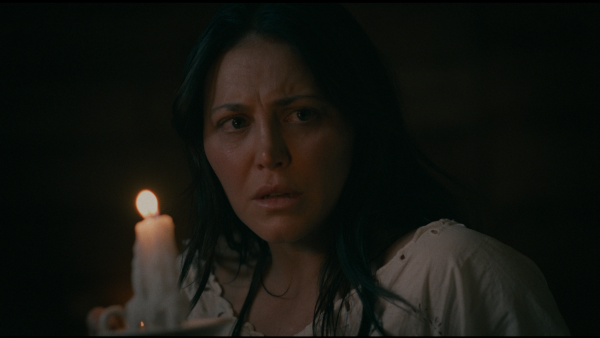
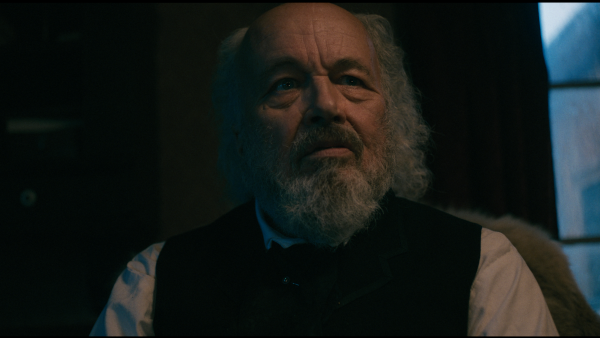
Predictability is absent within this tale of loss and tested faith. You’ll find yourself pulled into a classic western setting and staying there so long you’ve almost forgotten that you’re watching a horror film. But make no mistake, The Wolf and the Lamb still has teeth and it sinks them in when the time is right. Practical effects and costuming give tangible life to the lingering threat that begins to terrorize the community. While occasional glowing eyes might take a viewer out of the immersion for a moment, there’s attention to detail at work when it comes to the blood and gore that are presented in a believable fashion. Tensions increase as the townsfolk begin to lose trust in one another due to a rising body count that’s haunting Josephine most of all. Viewers may recognize her as Cassandra Scerbo, the actress who played Nova in the Sharknado franchise. She’s joined by a cast of horror alumni that include the likes of Zach McGowan (Dracula Untold), Adrianne Palicki (Legion), and personal-favorite, Clint Howard (The Ice Cream Man). Fans of horror have plenty to look forward to with this one.
Foreboding and unforgiving, The Wolf and the Lamb delivers glimmers of optimistic hope before quickly stripping it away. Those familiar with the Aesop fable of the same name know that it represents a “might makes right” narrative, and the same applies here. Josephine and the members of her community will have to go tooth-and-nail if they expect to survive this surprisingly fun and unhurried brush with pure evil. With a conclusion as brutal as it is macabre, The Wolf and the Lamb delivers a thought provoking good time that plenty of other western horror films seem to fail to pull off. It’s Once Upon a Time in the West meets Until Dawn in this cerebral descent into chaos that delivers a nuanced balance between the contentious world of man and the feral domain of something far more wicked.
The Wolf and the Lamb is brought to us by Samuel Goldwyn Films and is currently available Digitally while simultaneously showing in select theaters.