
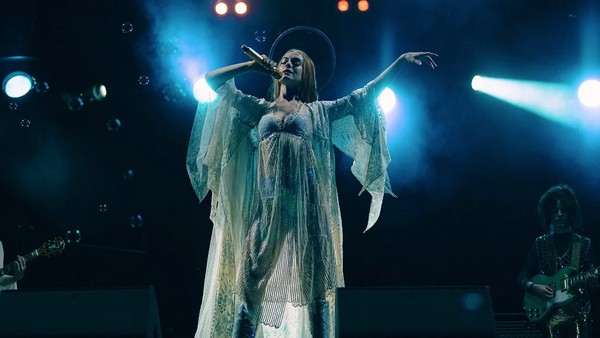
 A pop star meets with her estranged best friend to try to reconnect with herself and their shared past in David Lowery’s beautifully designed but muddled Mother Mary.
David Lowery’s bread and butter is the human condition of wanting connection and the gaps we have in making that bond. For whatever reasons, whether it be death in Ghost Story, a drive for honor in Green Knight, or losing oneself in the fame monster of Mother Mary in the film of the same name. In her years as a massive pop superstar, she’s lost her way, and to find it again, she shows up at the massive workshop of Sam Anselm, her former best friend and costume designer, asking for a dress for a special midnight show in a few days. Sam’s specialist is finding the best dress by digging into someone’s soul, and what better way to fix what’s broken than soul searching with someone who might know Mary more than anyone else, reconnecting and closing wounds. Or is it? Honestly, I don’t know. I THINK this reconnection is what David Lowery is going for in his writing, but whatever Mother Mary has to say is muddled and unfocused; although the visual styling and performances are top-notch. Mother Mary is ambitious and intricately designed, but misses the overall mark, leading to mixed, conflicted feelings.
I love a good two-hander. Two people, mostly alone in a space, going on with another, a tight play of power, emotion, and character. Mother Mary is mostly Anne Hathaway’s Mother Mary and Mikaela Coel’s Sam as they explore everything of their pasts and futures locked in a dim, gorgeously semi-derelect barn. There are others around, in the now, like Hunter Schafer’s assistant Hilda, or in flashback, such as Mary’s managers, assistants, and a specific sequence with FKA twigs (better than her terrible The Crow remake performance, but still awkward and stilted). No matter the other faults, the pair is fantastic. They build into one another, bite down, and find a conflicted, connected depth. Afterwards, my fellow critic Kathy noted there were no men with lines, only women. That’s cool. Written and directed by a man, yes, but a woman’s story. 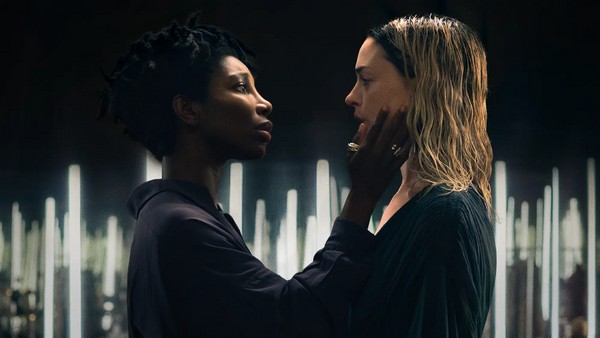
With mostly Hathaway and Coel playing off of each other, they are astounding. The pair gives gripping, full-bodied performances. I believe what they’re saying, tearing into the layers of the past and language. Mother Mary is one where the broad strokes of scripting work, but are lost in the line-by-line details. Whatever issues with the writing overall, one still feels the long-standing connection, the still-open wounds of a buried history. Their history, ups and downs, especially lingering issues, are ready to burst, simmering in tension. It’s a delicious intensity, a hypnotic watching the pair fall deeper into their history, bicker, tease, flirt (maybe? Hints perhaps), and fight. This back and forth of power dynamics and personalities, cutting down the layers and walls they have built up, especially in Anne Hathaway’s lost Mary. She’s haunted, icy, and striking. But who is she really?
But who is anyone? It’s muddled within the film; one almost doesn’t notice there’s nothing underneath, especially with Coel’s Sam, with how good they are in building up the repetitive screenplay, repeating the same concepts with a never-ending shifting of metaphors (for those frustrated with my shifting metaphors in this review, that’s on purpose to match). I was never quite able to grasp just what anything was for the sake of character, meaning, or depth. But not in a purposely ambiguous and enticing way, but in a way that Lowery had something in his head, but it became coded in release, and the audience didn’t have the key. The strength of the performances leads me to believe Hathaway and Coel know what they mean, even if I couldn’t cut through the enigmatic storytelling. I love this story; there’s a strength to be seen in this setup, but Lowery’s script underwhelms.
But within the muddle, albeit pushed up by great performances, Mother Mary is a truly gorgeous buffet of imagery and design. Lowery, with cinematographers Andrew Droz Palermo and Rina Yang, has impeccable control of his image, and the film features so many striking shots. Each frame of a single backlit image centered on its subject gives it weight. The location use of the darkened barn, full of shadow and depth, gives awe. Images move and cut with precision to the other, a skill of purposeful editing by Lowery himself. Floating red dresses, notable blood use, halos, it’s a treat. A sequence of a flow of stairs, falls, fame, entrance, and exits is unequivocally gripping. The beauty continues in the lavish costuming by Bina Daigeler, providing breathtaking body scenery in Hathaway’s parade of complex dress. However, with the length, the gorgeous nature feels more and more empty as it continues for just about two hours. I couldn’t help but think of Peter Strickland’s films, such as Duke of Burgundy or In Fabric; they are also small chamberpieces of esoteric beauty but far more compelling. 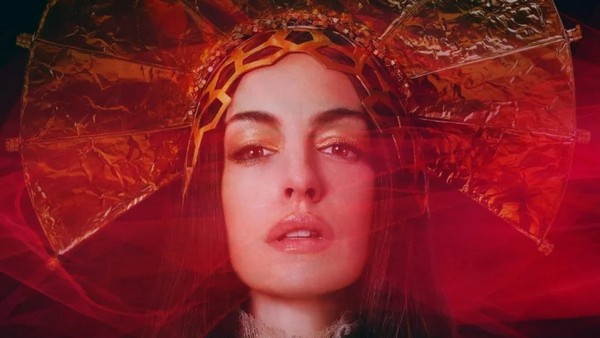
The music, however, is astounding. Based mainly on Taylor Swift (Lowery has stated the Reputation tour was a large influence), the power pop soundtrack fits and builds the film. I’ll freely admit I really enjoy the work of Swift, Lorde, Lady Gaga, Lana Del Rey, and others of this era, and Mother Mary’s music fits right within. Jack Antonoff and Charli xcx (continuing a year of cinematic connections after The Moment and Faces of Death) wrote most of the music (one is from FWA twigs), with Hathaway performing, and it’s impressive. Heck, A24 has released “Mother Mary: Greatest Hits” as the soundtrack, and I’m tempted to pick it up. Additionally, dance choreography by Dani Vitale is wowing, especially a singular, visceral performance in the work barn.
Ultimately, David Lowery’s Mother Mary is a messy misfire. It’s ambitious, and that always goes far for me. Lowery has a vision, although I’m not entirely sure what it was, rendering a slim nothingness come the credits roll. But with two astounding performances by Anne Hathaway and Michaela Coel at the center, and an impressive and gripping visual style, along with a fantastic soundtrack, Mother Mary evens out with an uneven placement.