
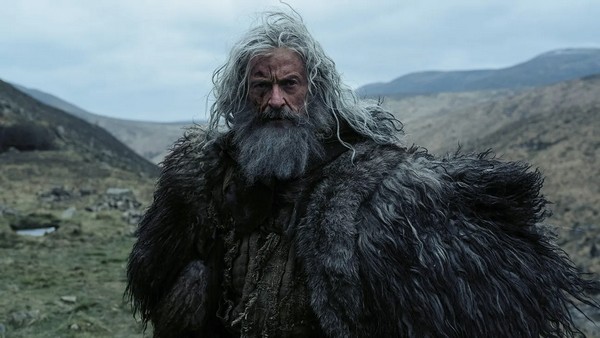
 The legendary outlaw slightly struggles with his past in Michael Sarnoski’s gorgeous but dull The Death of Robin Hood.
The Death of Robin Hood is a movie that I should have loved. Both of Michael Sarnoski’s previous films, the Nic Cage-led Pig and the surprisingly amazing prequel A Quiet Place: Day One, are top-notch efforts of people on the edge of society forced into an action they didn’t want to face. He continues this theme with the new film, pushing an elder version of the famous titular outlaw, living alone in the isolated hills, only interacting with people to dispatch another vengeance seeker. That is, until Little John seeks him out to help him keep his farm, ultimately having John’s daughter and Robin in an isolated priory. Run by a nun, keeping a leper and children around, Robin is given peace to muse on the violence of his life compared to his legend. In doing so, Sarnoski revisits the ideas of legends and storytelling, also up my alley, how the story of a life is told and changes and shifts with tellers. But The Death of Robin Hood is a dull slog, keeping its ideas at surface level, never giving the more than capable performers of Hugh Jackman, Jodie Comer, newcomer Faith Delaney, and Bill Skarsgard much to dig into. But at least it’s nice to look at.
The Death of Robin Hood is gorgeous. Filmed in the Irish countryside on 35mm by cinematographer Pat Scola, who also lensed Sarnoski’s previous films and Sing Sing, it’s astonishing. Whether those expansive green landscapes, the fog-strewn fields, nights lit by fire leaving impressive silhouettes, the film is breathtaking time and time again. It has a grain, a sense of detail, and space. Every shot of the expanse of sea with the priory looming on the cliff wows. I’m reminded of the look of Robert Eggers’ The Northman and David Lowery’s Green Knight (both of which also deal with modern revisionist takes on classic stories, albeit much better). With the characters clothed in impressive, layered, and detailed costumes (the shrouds of Murray Bartlett’s Leper, a standout performance and character as well, are a particular highlight). Keeping to the technical, the sound design is muddled. I thought it might be on my specific screening, but a look at the Reddit discussion shows other viewers arguing over the specifics of the line and saying the same. Try to see a subtitled show, or wait for home viewings (though one misses the astonishing vistas).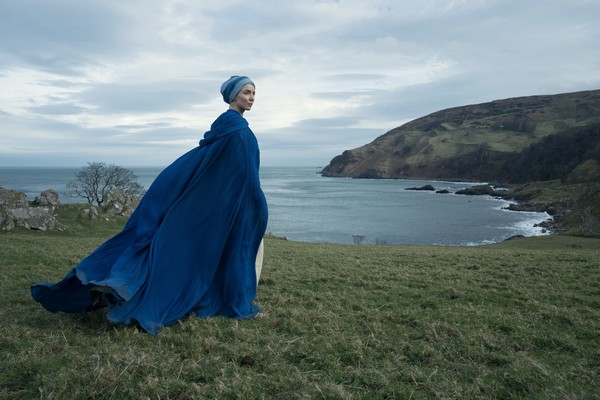
I wish I had enjoyed watching the movie as much as I enjoyed seeing it. If that makes sense. Viewers who have seen the writer and director’s previous film, Pig, know Sarnoski purposely defied expectations. A Taken-like setup with lines, dialogue, characters, and other elements would go in a certain direction in other films. But that’s not what Sarnoski is interested in exploring, leaving a much better, more fulfilling tale. I Sarnorski is going for this style again. Sadly, it doesn’t work as well, stretching the idea into often a dull drag. I’m not saying I wanted the path he purposely avoided; I’m glad for it, but I wish there was more to get into.
The concept of a personal myth and legend already being twisted and upturned in his lifetime is of interest. It’s been done before in films like Unforgiven and Logan, with both of those films also dealing with how a life of killing weighs; on living with the past and how it might be different is one to be mined well. Especially if the actualities are far different. The what-ifs of Robin Hood and his merry men were far from the heroes of legend; instead murdering brigands and sellswords who perhaps occasionally tossed a coin at the poor is solid. An aged Robin Hood, living as a solitary man continually dealing with the descendents of his victms is wholly interesting, especially when possible giving a chance of salvation and living up to the legend or at least a more positive end as he must take on the daughter last surviving Merry Man Little John under his wing when John’s own brutal (this movie is absotleuly brutal in the first half; even seasoned horror fans like me wince ) past after Robin catches up and they find their way to an isolated Priory run by Jodie Comer’s Sister Brigid.
The concept gets worked a bit, teasing a newfound peace, a level of forgiveness, and a breaking of the cycle of violence. Plus, there’s a through line of storytelling, the importance of oral tradition, and how they affect people who hear the stories throughout. The words used and how they work, how to knead and rework,e especially in the eyes of those who may have met or known the folks involved. Hugh Jackman gives a solid gravitas of world weary pain and a feeling of powerful melancholy, but it’s too easy to compare to the stronger Logan with the casting. Because that’s it. The idea is there, their idea is stated. And little is further deepened.
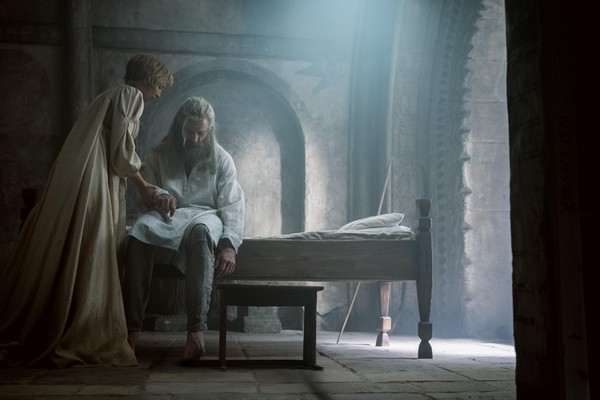 It’s a strength that the film doesn’t devolve into the third act, as other films with a similar setup would, but instead also drones. Sarnoski’s screenplay hammers the points without expanding, debating, save a moment or two. Whether it be the prioress, played by a wonderfully expressive Jodie Comer (an actor who deserves more; she carries a whole character arc and memory on her face) and the scene-stealing ease of Bartlett’s Leper, or the comparison of the brutality of Skargard’s Little John, the same platitudes are repeated and told against and again. A moment on a beach with Noah Jupe reaches the emotional climax of the film, pulling it together and finally showing a modicum of intention Sarnoski has been aiming for.
However, as disappointed and let down I felt leaving the auditorium, The Death of Robin Hood had been rattling around in my brain. It made an impression. In the time since, the dragging dullness compresses to have a better sitting in the memory space. There’s something that works intrinsically to the material, and fittingly to the point of it all, it alters itself in the time after the action. Perhaps I need to revisit the film. But until then, I chalk Michael Sarnoski’s The Death of Robin Hood as a disappointing tale, told better in other iterations.