
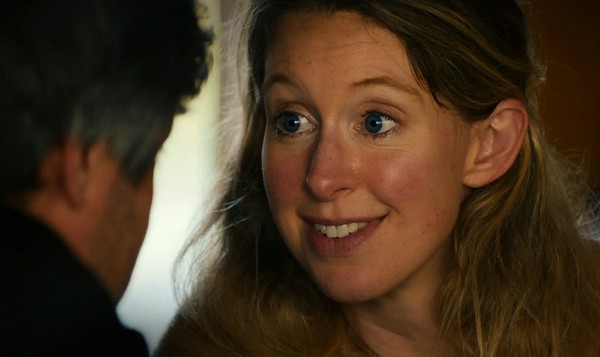
 In YOU CAN SEE EVERYTHING, Elizabeth Holmes and her family invite Nathan Fielder and Lance Oppenheim to document their lives before her prison sentence. The provocative, strange, and truly fascinating documentary blurs every line and emerges as a strong contender for the year’s best.
You Can See Everything is not only one of the best documentaries of the year (though Boorman & The Devil might be my favorite on a personal interest alley) but one of the best films overall. It’s fascinating, bizarre, complex, and utterly engaging on a level I haven’t seen before. While documentaries commenting on documentaries are common, at least on some level, Nathan Fielder and Lance Oppenheim’s embedding of themselves in the lives of Elizabeth Holmes and her family turns the standard look inward into the strange in finding the truths, distanced and personal, lies, manipulations, narrative controls, and perceptions. Honestly, a day later, the film still lingers with me in a flabbergasting hold. Wow.
The premise is simple: disgraced Theranos co-founder Elizabeth (often shortened to Liz in the text) Holmes is 34 days from going to jail for defrauding investors regarding the company’s claim to fame: a device that was touted to use a single drop of blood to test everything (the company’s other founder and face, Holmes’s ex, Sunny Balwani, is not an active participant in this film). She and her husband, Billy Evans, invite comedian/director/provaceur Nathan Fielder of Nathan for You and The Rehearsal and documentarian Lance Oppenheim (who just moved into narrative with also-out-now Primetime) into their home to try to shift the pubic perception and narrative of Holmes after years of exposees, articles, news items, and the 2022 Hulu series “The Dropout,” which earned Amanda Seyfried an Emmy.
The result is far from simple, as Fielder and Oppenheim (It’s almost easy to forget Oppenheim is around, as he only appears on screen in a single sequence, with Fielder seemingly leading the direct charge in conversation and confrontation) become engaged in a series of interviews and interactions questioning everything, pressing hard and gaining oddly and flabbergastingly funny and shocking humor in Fielder’s questions, how people respond (or don’t), and in the bizarre nature of the whole lives around.
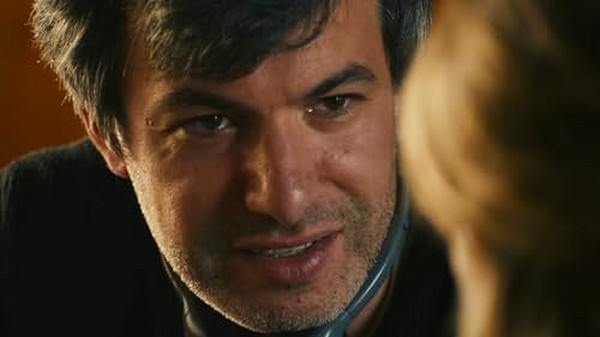 But who would expect Nathan Fielder, known for destroying the line between documentary and comedy bits with his blunt oddity, twisting and turning subjects, himself, and viewers to keep things straight and narrow? Audiences who come in aware of his work expect revision, uncomfortable lines of inquiry, and a blurring of the lines between subject and author. One wonders why they chose Fielder (and they specifically chose him, adding a further intrigue), knowing he breaks down barriers and gets underlying notions out with his pointed questions. Questions that are interesting in their own right get an edge in how direct and persistent he is, but in a way akin to a toddler saying “something smells bad” in front of the person he’s talking about. It’s almost innocent, prompting an answer (or humor in a long pause). Fielder’s ability to go further, in recursion of methods, fascinates and shifts the film. His cutting questions slice deep, revealing layers meant to be hidden. Or not?
You Can See Everything is a film of manipulation. Who is manipulating whom, what lies are built into truths, and who can we trust to give the real, direct, unvarnished truth (answer: no one). Now, trying to suss out whether Holmes is innocent, blissfully unaware until Theranos came crashing down, fully complicit, or somewhere in between, is the documentary’s need for the whys of culture as a whole? How much deception, macro and self, is in a documentary of their lives? What are Liz and Billy hoping to get out of this? Why bring in Fielder? What does Fielder give us as he and Oppenheim fold the documentary back on itself? When a meta-shift occurs (staying mum on details here, and whoo boy do I want to get into it, because that’s what makes this so much more special), the already-bursting questions of truth about everything we’ve seen break our perceptions and question our questions. How do we, as the viewers, approach documentaries like this? Is Fielder, as seen in the film, playing a character too as he lurks into private moments, whether it be awkwardly watching from afar, sharing a couch in an intimate moment, or getting too close in interviews, as Oppenheim and Feilder revel in pushing too close with extreme close-ups, reframing the subjects literally and figuratively with uncomfortably familiar?. I love that they chose a full-frame 4:3 aspect ratio, which heightens the unease of those frame-filling close-ups.
At the center is Elizabeth Holmes and the question that opens the film, over what the New York Times says was a mistake: she was misquoted as saying, “She’s playing a character I created.” What now? Holmes says she said “she [Seyfried] created,” but the difference is the question. Who IS Liz Holmes? With her big blue eyes and Pennywise smile, she’s a little dorky, bubbly, and endearing. Or is she? She’s also intense, staring with a spark of a smirk that says, “Oh, you think that; how cute.” As a subject, she’s fascinating. Nearly unreadable, after so long with her, I have no idea where her truth lies; nor do I think Fielder and Oppenheim. Does she truly believe she’s innocent? Is she using her natural likability to deceive us? Part of me wants to believe she’s just wired in a weird way that keeps her from fully understanding the whole situation. A bizarre scene involving Abbott and Costello is fascinating and so strangely shocking for such a light topic; but it might be the moment that sticks with me most and centers the film. Another moment about lying shines a different light with jaw-dropping confusion. But we can’t help but feel for her on some level, as she watches Seyfriend’s take on her for the first time, or as she goes about her day. I’m reminded on some level of Tammy Faye Bakker. A Personality, for sure, but one who gets blamed more than others because she’s a woman and a bigger face; one who may be used by the more scheming men, Jim or Sunny (who also went to prison). Heck, the header image of this review was instantly meme-ified; what does that say?
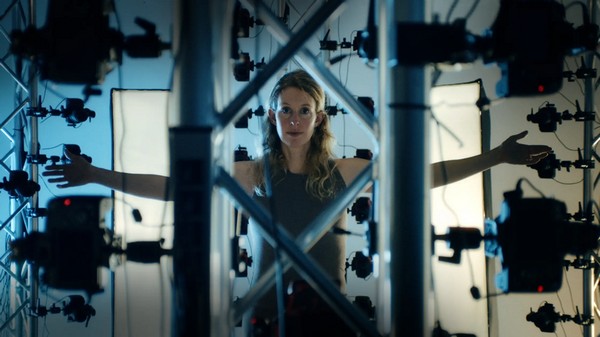 Then there is husband Billy Evans. A whole different beast than Liz, very much a villain ‘performance.’ I’m tempted to say ‘or is he…’, but even if we’re talking manipulation, we’re past questions by the end. Also big-eyed and unblinking, something is… off. Fielder can tell, and their interviews and hangouts are something else, shaping the film’s odd dimensions, especially in the back half. But you see his control, his little power plays, and “wait, what” moments, and again everything is reframed. It shows how he steps in, lurks as much as Fielder, and becomes defensive and angry at the drop of a hat, or at a wrong statement from someone in his sphere.
It’s a lot to take in, but even after three hours, the truth is still as evasive as ever. That might be the point, right? But then again, You Can See Everything is less about the truth than about our perception, and how it can shift. It’s a quick three hours, truly fascinating, and it pulls the audience in, both with interest and as a silent participant. Saying more about the final part of that statement would tell more than I should, but see it. Trust me, and you’ll see.
Hilarious, shocking, thought-provoking, and absolutely unpredictable, Nathan Fielder and Lance Oppenheim’s You Can See Everything is one of the year’s best pictures, documentary or not (and once you see it, you might argue about how much of a documentary it actually is). Holmes is a truly fascinating subject, and the format’s twists and manipulations reflect how we see her, and others we aim cameras at. See it. Discuss it. Question it. But See It.