
 A group of high school girls get together for a slumber party, unaware that an escaped power-drill-wielding killer is loose in the neighborhood.
Few things are more quintessentially slasher than teenagers gathering for drugs, drinking, sex, and partying. At first glance, The Slumber Party Massacre almost reads like a checklist of genre tropes. And there’s a good reason for that. Screenwriter Rita Mae Brown, perhaps best known for her novel Rubyfruit Jungle, originally conceived the film as a parody of the slasher genre.
Amy Holden Jones, making her feature directorial debut after beginning her career as a film editor, took a more straightforward approach to the material. Jones would later write several notable screenplays, including Mystic Pizza and the family comedy Beethoven. Her playful sense of humor is already evident in The Slumber Party Massacre.
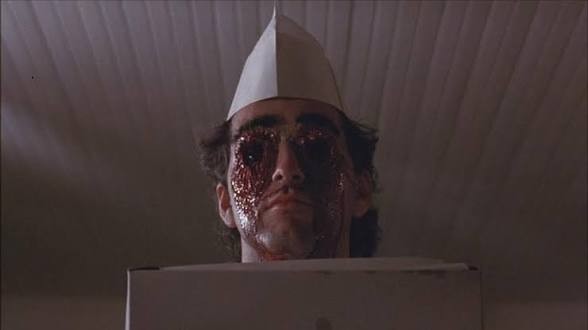 There is absolutely no subtlety in this film. Any subtlety that may have existed died the moment the penis drill came out. But that is precisely why this film is such a treasure. Had Jones filmed it as a strict parody, the film might have become just another horror spoof, winking at the audience until the joke wore thin. Instead, by treating the material as a straightforward slasher, Jones highlights the ridiculousness of the genre’s conventions simply by leaning into their over-the-top shenanigans.
In some of the opening scenes, we see several nude young women, the camera lingering on their bodies. On one hand, this could be viewed as just as exploitative as any number of slashers from the era. On the other, it immediately confronts the audience with one of the genre’s biggest conventions. You wanted nudity? Okay, here it is. Does it help the plot? Give you insight into the characters? Nope! It’s just a boob. Whatever Jones intended, these scenes can also be read as the beginning of the film’s ongoing commentary on the expectations of the genre.
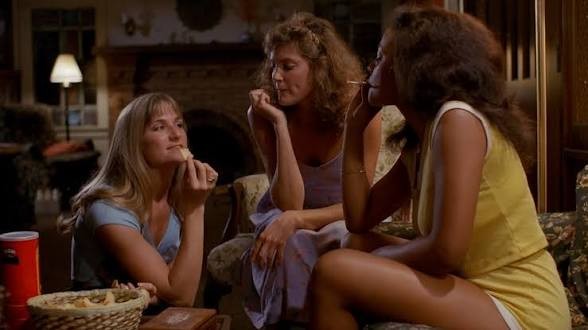 Much of the film’s success comes from how the characters are portrayed. The men aren’t the heroes fighting off a dangerous killer; instead, they’re portrayed much like women in traditional slashers, making poor, bumbling choices when faced with danger. The women, however, are proactive. They arm themselves and look for ways to defend themselves or hide. They’re resourceful. Even the killer is stripped of the larger-than-life qualities typically associated with slasher villains. Russ Thorn lacks Freddy Krueger’s wit or Jason Voorhees’s imposing physical presence. He’s just a creepy dude with a bad haircut and a drill, using his weapon to project a sense of masculine power. We know little about his backstory beyond the fact that he’s murdered several people, and we don’t need to. When the surviving women are finally victorious, they break his drill in a bit of symbolism that has all the subtlety of a brick to the skull. Or a drill to the belly.
The Slumber Party Massacre remains a bit divisive, even among horror fans. Some view it as a novel piece of feminist horror, and the first slasher both penned and directed by women. Others find it exploitative and not at all different from the dozens of other pieces of schlock horror that were flooding the market at the time. Regardless, the movie remains significant. It would go on to spawn two sequels (each one somehow even more bonkers than this) and a remake. Feminist satire or shameless exploitation? Perhaps the real joy of The Slumber Party Massacre is that it never quite makes us choose.