
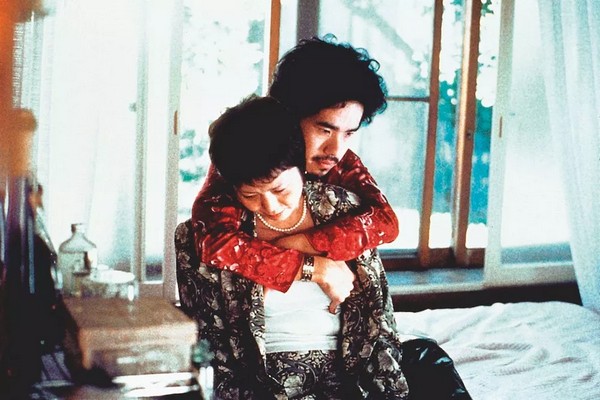
 In VISITOR Q, a messed-up family gets even more messed up when a mysterious visitor moves in. Takashi Miike’s disturbing 2001 flick comes to Blu-ray via Radiance Films this month.
The Film
TW: ooh boy. Everything? It’s a Miike, and a particularly fucked one. But to be clear: incest, necrophilia, rape, feces on camera.
Wow. Takashi Miike is particularly well known for his boundary-pushing genre films, the ones that rise to the top of conversation of the 126 directed film and TV titles (the man is a monster of continual and efficient filmmaking) are the most messed up: Audition, Ichi the Killer, Gozu, Happiness of the Katikuris, and today’s topic: Visitor Q. This one, written by Iaru Era, is new for me to see, though I’ve known it by reputation. After a recent restoration and festival run, it’s now coming to a new physical media release.
Visitor Q uses its concise 84 minutes to cram in perhaps the most messed-up. Visitor Q is a vignette-based, nearly plotless film, more focused on the shifts in the characters of the fucked up family at the center. When a film starts with a dad, Kenichi Endo, picking up his own missing daughter, Fujiko, as a prostitute and neither of them really caring about it, heck, she makes fun of him for premature ejaculation; you know it’s going to be an uncomfortable ride. Dad and daughter aren’t the only issued folks. The mother, Shungiku Uchida, is unhappy, working as a prostitute, and high on heroin most of the time. The son, Jun Muto, has impulse control issues, setting off fireworks, bullying others, and beating his mom. Such a happy family, right? Of course not; they’re miserable and making it everyone else’s problem. But that can change. The new visitor, Kazushi Watanabe, shows up unexpectedly and is unknown (at one point, the dad, talking to his family about their faults, points at Q and says, “Him… I don’t know who he is”), but he doesn’t make them better. Because it’s Miike, it gets worse; instead of fixing their problems, Q focuses them into their depravity. They each get better, and find a different sort of happiness.
It’s a twisted take on the family solitary film and an indictment of the society around them. Some of the specifics of what it might say are lost in translation and time, but the feeling still comes through. It has a clear dark edge of satire and revision. Miike chooses a found-footage style, shot on low-res cameras. This crafts an intimacy with the family that draws in, incapable of keeping them at arm’s length. It shifts from “watching a professional film” to “watching home movies.” Especially since much of it is filmed by the actors, handholding the camera.
Some might say there’s little below the surface: it’s shocking, and the characters never dig deep or learn anything but how to be worse. I get it, me? I liked that aspect. Shallow, terrible people find better ways to be shallower and more terrible, but happy (to an extent) as they do it. Miike aims to shock in his films, but it’s never forced shock for shock’s sake. I was often appalled but engrossed in the family’s ongoing issues and troubles as they “better themselves,” at least in the “a family that slays together, stays together” sort of way. Heck, I wouldn’t be surprised if we pick up with the family in a few years and it’s gone full Texas Chain Saw Massacre. (Miike himself commented on last year’s great TCM doc, Chain Reactions). With Visitor Q, Miike makes a deliciously malicious, fucked family that the viewer is disgusted by, yet strangely entwined with. Taboos break, lines blur, and you won’t be able to look away.
Packaging and Presentation
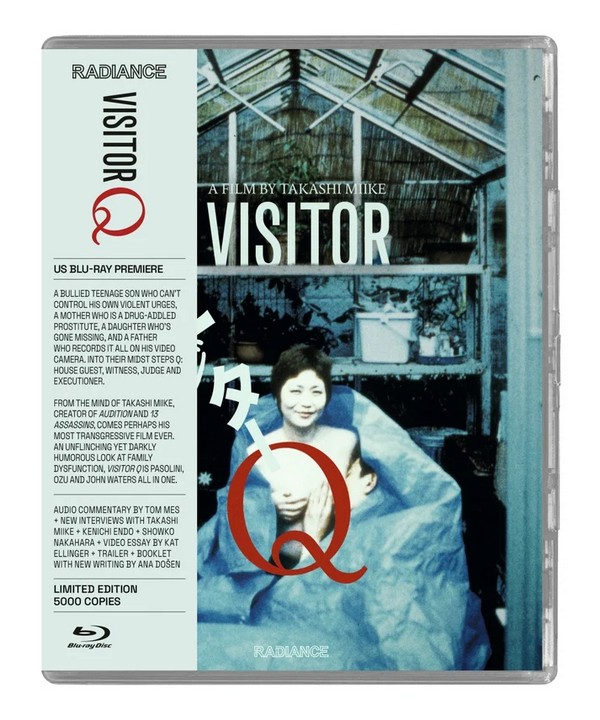
Radiance puts Visitor Q and its features on a single disc, with the title printed on a light-blue background. It fits in the thick Stanovo Blu-ray case. The clear case contains the double-sided sleeve with new art based on the old posters. A booklet is included. An obi-strip slides in as well, with the disc info, to keep one side of the sleeve clean. Spine #207.
Radiance gives Visitor Q a new transfer from the original master beta tape. For what it is, it looks good. Of course, filmed as it is, it’s not the most detailed; we’re essentially watching home movies. But it’s as clear as it can be and, most importantly, the needed detail isn’t fuzzed out or filled with artifacts. It doesn’t feel like a VHS copy, even if it was filmed that way. Similarly, the sound matches the filming but isn’t buzzy or lost in the muddle. It works while keeping the source’s fidelity and style. In Japanese with English Subtitles
The Features
Every feature here is new to this edition. From what I can tell after a few minutes of searching, previous editions have been bare-bones. Interestingly, Japanese/Australian label New Wave Video is also releasing the film now, with a different set of features.
Commentary
Miike biographer Tom Mes, who also commented on Audition for Arrow this year, returns for Visitor Q. I liked him much better here. Mes talks about his history with the film and Miike, the standard nuts and bolts of how it happened and what it means, along with the reception, history, and how it compares to a similar film.
Takashi Miike
Miike breaks down his work on the film, working with a short time frame, a small budget, and a specific style. He goes on to discuss his efforts, style, and broader approach to filmmaking. He’s always interesting and forthcoming, and he’s still great (22m)
Kenichi Endo
Endo talks about working with Miike and his style, how he approached this film, and his career on teh whole. But much is about Miike and how they work together (19m)
Showko Nakahara
Nakahara details how she’s played a corpse a few times and what that experience is like. And how it fit into her whole career. (21m)
Mother’s Milk: Visitor Q and the Feminine Principle
A fantastic video essay by Kat Ellinger about how this film, and a slightly wider look at Miike’s filmography but mainly this, talks to relationships of men and women, how they are used and abused, but how motherhood works in.
Trailer
A very weird trailer, directed by Kazushi Watanabe, Visitor Q himself! (2m)
Booklet
Included is a 20-page stapled booklet. Along with the normal, it includes Beyond the Real by Ana Dosen. The damned good essay discusses how the film subverts and works holes into family dynamics, connecting to Saltburn and the American Family documentary series. It’s a great example of speaking to Japanese society of the time
Final Thoughts
Visitor Q is a truly disgusting, twisted film, even by Miike’s standards. But it’s so compelling, and it doesn’t let the audience off the hook for the depravity. Radiance offers a strong set of features that build on the film and what it says about 2000s-era Japan.