
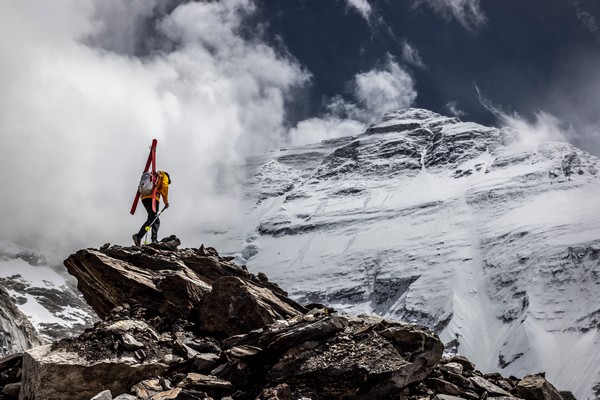
 After tragedy, a ski mountaineer tries to climb Everest’s north face and ski down. EVEREST: THE OTHER SIDE, Jimmy Chin & Elizabeth Chai Vasarhelyi’s documentary, is visually wowing, as expected, but is frustrating at connecting emotionally.
There’s a phrase: “Every corpse on Mount Everest used to be a highly motivated person.” A person who selfishly left behind their life, their families, and loved ones so they can tell people, “I did this feat. I paid piles of cash for a stunt that got me killed.” These thoughts sit at the center of Jimmy Chin & Elizabeth Chai Vasarhelyi’s Everest: The Other Side, which also asks, “How can they outdo Free Solo?” the fantastic 2018 documentary about Alex Honnold’s ropeless, solo climb of El Capitan. Their answer: Jim Morrison climbing, then skiing down the rarely mounted north face of Mount Everest. Unfortunately, when it expands beyond Honnold’s deliberately limited journey to a wider cast of people and planning, Everest: The Other Side loses its wow factor and becomes a frustrating exercise in obsession and the showiness and selfishness of those left behind. And the thing is, it stirred different feelings in me than I expected, since I normally adore these sorts of films; I don’t think it meant to. The conflict between intention and result left me with mixed feelings and a jumble of emotions. And it sent me into a death spiral of frustrating, mumbling “go home, just stop” to our climbers for much of the runtime.
I’m honestly shocked I came out this way, incensed and basically ranting after spending the back three-fourths mumbling for everyone to pack it up and go home. I was already starting to grumble before a huge shift at the quarter mark just tumbled me into a groove I couldn’t get out of. At the start, I was in as it begins as a mountaineering Fire of Love, a wonderful documentary I adored of simpataco volcanologists. Here, Jim Morrison and Hilaree Nelson are partners, both in life and as ski-mountaineers who climb the tallest peaks and ski down them. As it opens, they prepare to climb the north side of Everest, a feat few have done, and, yes, ski down. But tragedy strikes, and this is on the edge of spoiler, but occurs 25 minutes in and is the crux of the remainder of the film, as Jim uses completing the climb and ski as a way to find closure and reorient after a second tragedy of his life (I’ll leave the movie to tell you that one). While on Manaslu, an avalanche triggers as Hilaree’s skis hit the slope and, well, she dies, leaving behind her 12- and 15-year-old kids. And Jim. In trying to get back into his life, he re-ups the quest, trying multiple times. That’s when the film shifted for me, and the focus did too.
 But let me note, for full honesty and understanding of my feelings here. It may just be me being unable to let some subjective factors go in favor of an objective review. Here’s why. My five-year-old is my life. I love nothing more than being with him. I feel guilty leaving for a weekend convention. Heck, even two nights in a row makes me feel bad. I absolutely cannot imagine willingly leaving him for months for something I choose (compared to a military deployment or something like that; yes, this is technically a job, but I stand by it). And I’m hung up on when a hobby takes over family.
Before the tragedy, younger son Greyson, who noted he dislikes the climbs but does “smaller” (relatively) ones with mom because she wants to, states that when he was four, his mom left for months to hike Everest, and little him couldn’t understand where she went. Now, he’s used to it, resigning himself to who she is. Heck, her “save my marriage” push with her ex-husband was to go hike Everest. It’s shortsighted and selfish. She says the best she can do is hug them, love them while she’s there, and look to the next day. You know what you can do? Stay with your kids. Put this aside. They need you more than the mountain does. Quinn and Greyson do. Mike’s infant does. The director pair’s two kids, who they have to video call in after the daughter readily lists everything they’ll miss when they’re away, do. It’s almost sadistic to use the kids this way; the fear of me thinking of losing their parent was overwhelming. I wonder if that’s the point, but it’s so offhand; I don’t think so. Or, with a pair of directors, one climbing and on camera (Chin) and the other usually off-screen, when a participant seems to think it’s all a bad idea, it becomes a push-and-pull between them (but I won’t conjecture further).
I couldn’t stop thinking of “what are you trying to prove? And at what cost?” They’re not hanging with a science team, not a study like our volcanologists of Fire of Love. It doesn’t benefit others. It’s purely about him. Jim’s closure. Jim’s NEED to do this act. As the people helping were dragged along, it increasingly felt like a selfish “look what I did” to me. At one point, the Sherpas forging ahead and doing all the dirty work get caught in an avalanche. One breaks his leg, and they argue to continue in favor of “this foreigner’s orders.” At a few points, Jim and Chin give their Sherpas almost condescending pep talks. It rings false. Much of it does, manipulating heartstrings with flashbacks to Hilaree and other losses. I believe the people involved are sincere, but the composition and editing feel forced. I feel bad ranting on the myriad of tragedies. They are real. These are real-life, but the way they edit them into film is near parody, one after another. It’s crass.
Separate from any baggage, the cinematography and the “seeing something like this in IMAX” visuals work. The first-person skiing and hiking is breathtaking. The actual hikes and climbs are thrilling. At times, I could put it away and breathe it in, until a cutaway crashes back down, reminding me it’s an inane stunt, then back to the anger.
Maybe I’m off. Maybe I’m totally wrong in how I came out. Maybe I let my personal feelings overwhelm the film’s astounding visuals and the journey. Maybe it’s supposed to be slightly damning; it has tinges of noting the stunt show’s exploitative nature. But just as much, Everest: The Other Side is clearly meant to be inspiring. For me, Elizabeth Chai Vasarhelyi and Jimmy Chin’s film is past the point of “go you!” and instead “You go home!”