
 In Wes Anderson’s fun but flawed The Phoenician Scheme, a businessman takes his nun daughter and Swedish tutor on a world-trotting adventure to make a deal before his assassins catch up to him.
Wes Anderson is not a filmmaker for everyone. His particular method of storytelling doesn’t hit for many, whether it be the artificiality of his staging, the extreme idiosyncrasy of his characters, or the staccato of the acting. To each their own. Me? I love him. The Royal Tenenbaums is one of my top ten films. He’s toned his style and methods across his 13 films and various shorts, with only The French Dispatch not working for me; bouncing back with a 2023 favorite in Asteroid City. The Phoenician Scheme, following ruthless businessman Zsa-Zsa Korda as he makes deals and avoids assassination, dragging along his daughter Leisl and tutor Bjorn, is a lesser effort, unsure in plotting but high in great moment-to-moment bits.
I’m going to be honest. I don’t know exactly what the Phoenician Scheme is. The whys and whats of the plan Zsa-Zsa Korda is up to is beyond me. Trying to “bridge the gap”, whatever that is? There’s some cockamamie idea of a dam with trains and other additions? I do not know. The lack of a true plot, or at least an understanding of it, disallowed a true connection for me and the film. Anderson holds at arm’s length, with no emotional connection due to the plot issues.
Many state that Anderson doesn’t have emotional films. His style of flat affectation, directness in dialogue, and the artificial manner of the production dull connection. But, under that veneer of aloofness, are very emotional people who don’t know how to deal with their emotions and other people. The strange unknowability of those around oneself is given visual acuity in that artificiality. Anderson turns the oddity and comedy of emotion and alienation into a presentation. I love him for it. Others don’t, seeing the extreme stylization as twee and forced. With each film, he leans further into it. The Anderson look is barely present in Bottle Rocket, seeps into Royal Tenenbaums, increasing to peaking with overt theatrical stylings in Asteroid City and The Wonderful Story of Henry Sugar.
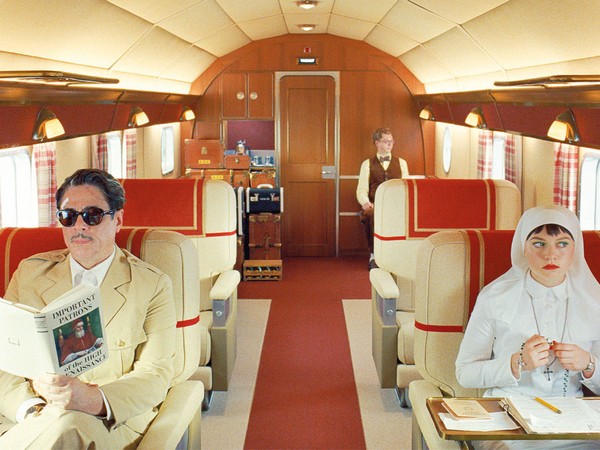
Unfortunately, detractors may be given more to chew on with The Phoenician Scheme. It is style over substance as Anderson uses the film to draw together a stable of performers for various vignettes as Korda attempts to do whatever it is he does, with Leisl and Bjorn for color commentary. Interestingly, the style is toned down from the previous entries in his canon, but it is a gorgeous film to look at, lush and impeccably designed. Now these bits are funny, well-designed with a great variety of locations and focuses with a great cast, including but not limited to: Bill Murray, Scarlett Johanssen, Willem DaFoe, Brian Cranston, Tom Hanks, Jeffrey Wright, Richard Ayoade, and so many more. One looks at such an impressive list and thinks, “How will all my favorite character actors be used?” The answer is a quick how ya doin’ for two scenes. Come in, make a few jokes, screwball comedy banter, a physical gag, and off they go into the next, with only Del Toro, Threapleton, and Cera continuing across the sequences.
I suppose there is meant to be a trough line of Korda becoming less selfish, growing and connecting with family, especially his one daughter (he has 9 younger sons), and in turn, her opening up her own closed-over emotions. She’s soon to be a nun, allowing a push down of her wants and keeping the world distant. Families, broken, breaking, and reconnecting are themes across Anderson’s work, as it is here. He’s been adept at complex people facing their complex pasts and emotions, and change. But I don’t see it here. Similar to the emotional disconnect, there’s a real character growth or alteration from the events. We’re told, rather than shown, that changes occur and circumstances change, and it’s out of left field.
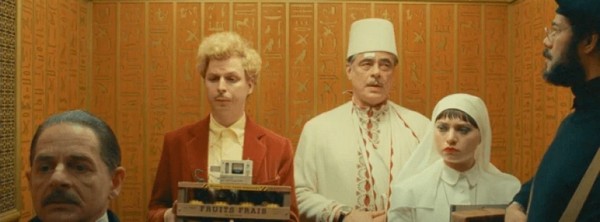
Despite all of this, the film is a lot of fun. It’s never boring. The in-scene writing is sharp, and the back and forth are hilarious, and the beats of the film earn snickers and bits. Anderson’s staccato style lends to perfectly timed moments, with a great sense of actor control to deliver in the best ways. With the continued stable of cast members continuing across his oeuvre, Anderson clearly is great to work with, providing something different and fantastical to work within his idiosyncratic worlds.
Benicio del Toro is fantastic, melding into the style for his second time with Anderson, after The French Dispatch. The insane, yet restrained, energy he brings to Zsa-Zsa Korda is perfect, selling a man a little world-weary and on different footing. He digs in with relish and delight. The other two leads are new to the Anderson troupe. Mia Threaplton is a breakout, melding into her role as the distant novitiate, resting and commenting on the esoteric world around her. Threapleton is the daughter of Kate Winslet, and you can see it in her face and voice, but she’s wowing and ready to be a star on her own right perfecting a engaging deadpan. This may be strange to hear, but Michael Cera nearly runs away with the film. His performance style has nearly always been within Anderson’s parameters, so, strangely, it’s taken this long for him to join Anderson. He’s never been better; Anderson knows how to use him well, and I look forward to how he does in the future.
I wish I liked The Phoenician Scheme more than I did. Each scene is very well designed, written, and performed, but the connective tissue doesn’t come together. Wes Anderson gains amazing performances from his cast, especially from Mia Threaplton and Michael Cera. For non-fans, The Phoenician Scheme won’t convert, and for fans, it may be a letdown. Not a big letdown, as it’s still a fine film, but lesser for Anderson.