
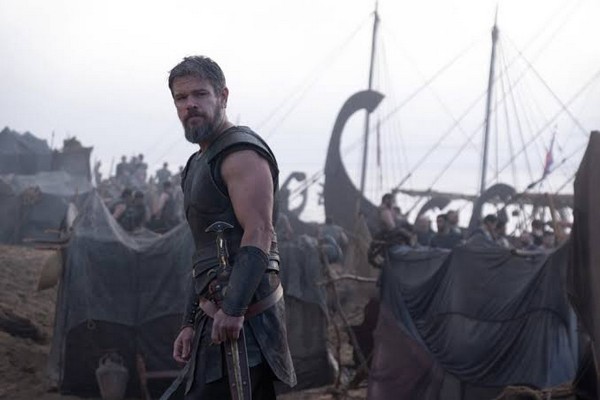
 A Greek soldier tries to get home while his wife and son try to keep it safe in Christopher Nolan’s adaptation of the classic tale of The Odyssey. While filled with magic and monsters, Nolan finds a heartfelt humanity in a grand, but grounded, epic, a fantastical triumph of confident filmmaking.
It’s only been twenty-five years since the Coen Brothers’ masterpiece O Brother, Where Art Thou, so why are they remaking it already? And taking the story of Depression-era Mississippi and twisting it into a series of mystical islands between Turkey and the west side of Greece three thousand years ago? So strange. But when Christopher Nolan wants to do it after winning Best Picture for Oppenheimer, just let him. Kidding aside, Christopher Nolan has chosen to retell one of history’s most retold tales with three thousand years of oral and written traditions, long before any film and TV adaptations, literally retold, passed down from Homer (maybe) to storyteller to storyteller across the centuries. And Nolan does so admirably, crafting a grand but grounded epic, yet still with plenty of magic and monsters, sea serpents and sorcery; efficiently and gracefully making the epic his own: engaging and emotional. Christopher Nolan’s The Odyssey is a triumph of fantastical filmmaking.
It’s a tale as old as time, or at least a few thousand years. Or tales, as the Odyssey is directly linked to The Iliad (with the Aeneid around as well). Despite the oft retellings, adapted and used as a basis for so many episodic stories of someone on a quest of dangers and roadblocks, I won’t presume one knows all the details, and will do my best to endeavour not to show the film’s hand too much. If you have vague memories of high school English, so many aspects will click, whether reused directly in other media or repurposed for things like Percy Jackson. Greek myth pervades our cultural storytelling. The quick: Helen, wife of Menelaus, runs off to Troy, and Menelaus’ brother, Agamemnon, uses this as an excuse to start a war. One that lasts ten years, taking Odysseus and so many fighting men and boys away from their homes. Once Greek victory is assured (by maybe not-so-honorable means), they head home. Odysseus and his crew try to head back to Ithaca, where he left his wife Penelope and son Telemachus. They are now besieged by suitors abusing the rules of hospitality while they wait. It’s not an easy return for Odysseus as he and his men find island after island of magic and menace, surreal places of uncertainty and danger, decreasing the crew and increasing their frustrations with their leader with each stop. Will they get home safely? Will the suitors have enough and take the palace? What of the other survivors of the Trojan War? Are they possibly cursed for what they did?
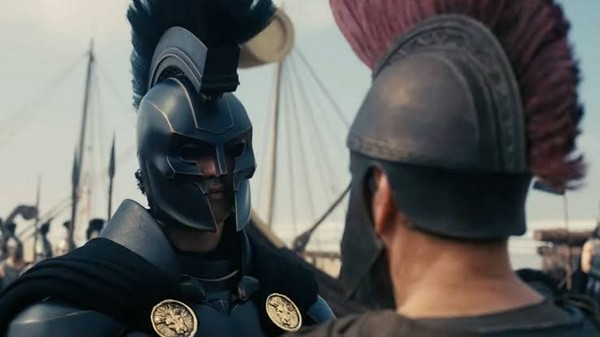 Within all the magic and wonder, perhaps I most appreciated the humble grounding and restraint Nolan brings. He seems to purposefully avoid “Going full Hobbit,” to coin a term. Wherein Peter Jackson’s fumbled adaptation of my favorite book took moments and sequences and heightened the action and excitement to make inane and overdone set-pieces (look at you, illogical barrel sequence), Nolan resists the urge to go bigger for bigger’s sake. Whether it be the Cyclops Polyphemus, or the danger of choosing between a terrible whirlpool and a cliff-dwelling monster, Nolan holds a matter-of-factness, no need to go too big and show off by leaning on effects and cleverly executed sequences that stop the story for spectacle. He knows the three thousand years of this story told in this way is enough (in a few cases, he cuts down the island stops and removes many altogether to keep the nearly three hours flowing, editing with Jennifer Lane). That’s not to say they aren’t thrilling and engaging. They are, fully, and he draws in with that specific grounding, keeping the humans and their peril at the center, of course, cycled around Odysseus and his son. With tight camera control and Ludwig Goransson’s pounding score, Nolan keeps close to the humans of the horror and danger, whether localized to a magician cringingly leaning into body horror of personally reshaping men to pigs, surviving on an island of traps and giants, or wider, such as sailing into Hades itself, personal, yet pulse-pounding. Within this control are astounding set-ups, camera use, big moments, and impressive set and world design. But not flashy, keeping a practicality. Thus, with keeping it real, the haunting, surreal imagery and specific design (the Goya-like Cyclops stands out) of Hoyte van Hoytema’s cinematography has an understated power.
Nolan’s script finds the humanity in the hugeness of the story, revealing a beating heart. The nature of honor and hospitality, of expecations, and decorum come in cycles through the two-pronged story (three if you look at the flashbacks as their own). How does one carry guilt, tragedy, duty, and diligence? What choices weigh? What do we hide, and what do we hold on to? As Penelope and Telemarcus do their best to hold off a legion of men invading their home under hospitality laws, and Telemarcus embarks on his own journey to discover truths, Odysseus remembers and tells his story to the island dweller Calypso, and all the trials and tribulations of his crew. Among this, across the islands and lands are whispers of a sea people, who have no care for any rules, ready to watch civilization crumble.
Nolan keeps it tight, using a leanness to amazing effect. Everything is through Odysseus or Telemachus’s eyes. We need not get into the politics of the war, seeing no character from Troy; I don’t think Paris’s name is ever stated. Agamemnon is presented as an unknowable hulk (I loved the way he was designed and filmed). Menelaus, Helen, Clytemnestra, Sinon, and others have moments but don’t steal focus, instead building the power of Odysseus and Telemachus in character and need. How each thread weaves together is ingeniously put together. Across his career, Nolan has had a keen sense of working the storytelling in different ways; how he unfolds and rearranges the Odyssey keeps the audience engaged and on their toes, mediating the stories together with a flow, as well as Oppenheimer’s time-twisting tale. As it all comes to a head, it’s an earned final act, using what is learned and needed to build in the adventures leading there.
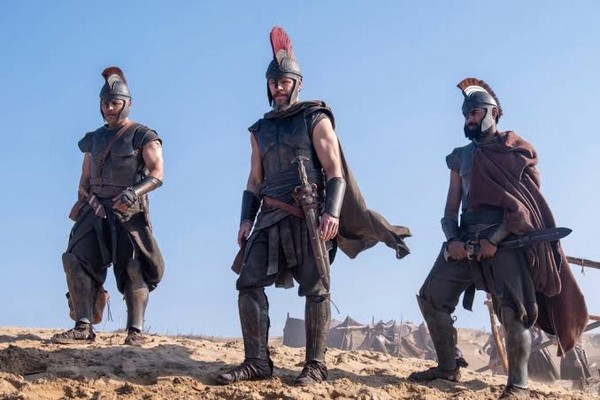
As the Odyssey is an epic, one expects an all-star cast. One receives. Matt Damon has his fifth film of finding how hard it is to go home, and his Odysseus is a haunted man, central and powerful but broken and burdened with a weight. Anne Hathaway is fiery as the frustrated Penelope. Tom Holland as Telemachus carries more than ever and does so admirably, proving himself as a solid actor. Robert Pattinson is wonderfully camp and sniveling as lead suitor Antonious (Tony Curtis vibes). John Leguizamo’s blind Eumaeus is a source of heart. Charlize Theron, Mia Goth, Logan Marshall-Green, James Remar, John Berenthal, Elliot Page, and Lupita Nyong’o: each and every one shines with limited parts, making the movie theirs for brief moments. One can go on and on about the amazing performances, but we’re out of time! But, most of all, I loved everything Samatha Morton was doing as Circe. She’s in a whole other plane of performance, and it’s delicious. Additionally, Hamish Patel is an unexpected foil as the right-hand man of Odysseus.
Christopher Nolan’s Odyssey is a triumph of epic filmmaking. A set of fantatsic peformances give a heart and home to a larger-than-life, surreal adventure; keeping it grounded, but just as astonishing. Nolan’s restraint in filmmaking makes a full tale of intrigue and excitement; buoyed with another great score from Ludwig Goransson and a look from Hoyte van Hoytema.