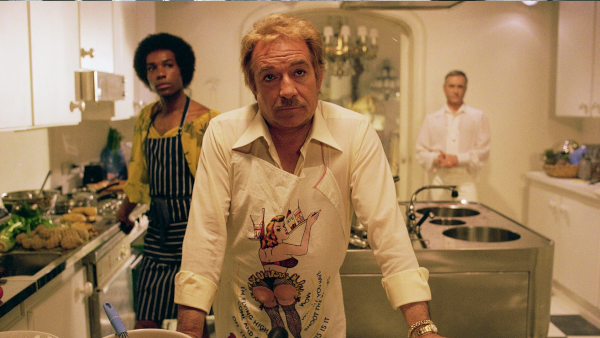
Renato and his partner Albin want to be excited for their estranged son’s engagement. But when the bride’s conservative family wants to meet them, they’ll have to use their drag skills for the hardest role cabaret crew has ever had to pull off… Playing things “straight”.
Many people familiar with the work of Robin Williams will recall this premise from his role in the American remake of La Cage aux Folles, otherwise known as The Birdcage. Fewer folks can tell you that it’s a remake of a French title that adapted a 1973 stage play and became a trilogy. The original film provides comedic insight into the world of Renato Baldi, with his club being directly inspired by Chez Michou, an iconic French drag cabaret. He’s accustomed to his animated partner and their crew of equally flamboyant dancers, while he himself has a more stern and soft spoken existence. When his son reaches out to tell him he’s engaged and the family of the bride-to-be wants to meet him, Renato has to find a way to pass himself, his partner, and his peers as straight men in an attempt to appeal to the family’s conservative values. A premise that could be contentious but creates the perfect comedic playground to work with.
La Cage aux Folles is “Guess Who’s Coming to Dinner” for the eccentric cabaret crowd. While the subject matter of hiding one’s identity to appease someone else’s social political values can feel heavy, the presentation is anything but serious. Every comedic moment comes from the social discomfort portrayed in each situational scene. Whether it’s the maid who’s normally barefoot struggling to walk in their butler shoes, or Renato quickly dishing out soup before his guests can notice the homoerotic bowls he forgot to hide, there’s a laugh a minute. The only drawback I can think about is domestic violence that’s alluded to in the name of comedy. That shouldn’t deter anyone from watching this otherwise humorous outing.
There’s a duality at play between the relationships. Renato and Albin live a passionate and vibrant life. Far from perfect, but it’s bright, emotional, and reinforced with a cast and crew of supportive friends. The family of the bride-to-be, however, are stiff, prim, proper, and void of any warm or welcoming vibes. Renato and Albin don’t just have to hide their nature and ask those around them to play specific roles for an evening, they have to stifle any of their usual lively mannerisms.
Albin, played beautifully by Michel Serrault, does most of the comedic heavy-lifting. Serrault had to embrace the very concept of selling yourself as something you aren’t. As a devout Christian, Serrault initially had doubts about stepping into the role. However, much like the story itself, discomfort led to a fantastic performance and the film is all the better because of it. As for Renalto, the role was far less alienating. The cabaret owner is played by Ugo Tognazzi, who was a married father of three at the time of filming. Ugo had a history of starring in raunchy sex comedies, such as 1964’s The Magnificent Cuckold. I personally remember him as the man who rescued Barbarella from killer dolls in the 1968 screen adaptation of the French sci-fi comic. My love for horror had me wondering how I recognized Tognazzi, which didn’t click until I did research for this very article.
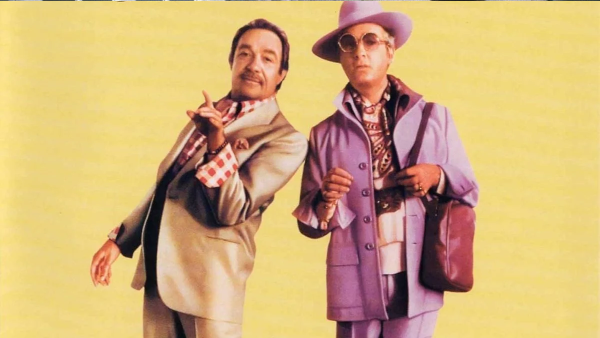
As a movie, La Cage aux Folles isn’t a technical marvel. It shows its age with several prolonged shots, some audio work that accidentally highlights chewing sounds, and a grainy raw video that would make a chore for anyone seeking to remaster the film. But to be fair, none of this matters. Thanks to the screenplay work of Francis Veber (with an assist from Édouard Molinaro, Marcello Danon, and Jean Poiret), none of the film’s age pulls the viewer out of the experience. His comedic timing always lands. Whether it’s the slow burn of the overall premise, or a scene where conservative heads have to intermingle with performers in complete drag, everything about La Cage aux Folles screams “comedy classic”. This isn’t new for Veber, whose work has a history of being adapted in the United States. Anyone who has history with such films as Dinner for Schmucks or The Toy, can get a general idea for what kind of comedy to expect. Marcello Danon, the production manager for La Cage aux Folles, passionately followed the franchise as a producer for the first sequel and America’s adaptation; The Birdcage. Edouard Molinaro also returned for La Cage aux Folles II. Neither had any involvement with the third film, which raises both curiosity and concern of La Cage aux Folles III: The Wedding. I’ll approach that film with cautious optimism thanks to Serrault and Tognazzi sticking around for all three French titles.
The film ranks highly, barely missing its place on the top ten list for imported movies. Nothing about the story is too harsh or hostile to any demographic, so viewers can trust that they’re in for a worry-free laugh. I hadn’t heard of La Cage aux Folles until this year and when I decided to research it for pride month and I found myself pleasantly surprised with what I discovered. This movie, and the stage performances its based upon, are presentations of beautiful chaos that never steps into cringe inducing territory.
Anyone looking for a laugh during pride month should consider this film, and perhaps its subsequent releases as well. Folks can currently enjoy La Cage aux Folles, its first sequel, and its American remake, on Amazon Prime. Anyone seeking the third entry can find it on MGM+.