

Karl Thomasson, former mercenary and hands-on substitute educator, finds himself dealing with another troubled group of students. This time, they’re white nationalists who are being groomed for domestic terrorism in a military academy.
The Substitute: Failure is Not an Option is the fourth and final entry in the Substitute franchise. For those unfamiliar with the movies, the premise is fairly simple. A war vet steps into academia to pose as an educator while trying to investigate and eliminate a criminal element. The first film, 1996’s The Substitute, followed Jonathan Shale, a Vietnam War vet who tackled an inner city gang problem. Following films abandoned the character and became a straight-to-video series that followed Carl Thomasson, later spelled “Karl” for part three and four. The idea was more or less the same for The Substitute 2: School’s Out and The Substitute 3: Winner Takes All. Going from high-school, to college, the character of Karl Thomasson leaned into his facade, getting a teaching degree between the second and third films, which he uses to his benefit in The Substitute: Failure is Not an Option.
Karl Thomasson, played by Treat Williams, is approached by a former military companion, Teague, with a request. Teague’s nephew has cut off all contact with his uncle after telling him that he was joining a group called the Werewolf Unit at his military academy. Teague believes that the unit is a white nationalist group, and needs Karl to get insight to make sure his nephew is okay. Naturally, the suspicion is spot on, and Karl finds himself facing hostile students and the staff in charge of them when he arrives. He’s given the task of teaching military history, replacing a teacher who dropped out. We quickly find out why as Karl gets push back from some of the Werewolf Unit, who make bold claims, deny the holocaust, and try to threaten their new educator. Karl does what he has always done as he infiltrates the school, identifies the hostiles, figures out their scheme, and takes them down using hand-to-hand combat. It’s a straightforward narrative. The film showcases the enemy, makes you hate them, and then takes you on a journey of their undoing.
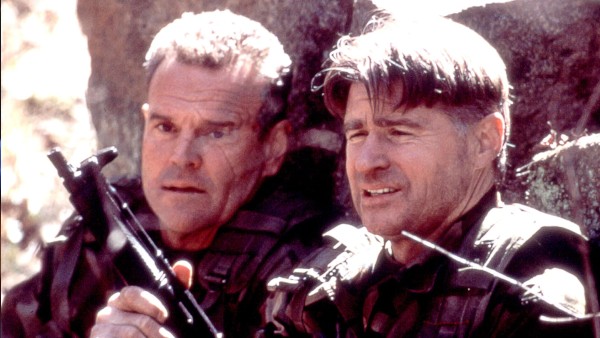
Treat Williams carries himself like a more charming Steven Seagal, walking around wooded areas in all black, barely jogging to avoid gun fire, and show no remorse after killing a target. It’s a low effort, high reward, endeavor. Treat’s character has plot armor, and he does little to hide it. While Karl was no more than a man, Treat portrays him as cool, calm, and collective, for better and for worse. Just crushed a truck with a couple of Werewolf Unit students in it? No reaction. In the next scene he’s casually planning a date. More humanity came out of Arnold Schwarzenegger in T2 when John Connor tried to teach him how to smile. This makes the Substitute films perfect for casual viewing. Whether or not humor is intended, the occasional laugh is welcome among the “good guy is good, bad guy is bad” narrative.
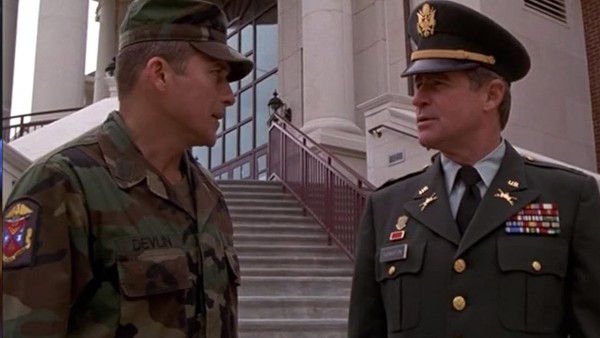
Treat is joined by J. Don Ferguson as Teague. He doesn’t carry himself seriously like Williams does, bringing concern and a bit of comedy to the mix. This was one of Don Ferguson’s final roles. Other notable works of his include Remember the Titans (2000), I Know What You Did Last Summer (1997), and Maximum Overdrive (1986). Karl and Teague get assistance from Luther, a handyman on the academy campus. Comic fans will immediately recognize actor Bill Nunn in the role. This was just two years before he would take on the role of Joseph ‘Robbie’ Robertson in the Sam Raimi Spider-Man trilogy. Luther appears in several scenes as an obvious character of interest. He’s an inside man during the entire narrative but doesn’t join forces with Karl until the final act. The rest of the cast is rounded out by Angie Everhart, Patrick Kilpatrick, and Tim Abell. They’re known for Last Action Hero (1993), Eraser (1996), and White House Down (2013), respectively. Everhart portrays Jenny, the film’s love interest for both Karl and Kilpatrick’s villainous Brack, while Tim Abell plays Devlin, another ally who joins late in the fight. Everyone put forth a respectful effort, especially for a straight-to-DVD outing. Nothing comes off as Oscar Worthy, but it isn’t Razzie territory either. Much like the film itself, all of the acting is acceptable for what it is.
The film is directed by Robert Radler, which is an odd departure from his usual work. He had previously directed such things as Mighty Morphin Power Rangers, Power Rangers Zeo, and Police Academy: The Series. The film’s writer, Alan Ormsby, has an equally perplexing resume that includes the previous Substitute installments, 1980’s My Bodyguard, and 1998’s Disney hit—Mulan. When you look at the past work for everyone involved in The Substitute: Failure is Not an Option, you see where the blunt, paint-by-colors, good versus evil, narrative comes from. Which may not necessarily be a bad thing. If you’re looking for a high octane action thriller, you may be disappointed. If you’re looking for thought provoking narratives, there’s not any to be found. But if you’re looking to see Karl Thomasson infiltrate another school for yet another case of boot-to-ass righteousness, you’ve got the perfect evening popcorn flick. Just expect a healthy dose of cinematic “cheese”.
At the time of writing, The Substitute: Failure is Not an Option is free to watch on Tubi.