
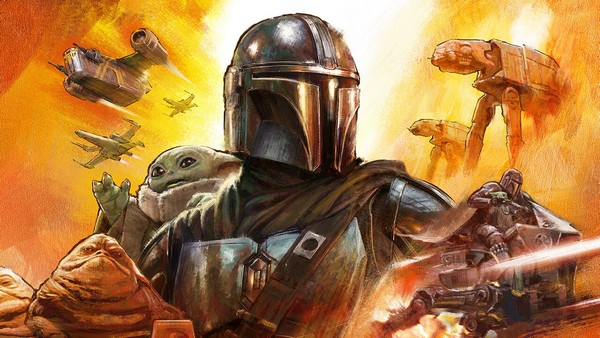
 A bounty hunter and his young apprentice search for an Imperial warlord and become embroiled in Hutt schemes in Star Wars: The Mandalorian and Grogu, Jon Favreau’s very fun but flawed big-screen version of the hit Disney+ show.
Star Wars: The Mandalorian and Grogu, directed by Jon Favreau, is essentially a stand-alone episode of the three-season Disney+ TV show and its immediate sequel, embiggened for the larger screen to a certain degree, for better or worse. Mostly for the better. That better: a series of fun adventures with all sorts of fantastic and fantastical creatures (via CG, practical, puppetry, and, hell-yes, stop-motion) and every sort of action sequence, such as chases, gun fights, dogfights, and hand-to-hand fights in every size and medium (now I sound like the Grandpa from Princess Bride; but this is not a kissing book). On the worse: as a stand-alone, there is little to arc the characters or give emotional heft, coming off a little empty, with the embiggening not quite IMAX-screen-worthy updates. It’s not a franchise shifter with all the ups and downs, big moments, but tempered to a fun, light adventure, one can have a good time; two hours of old-school serial energy in a fraught real-world (check Andor for the reflection of the world rather than escape). I love me some serial throwbacks: we all love Indy and The Mummy, but let’s not forget the Phantom, the Rocketeer, or even Sky Captain. Heck, that’s why The First Avenger is my favorite MCU. I like all those for what they are, so take it as you will.
Thus, fear not those who fell off the Mando landspeeder at some point along the way (and I get it, Season 1 is strong and has been diminishing returns from there). If you know the basics, the script by Jon Favreau, series creator and current overall Star Wars series runner Dave Filoni, and Book of Boba Fett writer Noah Kloor won’t leave you stranded on Hoth without a Taun Taun. Just being aware of the current (or 3 years ago, honestly) pop culture zeitgeist will keep you abreast of the adventures of Din Djarin, the titular helmeted Mandalorian, and his ward, the diminutive Grogu (aka Baby Yoda), as they travel the galaxy taking in criminals and helping those in need.
The basics of the plot for the movie: now working for the New Republic to capture or kill remnants of the Empire: warlords trying to take control of their fiefdoms. To bring in a big unknown, they connect with The Twins, Jabba’s siblings, who claim they’ll reveal the location of an important Imperial if their nephew Rotta (last seen as a baby in the terrible Clone Wars pilot, although the show itself was great once it got its footing; now definitely not a baby). That and any repercussions across the adventure is our plot. A whole lot is “go here, go there” with fights mixed within.
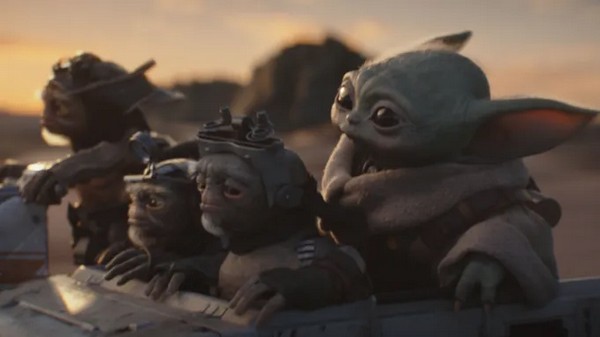
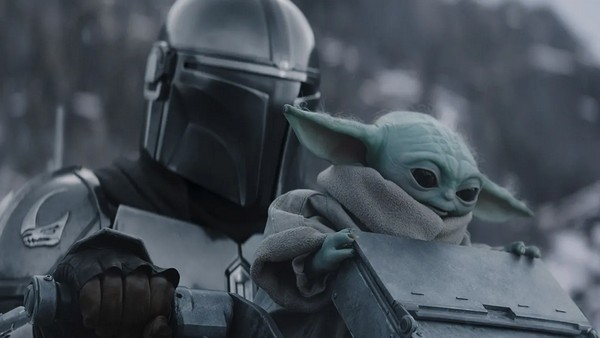 That adventure offers a great deal of fun within. It’s a bevy of wonderful creatures, a much higher percentage of non-humans than other Star Wars titles. Of course, many are CG, such as pilot Zev (from the excellent animated series Rebels, used briefly on the Mando show, now on hand across the whole time) and Rotta the Hutt. Others are straight from the Henson workshop, such as the diminutive Anzellans (the species of Babu Frek in Rise of Skywalker). Even stop motion! Straight from the 80s style. Let’s not forget our titular Grogu, one of the most expressive and lovable puppets. Thank you, Werner Herzog, for insisting on a live-action, tangible puppet over CG.
These creatures are awesome. It all looks great. A massive watersnake could be straight from Ralph McQuarrie’s unused Star Wars concepts. I did a quick search in my books and online, but didn’t see this specific one; it could be (if it is, I’ll update). Newer Star Wars is no stranger to using unused McQuarrie art – Zeb was an early Chewie design, and a spider-monster was used in Mando earlier. Speaking of spider-monsters, many of the creatures and crawlys could be straight from the Spider-Pit sequence in Peter Jackson’s King Kong. Lovely! That film also tapped into the serial energy. There’s great effort into giving the film life via the creatures and effects.
On the action front, as an action serial, it hits just about every combination. Fights hand-to-hand, gun chases, gladiatorial arena fights, chases on foot, air, and in water. The team keeps it moving. Favreau’s camera work isn’t all that special in the shooting and choreography, but it has moments that elevate. But all is constrained with a slightly bigger take of the already heightened TV show offers. It’s still held in small locations, handfuls of extra cast. Don’t expect the Battle of Skariff for a dogfight, nor a chase to come close to the depths across Coruscant in Attack of the Clones. With so many, they tend to be a little short, and as noted, smaller than expected for the screen.
 I appreciate how contained it is. Like the first season of the show, there is little to connect to the Skywalker saga. Never are Jedi, The Force, or our favorite characters from that cycle mentioned (save Jabba the Hutt). We’re off in the edges of the Outer Rim, C-3P0 isn’t going to randomly show up and freak out (Anthony Daniels is still in the credits as another character to keep his streak). Thus, it avoids fan service in that way. There’s some great world service, though, building up the Galaxy Far Far Away a little more. Is this the first time we’ve seen the inside of an AT-AT? I always appreciate moments of seeing the citizens live their lives; I loved a Cajun-coded fisherman. Fun to see a droid army made up of remnants of styles we’ve seen before.
The cast bringing it together is mostly in voice work, over the amazing creations of the effects teams. Mando himself is the combination of Pedro Pascal, Brendan Wayne, and Lateef Croder. Sigourney Weaver adds another geek property as Mando’s New Republic job giver. Honestly, she seems bored. But not bored is Martin Scorsese as a jumpy food and information dealer. Steve Brum brings Zev to life, and Shirley Henderson continues her voicing of the Anzellans. They all elevate the lackluster writing. Holy Sith is the actual scripting bad; basic lines, mostly in exposition. The snappy and quippy Star Wars push is not present in favor of direct and unmemorable dialogue. It remains in the brain in terms of how often it is repeated. I’m sure Rotta has about five lines with variations. Jeremy Allan White is such a strong actor; he makes them work and gives Rotta something more to hang onto (I really dug how he was used). Said writing is uninterested in moving Mando and Grogu’s story and connection further, nor any character shifts at all. The main set is the same as the start as they are at the end.
But fresh from his Oscar-winning score for Sinners, Ludwig Goransson continues and expands his awesome score to give the right excitement and drive. His score on the show was a masterful Western-driven one, and it is true in the film. Continuing sound notes: I always love hearing David Acord work with Ben Burtt’s iconic Star Wars sound design; out of everything, it’s what brings me into Star Wars when I watch.
Part of me wonders if Mandalorian and Grogu is too little too late. The series has lost steam, interest, and pop culture vitality after the initial explosion at Disney+’s launch in 2019. As it is, it’s a fine diversion. A fun serial-style adventure. It’s a little empty in that way, with no real stakes physically or emotionally; it might not fly for many, and I get that. Jon Favreau’s Star Wars: The Mandalorian and Grogu is theatrically released on May 22nd.