
 Guillermo del Toro’s Frankenstein finds a true soul among exquisite gothic grotesqueries in the iconic story of a reanimated corpse.
There have been countless versions of Frankenstein throughout film history since Edison Laboratories’ 1910 short. As mutable as using different parts of diverse corpses, Frankstein can be built in countless iterations. While James Whale’s Universal Monsters duology of Frankenstein and Bride of… is perhaps the most iconic, the creature, his creation, or simply the ideas have been used for serious, for fun, or just to explore the conception of creation, ownership, beauty, and knowledge. Heck, I consider Poor Things a Frankstein tale. (I’m particularly fond of Frankhennenlotters’ trashterpiece Frankenhooker myself) For Guillermo del Toro, his long-gestating version hews closest to Mary Shelly’s original novel since Kenneth Branagh’s 1994 over-melodramatic take, yet he takes the familiar and makes pure artistry in a way only he can.
Del Toro is a Monster Kid in an adult body, one who knows how to craft physically gorgeous, emotionally relevant, and just damned plain entertaining films. He understands the gothic horror: the soul of monsters and madmen, or the curious and broken. He finds the truth in pain and longing. He knows the sheer craftsmanship of pure cinema. He’s made an impressive career of melding all of his interests and presenting them to audiences to revel in his loves. From Cronos to Pinocchio, everything he’s done has formed a love of horror with character and emotion to make whatever the focus work. Yes, even Mimic, as messed with as it was by Weinstein, del Toro’s dark soul still oozes through.
He’s at his best working in the dramatic end of fantastic horror, but that’s nothing against Hellboy or Blade II; I love those films to death. Frankenstein joins Devil’s Backbone, Pan’s Labyrinth, and Crimson Peak of the top-tier Del Toro films. Not unlike the creature at he center, Frankenstein may be the culmination of everything he’s done, cobbled together from the corpses of his films to shoot a bolt of creation energy into a familiar story. His loves and interests laid upon the 1818 novel.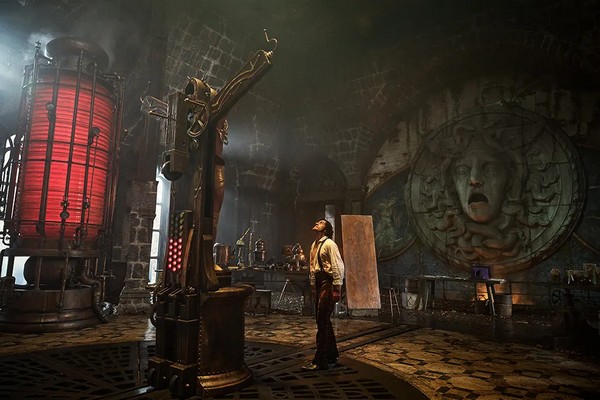
Sure, you can try to make wry connections to the Universal or Hammer Frankenstein cycles if one wants to, but it stands on its own two severed feet. It’s a film that seeps into the viewer with every moment, whether it be my new favorite creation sequence, the tiled lab with the massive hole, the love of monster art, or the living statue appearing to Frankenstein in a very Del Toro touch. This is a film that put an ear-to-ear grin on my face from an overwhelming beauty, continually thinking, “this is perfect. This is for me.”
Del Toro’s Frankenstein is a film filled with soul. It brims with both memento mori and celebrations of life. It explores gods, fathers, and sons, and the pains of generations, of how knowledge is gained and used. It’s a film of madness driven by obsession. What happens when the obsession pays off? What to do next? How can one approach what one wants without falling victim to a deep, dark nothing? How can another who seeks knowledge but can’t find it from regular means seek love and kindness? What makes a monster? What makes a man? Frankenstein is a powerful film that resonates. It has a sweeping grandiose.
Before anyone utters a word, it’s clearly going to be absolutely stunning visually with breathtaking beauty. Thanks to Shape of Water’s Dan Lausten’s gorgeous cinematography, a windswept Arctic plain immediately seeks the film’s importance; it hits how wowed one will be over the next 150 minutes. Frankenstein is a film where one can turn off the soundtrack and be overwhelmed by the sheer production value. The devilish decadence of the detail abounds every shot, thanks to the lush production design by Tamara Deverell. While every moment is visually stunning, the centerpiece of the derelict abandoned water tower of creation and destruction is one of the best film sets ever, and is representative of the film. Reminiscent of Crimson Peak, it’s exquisite with the rot and decay of sweeping staircases, exposed and overgrown molding. The faces of old gods look down on our characters. I’m a huge fan of Crimson Peak in every way, and that film’s look and the feel from the design echoes into Frankenstein. This continues with the shared costume designer in Kate Hawley. She was robbed by not even getting an Oscar nomination for Crimson Peak, and if she’s ignored again, it’s an absolute travesty. Others can speak to the intricacies of the complex and stunning vestments, but between Mia Goth’s stunning dresses, the sheer striking nature of the Creature’s massive hood and flowing robe when first encountered, and everything in between, it’s shocking that any person or team has this much talent. Tying all of the mostly practical astonishment together is a sublime score by Alexandre Desplat. Another I’ll have to pick up. 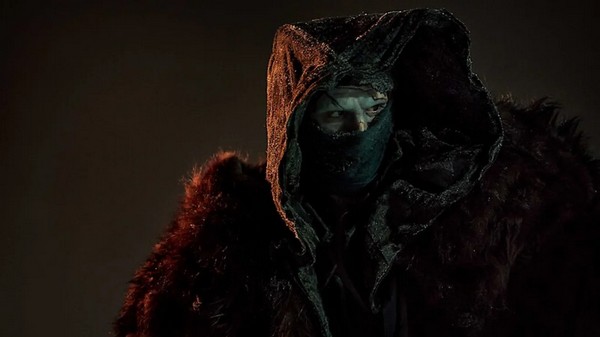
It’s a world where everyone is embused with a righteous madness. Oscar Isaac’s Victor Frankenstein is filled with electricity and sparks that he doesn’t know what to do with himself when he achieves his goal; he flounders when faced with the consequences of real action. It’s fascinating. Isaac is big and grand. But he’s not camp or over the top. Christoph Waltz lives and works in just campy enough performances, and he does some of his best work, edging close to Ernest Thesinger’s Dr. Pretorious, but also filling the Henry Cleval role. Mia Goth is as entrancing and ethereal as ever; however, if there is any rot in the film, it’s that she’s given the short shrift, tidily underused.
Perhaps the sanest, only sane one, is The Creature himself, brought to life by Jacob Elordi. While seen technically see him first on the ice in the Artic wraparound, the initial time we truly see his eyes, looking up at Victor post-creation, they are filled with such soul and wonder. That look. It immediately humanizes the creature. Of course, we know Victor Frankenstein is the true monster. That’s the rub of the show. At this moment, Elordi makes the film his, grasping it right out of Isaac’s hands. His Creature is the best since Karloff’s iconic performance. Elordi already made an impression on me with as Elvis in Priscilla and the object of obsession in Saltburn, but Frankenstein is a forceful declaration of the power of a perfect physical performance. For good reason, Del Toro and all, I was reminded of Doug Jones, little, tall, and with a beauty of movement to portray all the pain. (Jones cameos in a silent role near the start) I’ve never seen The Creature be this human. He’s filled with life but looks like death, down to a coat taken from a dead soldier with the impression of the exposed spine (the overgrown, forgotten battlefield littered with skeletons is a favorite moment) or the moments of rot and exposed structure of his body. Kudos to his make-up design by Mike Hill, not overdone but hardly lacking. Based on Bernie Wrightson’s drawing of the Creature, it’s just enough.
Guillermo Del Toro’s Frankenstein is a sumptuous and breathtakingly beautiful film. Every ounce and level of the production forms a divine decadence that seeps into the soul of the viewer, often overwhelming with the resounding triumph.