
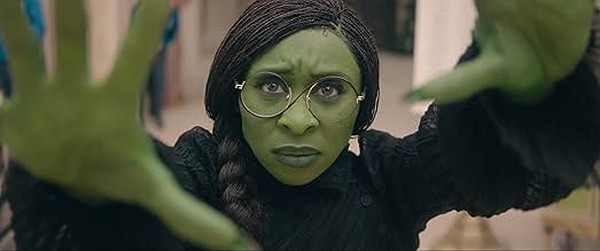
 Before The Wizard of Oz, Elphaba, future Wicked Witch of the West, travels to Shiz University, entering a rivalry and friendship with Galinda in John M. Chu’s musical extravaganza Wicked (Part 1).
Wicked was released during the holiday season of 2024. It was a massive, runaway hit, pulling in audiences for multiple viewings, including sing-along showings, nominated for a bevy of awards, and winning two deserved Oscars: for Production Design (Nathan Crowley & Lee Sandales) and Costume Design (Paul Tazewell). With the release of Wicked: For Good ready to drop onto culture like Dorothy’s house on the Wicked Witch of the East, I thought I’d return to Oz with a review of the first film. First half, to be technical, as Wicked and Wicked: For Good were made from the ground up as a set, two halves of a whole story. For ease of semantics, we’ll call 2024’s Wicked and 2025’s For Good.
The Wizard of Oz has been part of culture since the release of the first L. Frank Baum book in 1900. Across a never-ending series of book sequels and an interconnected universe of Baum novels, Baum’s story of the marvelous land of Oz has created generations of fans, and the property has continued across films, TV shows, stage shows, and various other sequels in print and comics. Of course, the 1939 Victor Fleming film, starring Judy Garland, is one of the most seen films of all time, and such a cultural touchstone; I’m sure the entirety can be recreated solely from The Simpsons clips. One of these extensions was Gregory Maguire’s book Wicked: The Life and Times of the Wicked Witch of the West, a prequel to the titular character. Published in 1995 and followed by several sequels, the revisionist Oz was enough of a hit with its expansion of the Oz mythos into a full-fledged world to become a Broadway smash in 2003, via Stephen Schawtz and Winnie Holzman. And now in a two-part film adaptation of the Broadway show, directed by Crazy Rich Asian’s John M. Chu, adapted by Holzman and Dana Fox.
 Call me surprised, but I was over the rainbow with how much I loved Wicked. Everything works so incredibly well. It’s astonishing. While the 2 part split was originally scoffed at, perhaps a cynical cash grab, making two halves the same length as the whole show, it worked in its favor.
Wicked is a Full-Fledged Flippin’ Film, far from a basic Stage Adaptation (based on a book based on a film adaptation of a book). It organically embiggens the telling in every way. John Chu’s production allows the story, characters, moments, and world-building to breathe and land. It’s huge and crowd-pleasing. By the time Defying Gravity lifts the audience into a cyclone of astonishment, it’s wowed again and again, with a zesty largess in its intensity and insanity, choreographed and performed musical numbers, but also a solid grasp of character. The world is grand, richly developed, and fully immersive. Oz is Alive. Chu and editor Myron Kerstein reconfigure the scenes, songs, and set-ups to flow in a film world, building and breaking, returning to a force; using the new medium to great effect.
At the center of Wicked is the rivalry, friendship, …more?, of Elphaba and Glinda. Elphaba, with her unnaturally green skin, has continually been an outcast, even as a rich daughter of the Munchkinland magistrate, ignored in favor of her wheelchair-bound sister Nessarose. When Nessarose attends Shiz University, Elphaba is encouraged to stay by magic teacher Madame Morrible. This disrupts the social scene of the university, led by the bubbly, pop-u-lar Mean Girl Glinda.
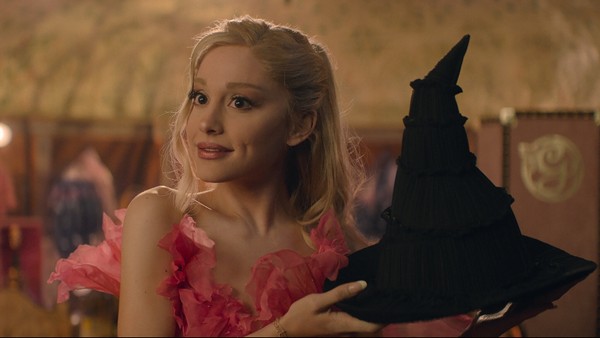
Ariana Grande was met with side-eyes at her casting, but she slays as G(a)linda. Glinda is the more dynamic character of the Elphaba/Glinda duology, making the big changes, revelations, and shifts. She brings it all, proving her massive star power. That doesn’t mean Cynthia Erivo as Elphaba slacks at all, just less showy (as matches the character). She has a powerful depth. She is stoic and pushes people off, since that’s how she’s been treated. When things change, how does it affect her? What about the known truths of the world, like the Wizard of Oz, being not as true as expected? The pair has amazing chemistry, as seen in the marketing blitz.
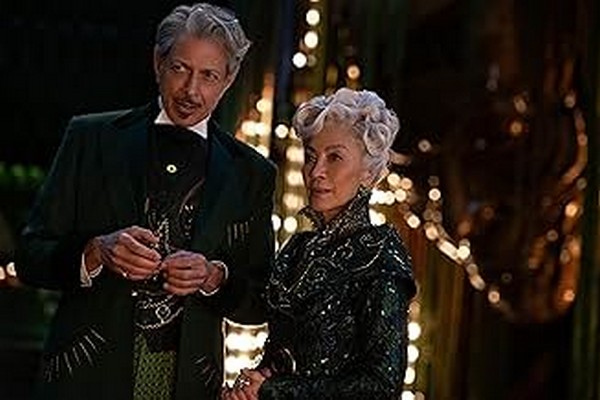
 The rest of the cast is similarly perfect, save maybe Jeff Goldblum’s singing voice. But really, Goldblum is very well cast as the schemiy, skeevy Wizard of Oz. Michelle Yeoh is wonderfully campy. Heck, the whole film has the right level of camp within, but the big brash Broadway camp that makes a show lively and memorable (but let’s not forget the darkness of Fascism lurking and growing). Bowen Yang and Bronwyn James as Glinda’s sycophants live in that world, nearly stealing the show in roles that may be annoying in different hands. Filling in is Jonathan Bradley, effortaly charming as Fiyero the Prince, and Ethan Slater as Boq. Peter Dinklage’s Dr. Dillamond (by voice; Luisa Guerrimo in movement as she was for him in Toxic Avenger) drives the importance of this story, the brutal underpins under the purposely over-lit and bright Oz.
On the technical side, it’s also a (Professor) Marvel. The Oscar-winning costuming is coupled with the character designs. The production design is sumptuous, using massive practical sets buffeted by mostly great CG. They used 9000 tulips in the Munchkinland sequences. Oh, how I loved the library set! The choreography in that part was wonderful, as was the joy of it all.
After this great setup. I wonder how the audience will take For Good. It’s much darker and dramatic; a lot of the candy coating of the fascism presented in the first half has melted away. This makes this work as a full free-standing story. Wicked is far more than a standard “the origin of the Wicked Witch” but a look at bigger issues. Maybe it’ll bring in more “Return to Oz” (I kid, or do I? I love that nightmare fuel).