
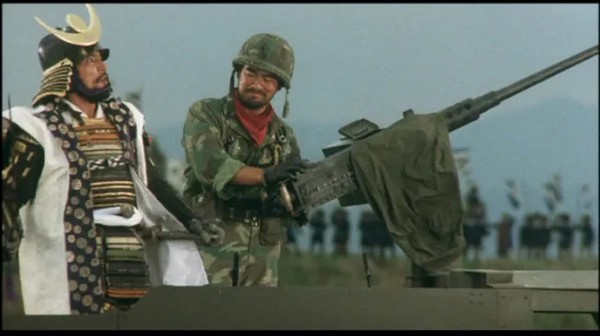
 In G.I. Samurai, Japanese troops find themselves 400 years back in time and join the fight during a civil war. Kosei Satio’s 1979 film is now on Blu-Ray via Arrow Video in May.
The Film
TW – Sexual assault
G.I. Samurai is an interesting, strange, and different take than ever expected for such a plot. It’s a conflicting film, where I’m not entirely sure how I feel about it. I’ll admit, while watching, I was taken a little aback, shocked at the film, but in reflection, in the time between finishing and writing this, it’s sitting much better, although not without my issues.
G. I. Samurai is a Japanese time-travel movie from 1979, directed by Kosei Satio and adapted from a novel by Ryo Hanmura, with a script by Toshio Kamata. Sonny Chiba leads, and the renowned Japanese genre film star may be enough to get folks through the door, which works for me! He’s very good as the head of a Japanese military group on a training exercise when they encounter an anomaly on the beach. Before you can say “Great Scott,” they end up four hundred years in the past, in the midst of a civil war. In a great change, it’s not just one guy trying to figure it out, but dozens. It avoids the “hide our truth,” and instead, when meeting the people of the time, especially the various warlords and samurai, they show off their cool stuff: a boat, a helicopter, a tank, and a whole lot of ammo and weapons.
What it does is, instead, the more things change, the more they stay the same. The bloodthirsty, those ready to burst out but kept in by society rules, in any era, are ready to do what their internal wants tell them. Those trying to keep more on the path remain as well. A touch of how humans act across time is a draw; with a wider variety of characters is more about that than getting back to the future. I love Chiba’s idea, “let’s mess with history so much whatever did this to us will send us back, and we’ll do that by taking the whole thing over,” a reversal of the “lie low and not mess with history” of most time travel flicks. In the shift of “go nuts” rules of society are broken down, Chiba tucks into a violent streak, and others get uncomfortably into sexual assault (one sequence goes on and on, I hated that). An already existing war blows up, with in-fighting between the groups of the time, the soldiers from the future, and the everyday citizens caught between.
So, those coming in expecting a fish out of water, or finding honor in any time, might be taken aback. It’s a violent, nasty film, tearing into how often people can be to one another, and nothing can change that. It’s very different, a strength for those willing to take alternate aspects for a time travel film, even if just about everyone turns nasty; maybe one good guy here, making it a hard watch in plot and character between the action.
On the technical end, it’s very well shot, using the Japanese countryside incredibly well. So many amazing compositions of the various warring groups mixed with the modern military equipment. Production design is well-designed and encompassing. The action sequences, whether the one-on-ones, the smaller battles, or the straight-up wars, are very well designed and put together. When your star is Sonny Chiba, he has to have work to do, and his choreography is as good as expected. Chiba was the action director, and it shows.
Overly long at two hours and twenty minutes, G. I. Samurai, directed by Satio, is an odd beast; so much of it works incredibly well, but some bizarre choices in soundtrack and character actions mar the idea and film. I appreciate the different tack on the familiar story, and another great Sonny Chiba performance.
PS – There are some very, very, VERY strange musical choices, both in modern songs and in unfitting instrumental choices. Jaunty boppoing during sexual assaults, like it’s supposed to be funny (I sure hope it wasn’t), or pop songs that clearly are meant to connect lyrically but don’t match in tone.
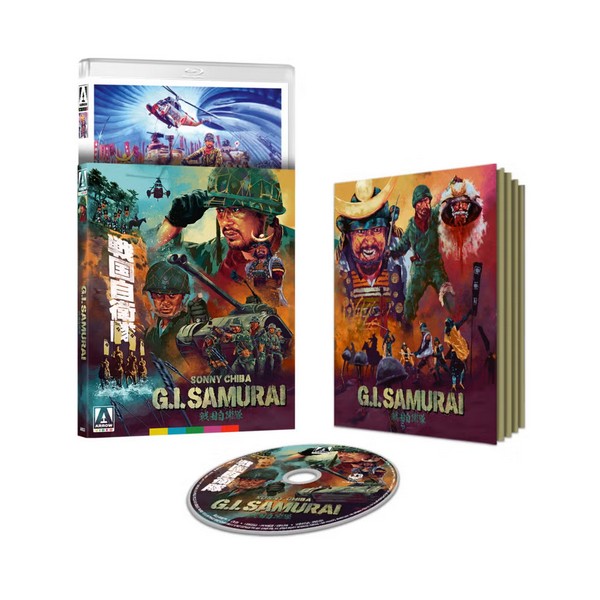
Image courtesy of Arrow Video.
The Package
Arrow presents G. I. Samurai on a single-disc Blu-Ray. The disc image is a close-up of the front cover art. It has a fully clear Blu-ray case with a reversible sleeve with original and newly commissioned artwork by Ilan Sheady. A booklet is included. All is bound with an o-Ring
The Presentation
1080p Blu-ray; Audio is original lossless Japanese mono and 4.0 surround, and a 5.1 remix. In Japanese, with new English subtitles. An uncut English version is also present, listed under special features, but of the same length. It would seem there may be different musical choices, as I’ve read that Time Slip, the original 93-minute US cut, put in rock songs instead of the other soundtrack. I was planning on going back and popping through to see, but time got away from me (fitting for the story here). I was actually a bit disappointed it wasn’t the truncated version; I was eager to compare.
The Features
Commentary (new)
Samm Deighan and Tom Mes make a solid pair to talk about everything about the film, its differences, the world the time slippers come from, and where they go. Highly enlightening and entertaining. They go well for the full length, too.
Critical Appreciations (new)
The Good Fight: Mark Schilling (22m)
Acting in Self Defence: Appreciation by Matt Alt (18m)
Back in Time: Masaaki Nomura and Tatsuya Masuto (25m); in Japanese
Arrow films three new appreciations/retrospectives from the folks above. Like the commentary, they dig into the details around the film, with a specific note of the country at the time, how their post-WWII forces worked, and their outlook. There’s an appreciation for characters, expectations, and how they were worked again, and lots of love for Sonny Chiba. They don’t overlap and get pretty detailed. I specifically enjoyed the Japanese pair, as people knowledgeable of living in the industry, in a lively discussion.
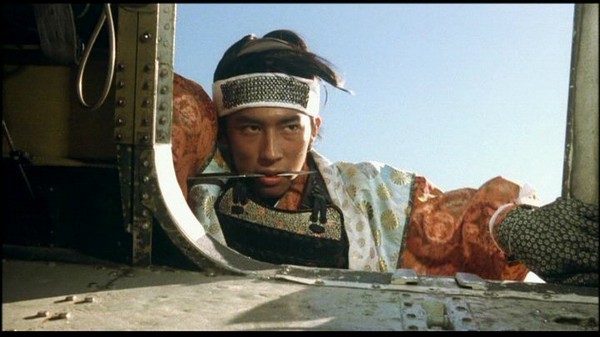 Interviews (2005)
Sonny Chiba (20m)
Isao Natsuyagi (23)
Hiromitsu Suzuki & Kamayatsu Monsirue (23m)
Jun Eto& Isao Kuaishi (23)
A solid collection. Of course, I was most drawn to Chiba; the legend has so much to share. But the rest are great, getting into the details of filming and their approaches. Great insight into what they were thinking as making and their character choices, what the film is saying, and the industry.
Original theatrical trailers
Image gallery
Booklet
Included in a nicely bound booklet of 25 pages with the essay “Sanity Slip” by Josh Slater-Williams. The wonderful, lengthy essay looks at the film in comparison to other time travel films like Back to the Future and the similarly military-themed The Final Countdown, but also how Japan’s culture at the time speaks to the bloody changes to the results.
Final Thoughts
G. I. Samurai is a film I can’t quite put a finger on in how I feel about it. I’ll certainly mull it and will definitely return at some point. I certainly enjoyed it well enough to want to watch again. So that’s something. Arrow crafts a great transfer and solid features, new and old, to bring home the ideas and make a worthy purchase for fans. Arrow Video’s Blu-Ray of G.I. Samurai will be released on May 5th, 2026.