
 A Māori woman travels to England to find her family, instead finding a job as a governess. The beautiful, affecting, and often horrific Mārama, from director Taratoa Stappard, uses the Victorian Gothic to tell a tale of the horrors of colonialism. Presented as part of the Overlook Film Festival.
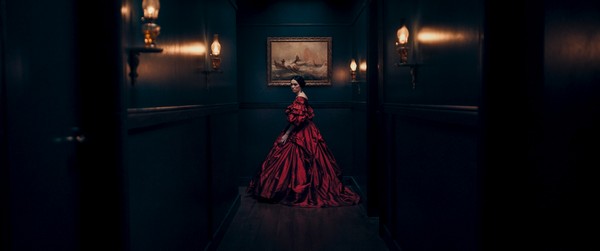
A woman in a white gown walks down a long, dark, and wooden hallway, holding a flame-lit light. A familiar visual on a screen or the mind’s eye in books? Yes. The Victorian Gothic trope is present often in Taratoa Stappard’s Mārama, as are so many others. But don’t discount it. This terrifying tale uses the sub-genre, infusing it with the horrors of colonialism to become a Māori revenge tale. A great first film for the New Zealand-born director, led by Ariana Osborne’s gripping performance as the titular character.
Mary, Anglicized from her Māori birthname Mārama, has just completed the 73-day journey from Wellington, New Zealand, to Whidbey, England. She’s come because she has received a letter claiming to know her family history, known in flashes and fits after being raised by settlers. Upon arrival in the brooding, dark, expansive mansion in the countryside, she finds not only that the letter writer has died along with his knowledge, but she may have a connection to the owner of the mansion: Nathaniel Cole. With his granddaughter’s mother passed and no one else to guide her, he asks Mary to stay on as Governess.
Mārama hits the expectations of the manse-bound gothic, a genre I’ve said time and time again is a favorite of mine (I stand by Crimson Peak as Del Toro’s third best film. Fight me). Taking a job in a secluded estate, an outsider continues to feel separate from whatever the hell is going on, with a new society of rules, histories, and secrets, sometimes familial, sometimes dangerous. People in the life are furitve with information, strange to action like the cultural appropriating Jack, White, but covered in Māori tattoos, or weak and sickly like Arthur, father to Anne, the young girl put in charge.
 And the powerful lord of the manor, Cole, might seem covenial to start, but is absolutely holding secrets that can threaten the livelihood of our heroine and her charge. Let’s also not forget those pesky ghosts, the sounds and figures seen or heard, gone with a flash, invading the night, mirrors, and dreams of Mārama; forcing a question of sanity and safety, and those nighttime wanderings.
All of this is used as a springboard to a new approach to the material, adding a layer of the lingering (or direct, even) effects of colonialism. The people in and around the mansion claim to have an affection for Māori culture, with artifacts and art about, but strangely mixed in with terrifying portraits of White conquerors performing terrible acts on people, animals, and nature. In the backyard, in a “secret” garden accessed by a rotating shed, creating a clear separation between the English world beyond the hedges, is a reconstructed Māori hut. Cole is very proud of bringing home the traditions and lives he found, but it’s locked, and he’s cagey about it. (natch).
As Mārama, Ariana Osborne is commanding as she becomes more and more unnerved by the events around her, out of step and out of comfort, while embracing her repressed roots. There’s something great about pushing off the colonizing that’s been done to her as she deals with what the house has for her. Ghosts in these stories tend to be about the histories of the people the outside is meeting, but for Mārama, it may be more than that, coming together well. Cole and his friends have costumeball that claims to be loving of the Māori but also seems to be damn them (highlighting themes here). She dreams of a Māori woman on a beach telling her she’s a seer, yet Mārama’s throat is cut in the visions. Is she in danger? She proves well to be a seer, pre- and post-cognative, leading to terrifying sequences as the history and people she touches flash at her and us. The rest of the cast is incredible as well, especially Toby Stevens chilling as the head of the household and Erroll Shand as the tattooed Jack. 
Stappord creates a gorgeous film, using the location to its best. The rooms loom, the hallways stretch on forever. It’s often filmed with natural lighting, creating an unease to the Gothic trappings (albeit with the “we see everything too cleanly due to digital” here and there). Importantly, Stappord crafts a tone of terror, leading to several effective, subtle horror sequences. And not so subtle. Without showing the film’s hand, the Gothic gives way to the grotesque grand guignol at times, to my surprise and glee, with shocking results in the 3rd act. What a way to end the film.
Mārama is the first film of a fantastic new voice in horror, led by a ferocious performance. Osborne is truly astounding as a woman in two worlds and has had enough with colonialism when presented directly with a path to her roots. It’s scary, using the Gothic tropes to great use, and deliciously bloody when needed to be. Seek it out.
Mārama is presented as part of the Overlook Film Festival, April 9th through 16th in New Orleans. It is due for a theatrical release in the US later this month.