
In 1956, nearly 72% of all American homes had televisions. In that year, the nation’s living rooms had Jackie Gleason, Ed Sullivan, and Liberace as regular visitors through the television screen. And also joining the home-based entertainment line-up was Bugs Bunny.
While the Bugs Bunny cartoons were always popular in theaters, either as part of the regular programming or within the confines of the kiddie matinee slates, television elevated these animated shorts to a great level of popular culture worship. Thanks to endless repetitive broadcasts, the Baby Boomer, Gen X, and the early cohort of the Millennial generations had the Bugs Bunny – and, by extension, the Warner Bros. animation output – as part of their lives.
In 1956, Warner Bros. sold the copyrights to its pre-1950 live-action Warner Bros. catalog for $21 million – as well as the copyrights to the pre-August 1948 color Looney Tunes and Merrie Melodies library and nearly all its black-and-white cartoons – to a company called Associated Artists Production (or, as the company preferred the spelling of its logo, “a.a.p.”). This company which focused on syndicating content to American television stations – it also acquired the Popeye cartoons from Paramount, among other offerings.
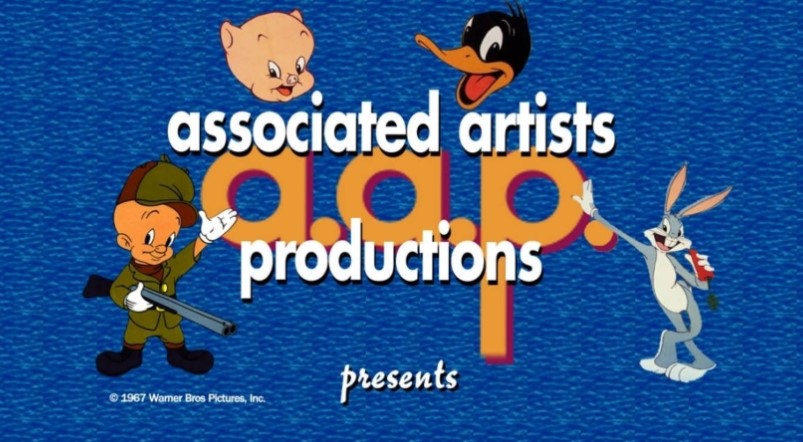
The a.a.p. deal had some interesting caveats. Warner Bros. retained the negatives of the cartoons it sold to a.a.p, as well as the merchandising rights to the characters in those short films. a.a.p. was provided with 16mm prints that were sent for broadcast to the local TV stations that created cartoon shows revolving around these productions. a.a.p. did not initially edit or censor the cartoons, but instead added a new opening credit featuring its logo which played with a snippet of “Merrily We Roll Along”, the Merrie Melodies theme, before each cartoon’s proper opening. The new opening credit featured Bugs and Elmer Fudd standing on each side of the new logo and the faces of Porky Pig and Daffy Duck positioned above the logo.
In late 1957, the ownership of a.a.p. became the subject of a legal dispute. In early 1958, the company declared bankruptcy. United Artists snapped up the troubled company, though it kept the a.a.p. logo on the Warner Bros. cartoons rather than take proper credit for itself.
However, because the original deal did not include the negatives to the pre-August 1948 cartoons, the visual quality of the films presented under the a.a.p. brand began to deteriorate due to endless broadcasts of the 16mm prints. Many of the surviving prints from this collection have a faded-pink opening credit title (see below) that betrayed the deterioration of the 16mm film stock.
But the youthful audiences of that distant era weren’t picky. These cartoons, which were mostly new to them, introduced them to the wild and wacky world of Termite Terrace. And if some gags and references went over their youthful heads – such as the Stag Reel that turned up in “What’s Cookin’ Doc?” (1944) or the reference to Bing Crosby’s horse in “The Old Grey Hare” (1944) – it didn’t matter. The freshness and innovation of these pre-1948 cartoons offered a unique blend of sophistication, silliness, and insouciance to an impressionable audience.
Some local TV stations would combine these cartoons with the works of other studios, while others would have a live host introducing the shorts while engaging in mild acts of tomfoolery. And still other stations just gathered up the a.a.p. Warner Bros. titles and presented them under the Bugs Bunny banner.
This section of the Warner Bros. output would later create problems for United Artists due to politically incorrect stereotyping. Cartoons featuring cruelly unfunny depictions of Black Americans generated anger as the Civil Rights Movement took shape, and by 1968 United Artists announced it was pulling cartoons from broadcast that were deemed too racist for comedy. The so-called “Censored Eleven” included the 1941 Bugs Bunny short “All This and Rabbit Stew.”
World War II era cartoons such as “Bugs Bunny Nips the Nips” (1944) and “Herr Meets Hare” (1945) were quietly kept off the air. However, cartoons that lampooned American Indians such as “Hiawatha’s Rabbit Hunt” (1941) and “A Feather in His Hare” (1948) were broadcast well into the 1980s.
Then, there was the sloppiness of United Artists in renewing copyrights. As a result, more than a few Warner Bros. cartoons fell into the public domain. With the rise of VHS video in the late 1970s and into the 1980s, several Bugs Bunny cartoons with unrenewed copyrights including “Fresh Hare” (1942) and “A Corny Concerto” (1943) wound up on cheap home video labels with the a.a.p. logo on their faded prints.
Today, the a.a.p. relation to the Warner Bros. cartoons is mostly forgotten except for animation historians and viewers old enough to remember that odd extra opening title. But without the constant broadcast of these cartoons from the mid-1950s to the early 1980s, a.a.p., the Bugs Bunny aura would have been considerably dimmer.