
Returning to a beloved comedy movie from decades past often comes with the nostalgic anticipation that one associates with school reunions. After all, favored comedies of youth could be considered the cinematic equivalent of childhood friends.
But not unlike many school reunions, viewing “Caddyshack” anew offers a reminder that nostalgia isn’t always what it is cracked up to be. Yes, parts of the film were uproariously funny as I recalled from years ago. But parts of the film surprised me with their laziness, their meandering and their utter lack of inspiration. What might have been funny (or at least forgivable) in the past doesn’t hold up today.
Memory served me well with Rodney Dangerfield’s astonishing performance as the reckless slob real estate developer who barges into the posh country club environment with tacky clothing and tackier behavior. With popped-eye exuberance and an endless skein of one-liners and putdowns, Dangerfield was the ultimate life of the party, and his level of energy was never truly duplicated in any of his later starring films. Ditto Ted Knight (in a rare starring film role) as the pompous, exasperated object of Dangerfield’s assaults. The two stars brought a broad, loud brand of old-style slapstick to “Caddyshack” that sold the film as a wild tackle to the funny bone.
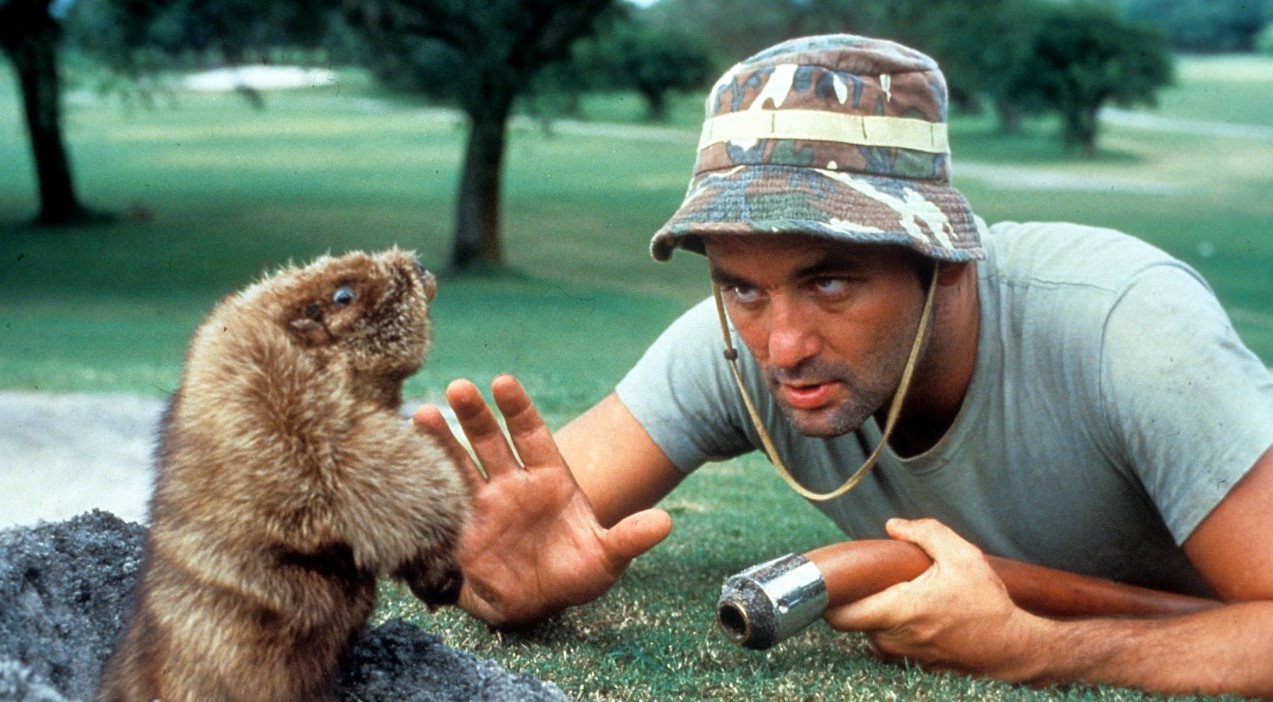
If Dangerfield and Knight represented old-school comedy, Bill Murray’s deranged groundskeeper represented (for the era) a new approach to comedy. His stream-of-consciousness monologues, with its detours into illogical notions (such as comparing a pesky gopher to the Vietcong), coupled with a deceptively slacker style, punctuated the manic atmosphere of “Caddyshack” with a subversive mischief. The cute puppet gopher being chased by the violent groundskeeper, of course, is an ideal foe for the decidedly non-cuddly Murray.
But, sadly, there’s the rest of the film – which often seems to interfere with the fun established by Dangerfield, Knight and Murray. The fourth star of the film, Chevy Chase, seems curiously unfunny by contemporary standards. His low-energy style and unfocused characterization (a supposed Zen playboy who engages in occasional physical mishaps reminiscent of his SNL-era Gerald Ford) constantly brings the film to a stop, and his interactions with his co-stars lack spark and personality.
Even worse is the film’s supposed core story, involving the goof-off teenage caddies at the country club golf course. Michael O’Keefe, in the nominal lynchpin role as the frisky caddy trying to seek a college scholarship, has such a weak screen presence that he rivals Chase for dull intrusiveness. The other caddies are given little to work with and merely take up space.
Director Harold Ramis doesn’t help matters through his lethargic staging of several major slapstick sequences, such as Dangerfield tearing up a harbor in an out-of-control yacht and the rude caddies invading the country club’s swimming pool. The film’s climax, involving a golf duel, is completely monotonous, and even Murray’s dynamiting the course to remove his gopher nemesis doesn’t make the sequence work.
Yes, I am glad to revisit “Caddyshack,” but the production was nowhere near the laugh-until-you-hurt joy I remembered. Either my tastes changed drastically over the years, or perhaps the film wasn’t as special as I recalled.
Or perhaps comedy films of a particular vintage are closer to soda than wine – rather than improving with age, their snap and fizzle grow flat with time.