
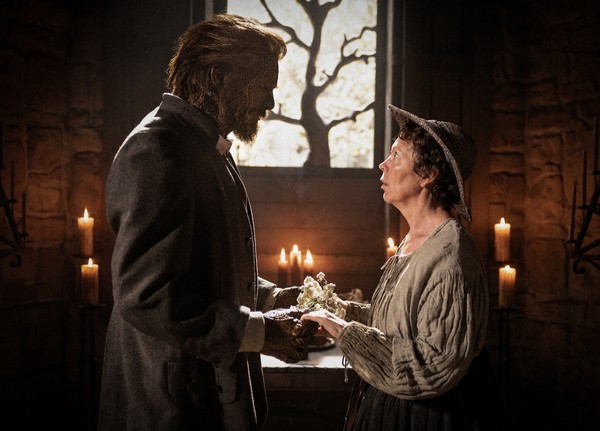
 In the delightful and hilarious Wicker, Olivia Colman’s lonely fisherwoman asks a basket weaver to make her a husband… out of wood. The intelligent, sensitive, yet rather ribald film from Alex Huston Fischer and Eleanor Wilson is wonderful and beautiful.
Sometimes love can come from the most seemingly unusual and unlikely places for those who don’t expect it. In a medieval (or thereabouts) English village. For the lonely and odd (in personality and smell) Fisherwoman, she finds it when she asks the Basket Weaver to make her husband. And since this is a fable, he does: he crafts The Wicker Husband, a sensitive wooden man utterly devoted to her. Their relationship shifts the village’s politics and personalities, speaking to our own inequities, histories, expectations, and actions. Wicker is a delightful, kooky, hilarious, emotionally intelligent, caring, and deliciously horny folk tale, written and directed by Save Yourselves’s Alex Huston Fischer and Eleanor Wilson, adapted from Ursula Wills’s short story The Wicker Husband.
Wicker is a charming film, led by another fantastic, lovable performance by Olivia Colman. A beautifully designed folk tale (in costuming, production, and makeup effects), it has just enough ribald humor, quite naughty and hilarious, but not forced; it feels natural. Everything and everyone flows together. The sorts of characters of the beautifully colorful town (compared to the normal brown drab seen on film for the era), who treat the lonely Fisherwoman with some scorn, not enough to hate and fully outcast, but pushed out for her smell and weird sense of humor, such as the Tailor, Tailor’s Wife, Baker, Baker’s Wife, Butcher, Butcher’s Wife, fall well into their folk tale archetypes, thus the nameless nature of every character. It has an elevated feel, with strong characterization, a simple setup, and dryly funny ritual touches. The Fisherwoman’s new Wicker Husband not only awakens her desires and happiness but also alters the town and questions how they all treat one another. Sometimes it makes them better, but just as often it forces them to quell those thoughts and lash out at the Fisherwoman, like the de facto town leader in The Tailor’s Wife.
 Wicker is a film about many things, expanding from the basic “weird lonely woman gets an even more weird husband.” It’s a film of communication in relationships, or lack thereof. Wicker Husband is forthright in his statements, often hilariously so; he’s incapable of lying, and in doing so brings out truths in others. Truths they might not say in front of those who need to hear them. A favorite scene is the bar scene with the men, which hilariously highlights how they keep things bottled up, or a moment with the Baker’s Wife overhearing Wicker Husband talk to Fisherwoman. When it comes to relationships, it focuses on questions about one’s own wants in life more generally. But it also speaks to the limits we place on ourselves because of society’s needs or fear, sticking with unloving relationships because society says so (a touch with a collar at a wedding is specifically pointed), slipping into gender roles, or the expectations that come with them. In a fantastic touch, Wicker avoids the clichés in teh stories that often go this way. There’s a spark of “awakening the village’s mindset,” but where many films go full bore on this, Wicker shuffles the concept in its own weird way, avoiding the saccharine and magical and drawing on deep wells of repressed emotion in smart ways. It’s not a surprise to those who have seen the solid Save Yourselves from the directors. That film merged an alien attack film with a relationship comedy with wonderful results.
If anything does quite weave together for Wicker, it’s the final act. Not bad, no; but slightly forced and contrived, with characters acting slightly out of character and being quickly rushed through. But with such a setup, and with the film purposely taking its time, it’s hard to wrap it up well when you think Wicker is more about idea than plot. The final few minutes do come together well; the steps to get there are a bit awkward.
The role of Fisherwoman suits Olivia Colman perfectly, to the point that it feels written for her. While she’s had plenty of purely dramatic performances, Colman plays the slightly oddball, just off the rocker enough, wonderfully across The Favourite, Hot Fuzz, or even Paddington in Peru, sketch comedy work and more. I don’t think anyone else could have fit the Fisherwoman as well. Perhaps Sally Hawkins, but she already had a film fucking a fish-man; let Coleman fuck her Wicker Man. Heh, in other films Edward Woodward or Nicolas Cage are put in the Wicker Man. Here, the Wicker Man is put in Olivia Colman. (At the first time in the film, my wife quoted the Futurama meme: “to shreds, you say?”). Wicker is a very horny film; sexual eye-openers all around.
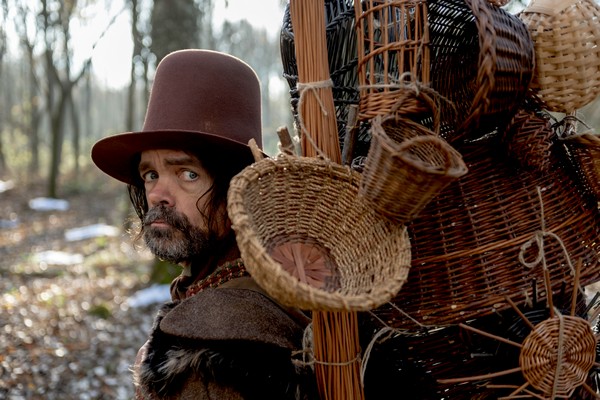
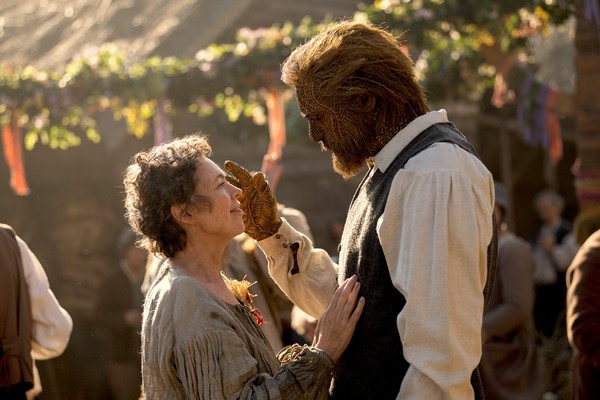 Colman plays against everyone in the film with her unique charisma. Alexander Skarsgård is similarly astounding as the plainspoken, direct Wicker Husband, with a beautiful sensitivity and softness, working the stiffness of his fantastic, fully realized make-up and body suit from Weta Workshop (on a sound level, love the little creaks as he moves). In the town, Peter Dinklage serves as the Magical-Realism base in the Basket Weaver. Elizabeth Debicki’s cool charm shines as she uses her stately, icy beauty to foil Colman as the antagonistic Tailor’s Wife. A standout is Marli Sui as The Bottle Cleaner’s Wife. She shone as a supporting character in the wonderful Anna and the Apocalypse and loved her here. Richard E. Grant appears in one scene as The Doctor, and he uses it for full Richard E. Grantness, looking like a wild version of another character, The Doctor, and eating up all the scenery he can for five minutes. The remaining cast of recognizable British actors are very well suited, playing the back-and-forth with fantastic timing.
Wicker is a film of sensitivity and beauty within the bawdy and horny. Fantastic performances from Olivia Colman, Alexander Skarsgård, and Elizabeth Debicki, and a keen sense of humor come together to tell a delightful fable. Alex Huston Fischer and Eleanor Wilson show amazing skill in balancing a myriad of elements to make one of this year’s big surprises. Check out Wicker (and their previous film Save Yourselves!)