
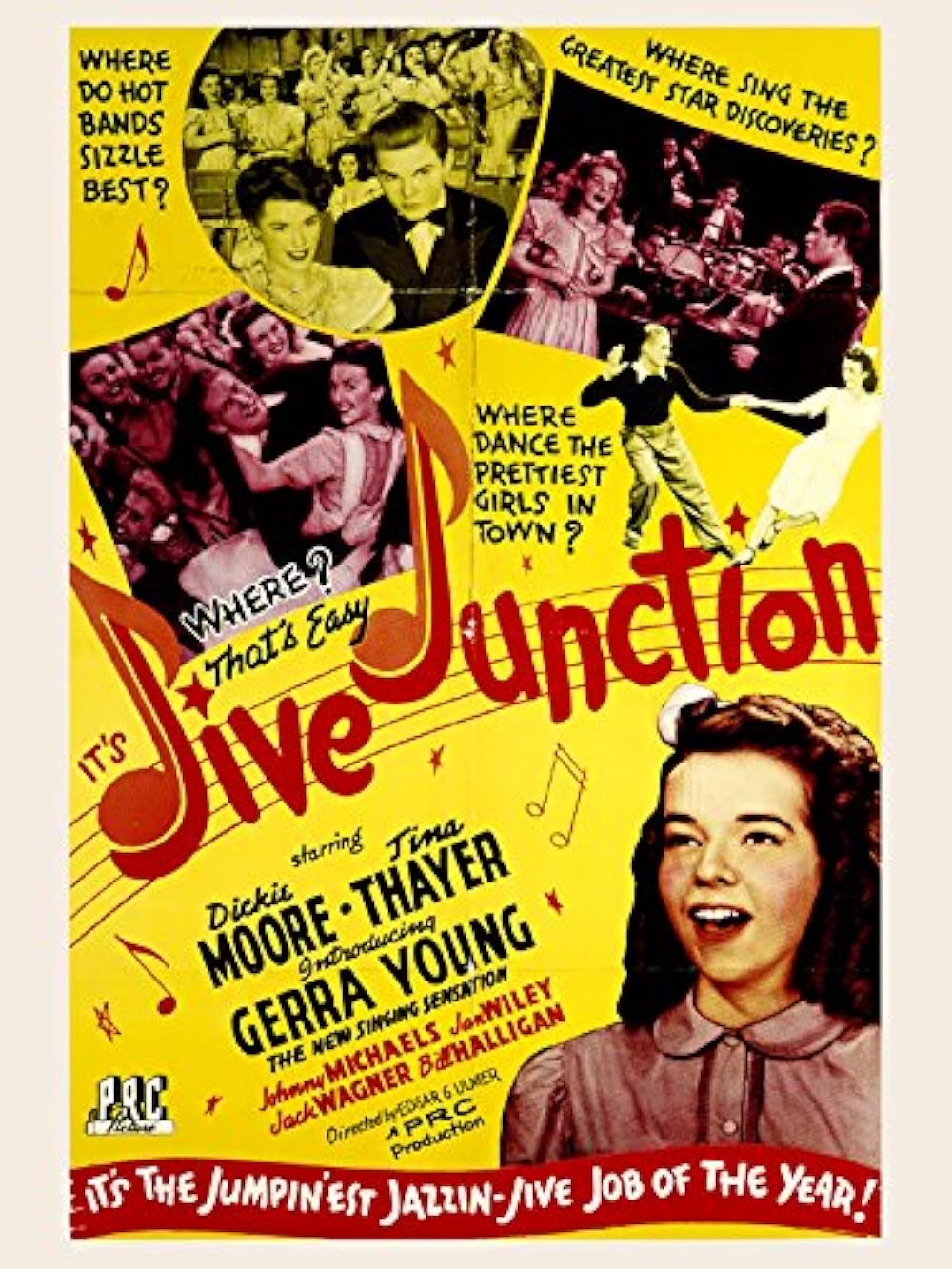
BOOTLEG FILES 847: “Jive Junction” (1943 musical starring Dickie Moore and directed by Edgar G. Ulmer).
LAST SEEN: On DailyMotion.com.
AMERICAN HOME VIDEO: It doesn’t appear to have been released.
REASON FOR BOOTLEG STATUS: There might be a music rights issue.
CHANCES OF SEEING A COMMERCIAL DVD RELEASE: Not likely.
When you think of the musicals of the 1940s, you probably think about the big-budget Technicolor productions from MGM or 20th Century Fox. Few people would immediately call to mind the output of Producers Releasing Corporation (PRC), the Poverty Row funhouse that churned out low-budget Westerns and thrillers. Every now and then, this cheapjack studio would put forth a musical – and while none of these films resonated within the popular culture, they provided enough silly distraction to help theaters fill their double features.
Typical of PRC’s musical forays was “Jive Junction,” a noisy but harmless little effort. The studio handed the responsibility for this work to Edgar G. Ulmer, an excessively prolific director with a talent for cinematic alchemy when it came to spinning threads of gold from leaden material. Under Ulmer’s direction, “Jive Junction” hums along at a crisp pace and never wears out its welcome during the course of its 62-minute running time.
“Jive Junction” focuses on the teenage Peter Crane, who arrives at a California high school after studying at a New York music conservatory. The girls in his class think he’s dreamy and the boys hate him immediately. Peter’s studies were in classical music, but he is savvy enough to realize the road to popularity is in jive. He arranges for a local barn to be turned into a dance hall where his all-girl orchestra plays jive music for soldiers who are in training for war. However, Peter doesn’t entirely turn his back on the guys – he also leads an all-boy orchestra in a national music competition.
“Jive Junction” requires a bit of patience as the story keeps switching personality gears as the story progresses – or, to be more precise, as multiple stories get slapped together. The initial fish-out-of-water story of Peter’s uneasy assimilation into his new classroom surroundings introduces the character as something of a junior snob. But things change dramatically when Peter and his mother receive a telegram that tells them his father died in wartime combat – this grim segment might feel out of place in what is supposed to be a light musical, but Ulmer’s direction makes it deeply moving, offering a chilling reminder of the genuine pain occurring overseas during this period.
The film’s let’s-put-on-a-show spirit in creating the Jive Junction for soldiers receives an unexpected shot of cynicism as the soldiers who are supposed to be the guests are initially hostile at the prospect of having to dance with high school girls. But when the soldier begin to appreciate the girls, the boyfriends of these girls become embittered – they can’t compete against the soldiers, who are viewed as heroes by the wider society. Peter solves the problem by bringing in older women to dance with the soldier, thus aggravating the teen girls who were enjoying their first pang of adult feelings.
There is an interlude where the girls in the orchestra happily volunteer to pick fruits at a local farm – this was an obvious bit of wartime propaganda to encourage Americans to help in the agriculture sector when the farm laborers were at war.
If that’s not enough, the segment with Peter and the all-boys orchestra gets into a cockamamie adventure with the instruments getting locked in a farm whose ownership is under dispute. Peter needs to lasso his former teacher from New York and get him to lend his orchestra’s instruments for a final competition round – even though the teacher is skeptical about having the prized instruments used for the performance of jive music.
Perhaps the most interesting aspect of “Jive Junction” is the casting of Dickie Moore as Peter. Moore was an uncommonly photogenic child actor in the 1930s who appeared in the Our Gang shorts, played Marlene Dietrich’s son in “Blonde Venus” and starred as Oliver Twist in the 1933 film version of the Dickens classic. When he reached his teen years in the 1940s, he was a very handsome young man and snagged some important supporting roles including Gary Cooper’s brother in “Sergeant York,” the boyfriend Jennifer Jones was forced to jettison in “The Song of Bernadette” and Robert Mitchum’s deaf-mute garage employee in “Out of the Past.” But Moore rarely received starring roles after he became a teen – during this time, there were relatively few opportunities for teenage male actors to shine, and Moore never had the comfort of a studio contract that helped provide him with the caliber of roles needed to build stardom. “Jive Junction” was among Moore’s very few starring roles after his heyday as a child actor – he is also the only recognizable actor in the cast to the general public, although rabid movie addicts might recognize the likes of Bess Flowers, Billy Bletcher and Harry Strang in blink-and-you-miss-them roles.
Many of the PRC films are in the public domain and are easily available for online viewing and on cheapo DVD labels. “Jive Junction” is a bit trickier to find – I found a two-part unauthorized posting on DailyMotion.com; 23-minute versions of the film are on Amazon Prime and Tubi. I am assuming the film is out of circulation because of its music – although the film itself might not be under copyright protection any more, it is possible that the soundtrack us still subject to those protections.
It is unlikely that any effort will be made to restore and properly re-release “Jive Junction,” but it doesn’t deserve the obscurity where it is stuck. If you have 62 minutes to spare, enjoy this vintage blast of cheeriness.
IMPORTANT NOTICE: While this weekly column acknowledges the presence of rare film and television productions through the so-called collector-to-collector market, this should not be seen as encouraging or condoning the unauthorized duplication and distribution of copyright-protected material, either through DVDs or Blu-ray discs or through postings on Internet video sites.
Listen to Phil Hall’s award-winning podcast “The Online Movie Show with Phil Hall” on SoundCloud and his radio show “Nutmeg Chatter” on WAPJ-FM in Torrington, Connecticut, with a new episode every Sunday. His new book “100 Years of Wall Street Crooks” is now in release through Bicep Books.