

What begins as a scientific inquiry into folklore and pharmacology quickly unravels into a nightmarish descent into political terror and spiritual unrest.
The Serpent and the Rainbow blends horror, anthropology, and conspiracy thriller into a hypnotic, often disorienting experience that stands as one of Wes Craven’s most unconventional films. Directed by Craven and written by Richard Maxwell and Adam Rodman, the film draws loose inspiration from Wade Davis’s non-fiction account of investigating Haitian “zombie powder,” transforming it into a surreal meditation on fear, belief, and power.
The story follows Dennis Alan, a Harvard anthropologist recruited by a pharmaceutical company to investigate a drug rumored to induce a death-like state. His mission takes him to Haiti, where political unrest and cultural mysticism collide. What initially appears to be a detached scientific expedition soon becomes a confrontation with forces that blur the line between pharmacology and the supernatural. The script moves quickly, layering dread through fragmented discoveries and hallucinatory sequences. Rather than building toward a single revelation, the narrative unfolds as a series of escalating encounters that erode Alan’s certainty. It is a story less concerned with definitive answers than with the terror of losing one’s footing in an unfamiliar world.
Bill Pullman anchors the film with a performance that balances curiosity and vulnerability. Dennis Alan is not an action hero but a man driven by intellectual fascination and professional ambition. Pullman plays him as affable and inquisitive, qualities that slowly transform into paranoia as his surroundings become more hostile. His descent into fear feels earned, as each discovery strips away his sense of agency. Cathy Tyson’s Marielle Duchamp provides a counterweight to Alan’s outsider status. Protective and perceptive, she represents a bridge between scientific skepticism and cultural knowledge, grounding the story in lived experience rather than detached analysis.
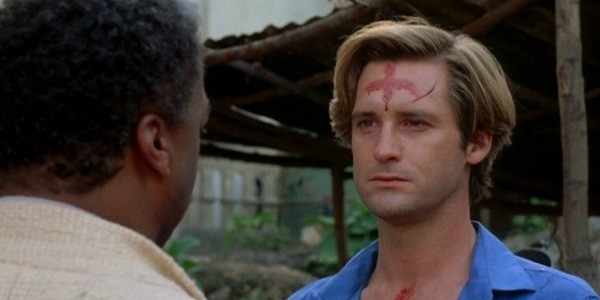
The film’s horror is as psychological as it is physical. While there are moments of bodily terror, paralysis, burial, torture, the deeper fear stems from control: who has it, and how it is wielded. The threat is not merely supernatural, but political, as the regime in power manipulates fear to enforce obedience. The idea of zombification becomes a metaphor for subjugation, turning folklore into a tool of terror. In this way, the film reframes zombies not as monsters, but as victims of systematic cruelty.
The Serpent and the Rainbow is steeped in unsettling imagery. Scenes of burial, paralysis, and ritual are framed with a deliberate stillness that makes them feel both intimate and inescapable. Craven leans into a fever-dream aesthetic, allowing grotesque visions to surface abruptly, often without narrative warning. These moments create a sense of spiritual vertigo, placing the audience inside Alan’s disoriented mind.
Haiti is not portrayed as a generic exotic backdrop but as a site of layered meaning, where colonial history, dictatorship, and religious tradition converge. The film’s depiction of voodoo is filtered through a Western protagonist’s perspective, yet it emphasizes the gravity and power of belief systems rather than reducing them to spectacle. This tension between observation and immersion gives the story its unease: Alan can study rituals, but he cannot fully escape their influence. Musically, the score reinforces the film’s dreamlike unease. Tribal rhythms and dissonant tones weave through key moments, amplifying the sense that Alan has crossed into a reality governed by unfamiliar rules. Sound design often replaces clarity with atmosphere, allowing whispers, drums, and ambient noise to seep into scenes where silence would normally prevail.
Though it was met with mixed reception upon release, The Serpent and the Rainbow has endured as an underrated entry in Craven’s filmography. It lacks the populist appeal of his more mainstream horror titles, but its ambition and strangeness make it uniquely memorable. This is not a film about easy scares or tidy conclusions; it is about the terror of cultural collision, the fragility of rationality, and the power of belief to shape reality.