
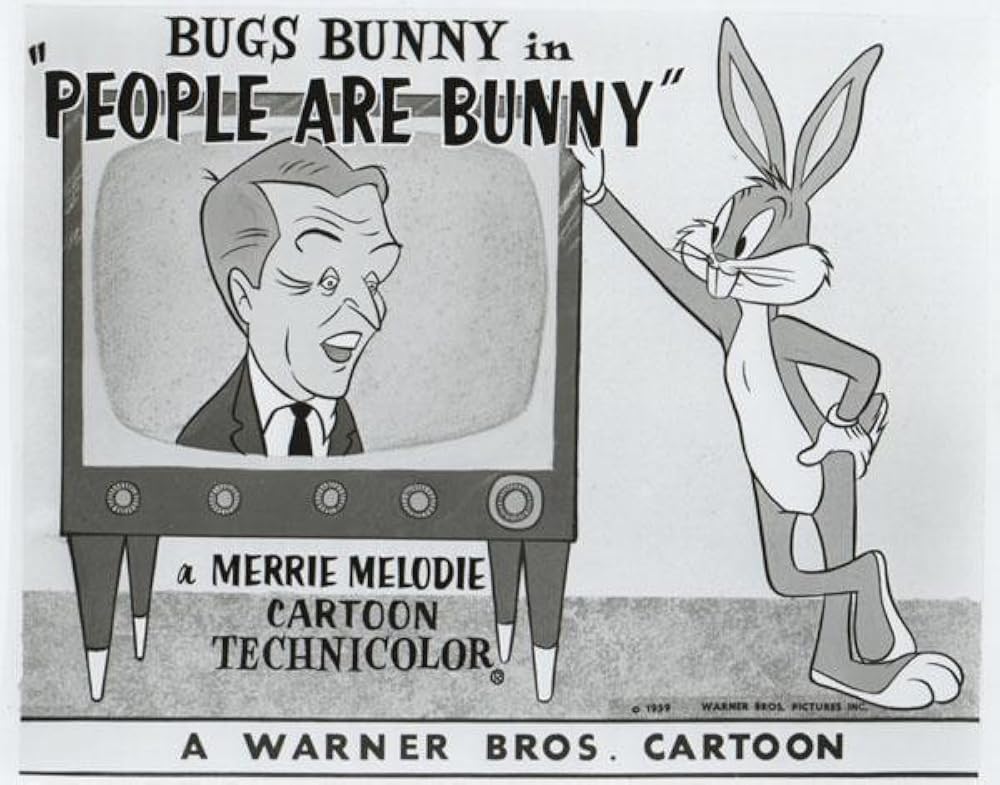
People Are Bunny (1959)
Directed by Robert McKimson
Story by Tedd Pierce
Animation by Warren Batchelder, Tom Ray, Ted Bonnicksen, George Grandpré, David R. Green
Music by Milt Franklyn
Daffy Duck is watching television and dials into “The QTTV Sportsman Hour” where the host promises $1,000 for the first viewer who brings a rabbit into the station. Daffy tries to lure Bugs with free tickets to a television show, but when Bugs declines Daffy grabs a rifle and forces him to travel to QTTV. Once at the station, Bugs and Daffy have separate experiences with game shows – Bugs enjoys a profitable outcome while Daffy’s excursion ends painfully.
The last Bugs Bunny cartoon of the 1950s, “People Are Bunny” is Robert McKimson’s reworking of his 1956 “Wideo Wabbit.” But this version is faster and funnier thanks to the substitution of the too-easily-tricked Elmer Fudd with Daffy Duck as Bugs’ nemesis. Daffy’s neuroticism, greed, and temper ultimately work against him, especially with violent sight gags involving a dynamite stick blowing up in his face and his getting shot on live television by a circle of hunters. The results are sadistically funny, marking some of the most invigorating comeuppance served on Daffy in the frenemy cartoons he made with Bugs.
Some funny moments involve a spoof of the excessively generous grand prizes awarded by quiz shows (including a key to Fort Knox!) and Bugs winning a telephone prize for quickly answering a complex multiplication question – resulting in the pay phone pouring out a flood of coins, slot machine-style.
This short recycles several gags from “Wideo Wabbit,” but the gem of this cartoon is an original funny-nasty parody of Art Linkletter’s show “People Are Funny.” In this version, the happily malevolent Art Lamplighter (voiced by an unbilled Daws Butler) delights in viciously pranking an unsuspecting Daffy, resulting in his being left unconscious in a street after being hit by a motor scooter. This type of spiked humor harkened back to the wild and wooly comedy from the mid-1940s Bugs Bunny cartoons rather than the more benign gags that weighed down too much of the late-1950s output.