
It is never a good idea to approach a film with preconceived notions of its awfulness. That is not easy when the film in question of the 1977 “A Little Night Music,” which has a reputation for being something of a mess.
Having just seen “A Little Night Music,” I did not get the impression that the film is as horrible as its detractors insist. A main criticism against the film involves its transition from the stage to the screen – but as I never saw a stage production of the work, I can only judge the film on its own merits. Others who loathe the film compare it unfavorably to its source material, the Ingmar Bergman classic “Smiles on a Summer Night.” But, alas, I never experienced that work, so I cannot do a comparison on that front.
From my view, “A Little Night Music” is a distracting but flawed work that is often at odds with itself. It strives to be bittersweet, but it often puts too much emphasis on the bitter while forgetting the sweet. Its farcical segments are steamrolled with sluggish pacing and, quite frankly, poor writing. This is baffling when one considers Harold Prince and Hugh Wheeler, who respectively directed and wrote the book for the Broadway show, adapted their work for the screen.
In order to fit the commercially viable two-hour running time, Prince and Wheeler sliced away several of Stephen Sondheim’s songs. But two of the deletions were done unwisely, as they threw the film out of balance. The wise and witty “Liaisons” offered depth to Madame Armfeldt’s distinctive behavior – its removal reduces the character to a mere eccentric and, even worse, shrinks the screen time for the always delightful Hermione Gingold. The decision to drop “The Miller’s Son” erases the subplot romance between the spunky maid Petra and one of Madame Armfeldt’s valets. Leslie Dunlop is fun as Petra and manages to shine despite the minimal time she is given.
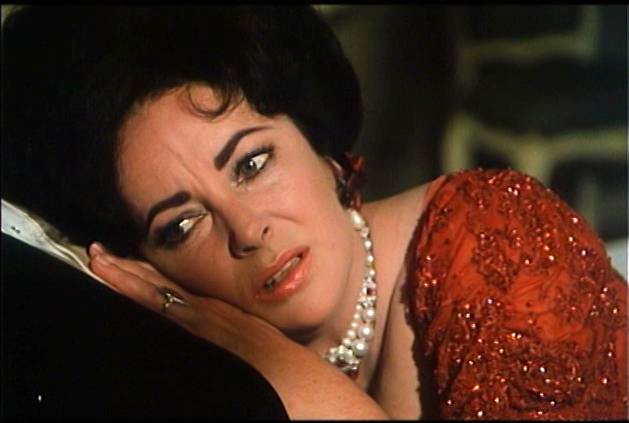
Much of the negative commentary surrounding “A Little Night Music” centers on Elizabeth Taylor as the aging actress at the heart of the overlapping story lines. Yes, she was not a vocalist and her rendition of the show’s hit tune, “Send in the Clowns,” pales in comparison to classic recordings by the likes of Judy Collins or Sarah Vaughn. And when viewed as a standalone clip, the sequence doesn’t inspire awe.
But within the context of the film, it fits perfectly. As a self-autopsy on lost love, Taylor finds the emotional core of Sondheim’s painful lyrics. The song was never meant to be a show-stopper – even Sondheim was surprised by its popularity – and Taylor effectively acts out its lyrics as it relates to her character’s position. (Sondheim praised her rendition, and he wasn’t one to throw around compliments.)
However, Taylor’s appearance in the film is a problem. Her weight fluctuated noticeably during the production and in some scenes she looks ill and haggard. Florence Klotz’s Oscar-nominated costumes made a valiant effort to camouflage Taylor’s physical difficulties.
Perhaps Taylor’s star power pulled attention away from the film’s bigger dilemma, which was Diana Rigg’s bad performance as the revenge-seeking wife of Taylor’s lover, an aristocratic soldier. For whatever reason, Rigg seemed to be on auto-pilot – none of her charisma or sex appeal is obvious here, and she is unflatteringly filmed during the film’s second half. Arthur Ibbetson, the cinematographer, had a long and distinguished career prior to “A Little Night Music,” but for this work he was off his game.
Still, the film had a champion in Roger Corman, who secured its American theatrical release via his New World Pictures. And “A Little Night Music” won an Academy Award in the awkwardly-titled category Best Original Song Score and Its Adaptation or Adaptation Score. To be frank, there wasn’t much competition that year – “Pete’s Dragon” and “The Slipper and the Rose” were the only other nominees – but, hey, at least it can claim an Oscar pedigree.