
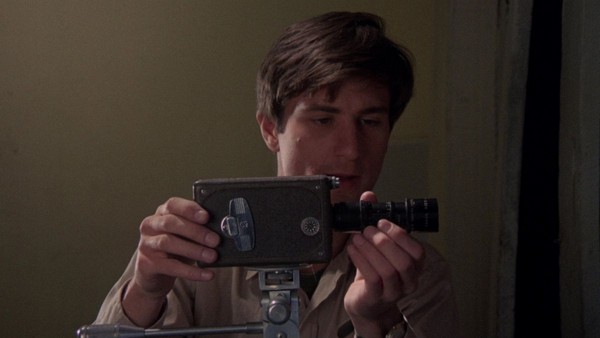
 A Vietnam vet becomes involved in voyeurism, avant-garde theatre, and terrorism in Brian De Palma’s pointed satire Hi, Mom! Now on 4k & Blu-ray from Radiance Films.
TW: Sexual Assault
Brian De Palma is mostly known for his often-but-not-always Hitchcockian tension-filled shockers, whether it be 1978’s Carrie, 1987’s Untouchables, or 1981’s Blow Out. But before that shift, starting with 1972’s Sisters, he often dabbled more in a French New Wave method of cinema verite; but all the while keeping many of the aspects that permeate through his works in the dissolution of the line of audience to creator, voyeurism, cynical power structure discussion in how people use and abuse others, and how far is too far? Looking at these early films: Greetings, The Wedding Party, Hi, Mom, and Get to Know Your Rabbit (I stand by, I highly enjoy this little-seen flick), one can see a different De Palma, but one with the trademarks to come. While they had some growing pains, I appreciate Greetings (of which this is technically a sequel to in sharing the same main character) and The Wedding Party more than I enjoy them. However, Hi, Mom is a huge stepping stone for De Palma, a major step up from Greetings, an early success in legitimately good film from a rising auteur.
Hi, Mom is a fascinating picture of post-War cynicism, asking the viewer about complicity in violence and the world, even via screens, media, and cameras, with De Palma and Charles Hirsh’s script tapping into the public zeitgeist. It’s a sharp satire of commercialism, voyeurism, putting on personas, and those who force their way into the need by false manners. From opening with a “through the camera” sequence of DeNiro renting a squalid apartment from character actor Charles Durning (which is referencing a then-known commercial about White landlords abusing in-need Black families) to a shocking act of terrorism relating to the performance of public and private, the people we put on and the people we pretend to be permeate. It goes both ways, forcing voyeurism and becoming voyeurs in interesting ways.
De Niro, who often worked with De Palma before Scorsese ran off with him, plays a proto-Travis Bickle (which Paul Schrader, Taxi Driver’s writer, admits to; writing the part for DeNiro after this film) in a Vietnam vet uncomfortable with the world nd the people around him, slightly out of sync, pushy, full of ideas if he can get heard. A stint with a pornographer pre-sells amateur pornography and the lack of consent in sharing private moments publicly. Sister’s Jennifer Salt plays the object of his affection here, with the underappreciated actress scoring well.
Gerrit Graham also returns from Greetings, but is a new character (BTW, if you’ve not seen him as Beef in De Palma’s 1975 Phantom of the Paradise, one of my favorite movies of all time, you’re missing required viewing) as the White member of a troupe of avant-garde activist players putting on a show called Be Black, Baby. The centerpiece of the film is this production, a cacophony of chaos where the audience becomes the actors by the Black cast painting White yuppies black and abusing them. Of course, there’s more, but I’m not going to spoil it. The way it plays and the ultimate punchline is biting.
Hi, Mom is oddly prescient, with our glued-to-our-hands every-present camera and filming it all; the audience and the actor in our actual lives are blurred to the point of absurdity. Hell, there’s an unseen character, meant originally to be more involved but dropped after two sequences, of a housewife buying a camera and recording her life and the people around her. Tell me this isn’t Hi Mom predicting the future.
Hi, Mom is a hard film to properly describe and sell to you. It’s a lot of movie with a lot of methods and messages, done with the chaos of a nascent filmmaker finding his control (as we see in later films, De Palma is a man who can execute very specific visions). With an early, amazing turn from DeNiro as well (and heck yeah, Gerrit Graham), Hi Mom, I’d be a disservice to be seen as a curiosity of the era and production, a before-they-were-them sort; but it works incredibly well within the big, powerful mess. It’s impossible to watch Hi, Mom and not tap into the 1970s De Palma is throwing onto screens. Not an early “oh hi, people I know” but an early triumph.
The Packaging
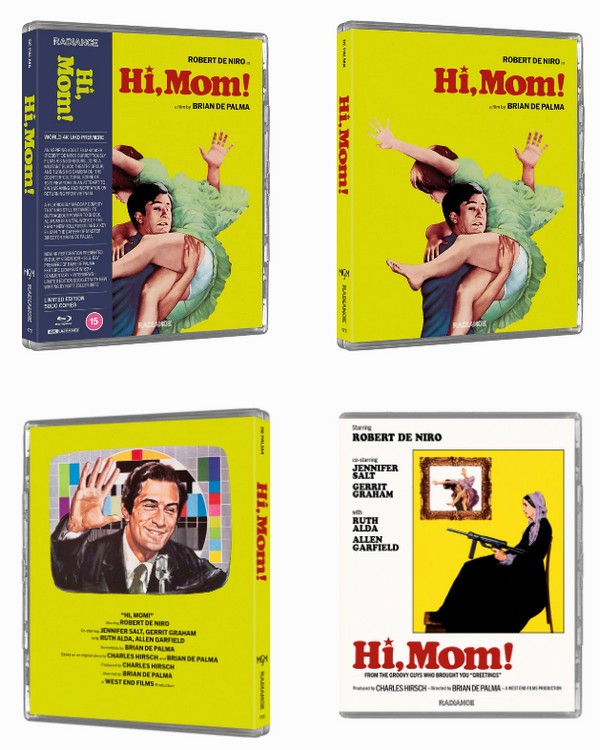
Radiance puts Hi Mom on a two-disc collection: a 4k UHD and a Blu-ray disc, both with just the stylised title printed. The film and commentary are on both discs, with all the special features on the Blu-ray. Both overlap on the right side of the package, with a booklet on the other. The reversible sleeve contains art from and based on the original release. The sleeve has an Obi-strip that allows a clean cover if desired. Limited to 5000 copies.
The Presentation
Radiance has a new 4k restoration from the original negative, and it looks astounding. Sharp with incredible detail; one really notices the color use and digs into the world of 1970s New York. It pops. After seeing this in previous, fuzzy forms, it’s an astonishing change. Audio is uncompressed mono; subtitles in English.
The Features
The commentary is on both discs, with the remainder on the Blu-ray only.
Commentary (new)
Travis Woods goes solo with a fantastic talk that does what it should: deepens the conversation with the picture by fully setting the world it was created within. Full to th brim with ideas and anecdotes, getting deep with the themes and concepts. Great track.
Dionysis in 69 (1970, but may be the first time officially available in the modern era, I know previously I watched on YouTube)
De Palma filmed a production of the play, starring his Phantom of the Paradise, William Finley as Dionysus in the modern era. Interesting to see this with Be Black in the movie, as both integrate the audience in emerging, uncomfortable ways. It should connect, as this play is what gave the idea for the film’s plot. It’s also where De Palma started experimenting with his trademark split screens (coming to fruition in Sisters), to show the audience and the cast at the same time. That said, this play is not for me; not my thing at all; I found a jumble of noises and “whats” but if you dig it, all for you.
Son of Greetings (1970; but new to this release; the title refers to the original title for this film)
A fly-on-the-wall documentary of making the film. Just sitting and seeing, no interviews, no talking heads; just as if we’re on set. Fascinating, but I know this sort of extra isn’t for everyone without a structure. (76m)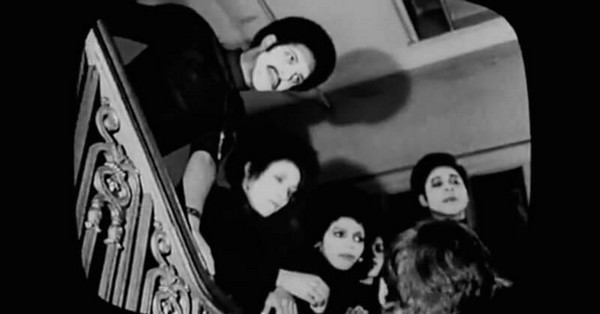
Ellen E Jones (new)
Jones gives an insightful look at how Hi Mom reflects later De Palma, discussing his themes and methods here and in his filmography. (12m)
Charles Hirsch (2018, from the previous Arrow Blu-ray)
Co-writer Hirsch talks about creating the concept and script with De Palma and a great deal about connecting Dionysis in 69 with Be Black, along with what they had to do to get it made. (12m)
Booklet
The 23-page stapled booklet contains cast/crew/tech info, production stills, the essay “The Medium is the Message: The Interplay of Ideas in Brian De Palma’s Hi Mom,” by Matt Zoller Seitz, and notes on Dionysus in 69. The essay is another great write-up from Radiance, getting into the world of De Palma of 1970 and the culture around it.
Final Thoughts
Radiance gives an underseen early film from a great director a worthy set with a fantastic transfer and a whole bevy of features. Say Hi! to Hi, Mom!